
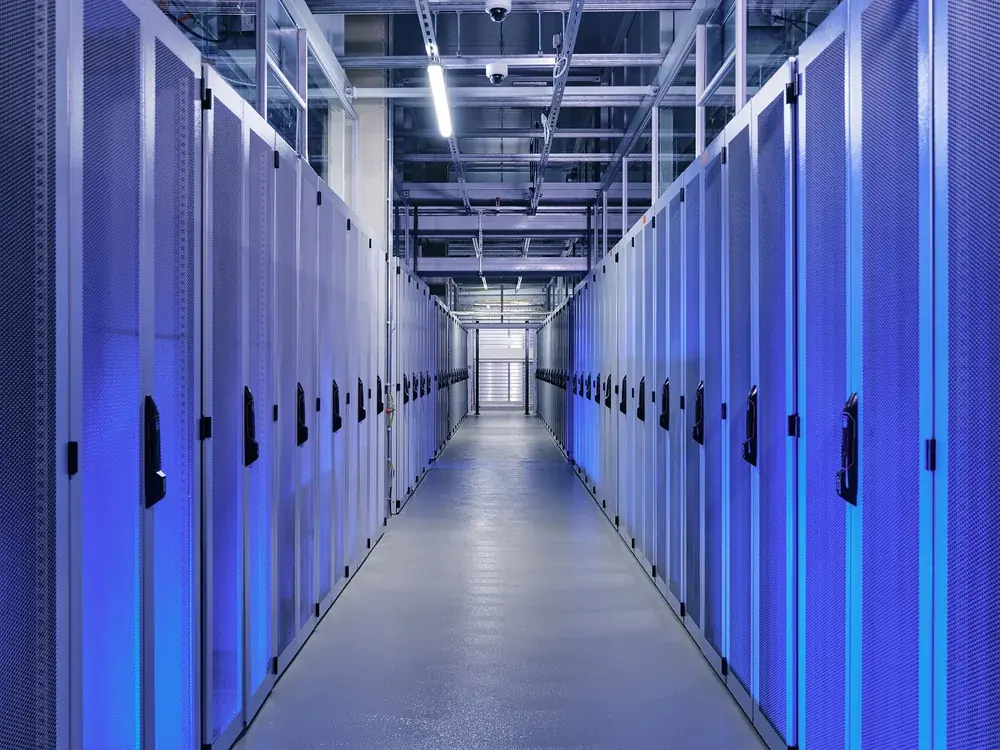
Data keeps growing and it has to be put somewhere. More and more companies look to cloud providers for the solution without thoroughly weighing the alternatives. That is no wonder, considering that until this year there was no good substitute in Estonia: a large-scale data center designed for the purpose. Now that the situation has changed, it is a good time to clarify the difference between a data center and the cloud, and how a company can benefit from each.
Equipment cabinets in the data center. Photo: Tõnu Tunnel
Let's talk about money first
As long as a company's monthly cloud bill stays in three figures, the cloud is one of the most cost-effective choices. Once the monthly cost grows to four figures and beyond, alternatives should be put on the table. One of them is establishing a footprint in a data center and creating a hybrid cloud. Contrary to preconceptions, that is not as costly and complicated as people think. Because the equipment is designed to last 5 to 7 years in good conditions, depreciation is relatively low too. Dropbox, for example, raised its profitability by more than 30% with such a move, shifting from a cloud service to a data center service. So it is worth planning and counting the money.
But what is a cloud service in the first place?
When cloud services come up, the first thing people often think of is ordinary virtual storage providers such as Dropbox and Google Drive. It is true that saving data to a cloud drive has become the norm for companies and individuals alike.
For larger companies, though, storage is only the tip of the iceberg when choosing a cloud provider; the service usually comes with its own set of tools and technologies. These are based on remote servers that are accessed over the internet. The cloud platform provider manages the necessary storage, servers and networks, and companies simply pay for using those services when they need them. The price is usually set according to the volumes used and grows linearly.
With the cloud it is definitely worth reading up on what the service includes. Many are surprised, for example, that it is a platform service and takes no responsibility for the quality or backup of the data. It is also worth paying attention to the cost of leaving the cloud; it can be impressive and obstruct a change of provider in the future.
And what does a data center do, then?
As the name says, a data center is a building constructed specifically for keeping data. Unfortunately, all sorts of other rooms also tend to be called data centers, rooms that are not actually meant for storing data and do not provide the reliability that gives a real data center its value. We are not talking about those in this article.
Like the cloud, a data center is a place where a company puts its data; more precisely, it rents space in the data center for its IT equipment. So for companies a data center is a step on from the cloud, because it provides a highly reliable physical location and security, the basis of a future-proof and flexible IT infrastructure. In a data center the initial investment is larger than starting in the cloud, but thereafter costs rise at a much more modest pace as volumes grow. Going by public price lists, at current price levels the cloud becomes more expensive than a data center at around 70 TB, comparing pure storage space.
Does the cloud have a lower entry cost?
When a company wants to expand its IT capability beyond the servers in its office, or is only just starting out, a cloud service is initially the logical choice because of its low entry costs. Cloud services are often preferred because they sound like a more flexible solution than any physical facility: volumes can be scaled up or down as the company's needs change. In fact that can be done in a data center too, but more on that shortly.
Another key factor in the growing popularity of cloud hosting is its easy accessibility. According to WebTribunal, 94 percent of companies already use cloud services to some extent.
But using public cloud services has its downsides for companies as well. As data volumes grow, costs can rise quickly, and security problems can arise where sensitive data is concerned. To scale successfully, you cannot rely on cloud services alone; you should think about a hybrid infrastructure that includes both a data center and the cloud. Excessive reliance on the cloud across a company's various departments and teams can create sprawling shadow IT that is hard to manage and consolidate effectively.
Flexibility is not the preserve of cloud services alone
Companies whose current data storage solution is starting to feel cramped often do not have enough resources to build their own data center. That is where centers built specifically to offer companies data hosting come to the rescue.
In the Baltics' largest data center, just opened on the edge of Tallinn, for instance, you can rent your own equipment cabinet or a private room, depending on what and how much the company needs. You can take one, two or even ten cabinets, and in a private room you can plan the layout entirely to your liking, so "flexibility" is by no means a keyword that applies only to the cloud.
Such a service in a data center requires companies to procure their own servers and storage, which may cost more than using public cloud services. The money does not go to waste, though, because the result is a far more secure and reliable infrastructure. We wrote at length last week about the top-class security measures of the data center on the edge of Tallinn.
Attention should also be paid to location. In a data center companies have full ownership of their equipment and control over its placement, but when engineers need to carry out routine maintenance on the servers, it matters that the center is within reasonable distance of the office; otherwise the time and money spent simply become too much. Fortunately in Estonia there is no need to agonise over that for long, since the only real data center is a 20-minute drive from the center of Tallinn. Not that Estonia has very long distances anyway.
So which is better after all: a data center or the cloud?
In fact the question need not be whether to prefer one or the other, but how to combine them. Many companies do use both, or a combination of them together with other IT infrastructure solutions.
The main difference between the cloud and a data center lies in how data is managed and stored. In the cloud the servers belong to the cloud provider and the data is managed virtually. In a data center the servers do not belong to the center but to the tenant of the space. If you value privacy, security and independence, it is worth seriously considering a data center from the outset. If volumes stay low and do not grow much over time, the cloud may be the most cost-effective choice.
Both clouds and data centers allow companies to cut costs, if they think through when to use one or the other. Poor choices, or failing to make them at all, can cost millions as volumes grow.