
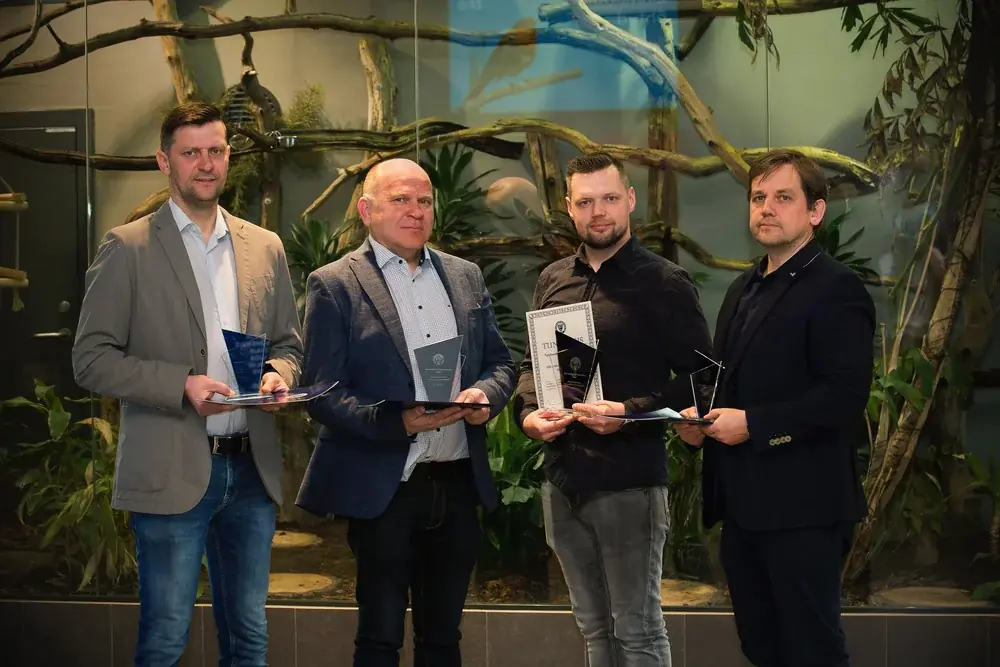
As surely as spring follows winter, Estonia's best security solutions are recognised every year. The Estonian Security Association (ETEL) has led that worthy mission since 2001, and this year too the most outstanding were selected by competition. The aim of the competition is to recognise companies, organisations and individuals who in the previous calendar year contributed significantly to mitigating their operational risks and raising the security of assets and people.
"There have been years when the contenders for first place scored equal points and the ETEL board has recognised several projects as the best. This year it did not go that way, and the win came by a convincing margin," said ETEL managing director Andre Lilleleht. The security system of the Greenergy Data Centers data center was chosen as the best. "The decisive factor was probably the effective integration of different systems and the forming of a well-functioning whole from many components," Lilleleht specified. "Probably, because the best was chosen by secret ballot."
How was the winning security solution born?
Tanel Klaar of Greenergy Data Centers, who led the implementation of the winning solution, admitted when accepting the award that behind it lie a serious effort and thousands of working hours.
Security came into play in planning the data center as early as the choice of location. It was important, for example, that there be no hazardous industrial buildings or transport hubs nearby, that no flight path run directly over the building, and much more.
The building was planned on the basis of the strictest EU data center standard, EN 50600, and all activities had to lead to obtaining the certificate. And they did.
"After choosing the location, the next step was creating a security concept from the brief, taking into account the team's professional experience and consultants' recommendations. On that basis we commissioned a preliminary design, with which we went to tender. The tender was won by Telegrupp. In choosing the partner we went by the best overall solution and competence, not only price, and that can be seen in the GDC data center today," Klaar described the process.
According to Tõnu Kutsar, managing director of EULE, which designed the security solution, the data center was planned following best practice very precisely. "The owner approached the design of the data center's security systems strictly along the right path, without skipping a single key point. The whole necessary algorithm for reaching a good end result was followed. For example, an independent threat assessment and a security concept were drawn up for the data center before design began," Kutsar explained.
The security concept assigned the complex and its parts security classes in accordance with the standards. Based on the security classes, the physical and electronic security measures were in turn designed, including the tender designs. "As the designer of the technical security solutions, EULE OÜ was pleased to receive the baton in a way that allowed it to carry out its part on the basis of the best professional experience," the EULE managing director added.
According to Tanel Klaar, in several respects they went beyond the requirements of EN 50600. For example, the data center's outer perimeter is guarded among other things by thermal cameras, which the standard does not directly require but which ensure effective surveillance even in the worst weather conditions. "In addition, the building has only electronic locks, which means every door opening is traceable and identifiable afterwards," Klaar added.
The final solution was created in close cooperation with Telegrupp. "I believe that, without exaggeration, I made thousands of phone calls to them during construction. Quick questions often turned into hour-long discussions," Klaar smiled.
Telegrupp's representative Oliver Riik praised the client, who took on a very large job and was an active partner. "The project went well. Above all we are pleased that high-quality and reliable products were installed that can be relied on for a long time. The plus of choosing newer technology and equipment from a well-known manufacturer is knowing it will be supported for years to come and will perform its function excellently," Riik added. "Compared with other public buildings, I would place the Greenergy Data Centers complex quite near the top in terms of security."
One of the bigger challenges, he said, was to plan ahead for more server rooms being added to the data center. "Connecting the equipment of new rooms into the integrated security system must also be smooth and cost-effective in the future," Riik explained.
Some fairly unexpected situations also had to be resolved. "For example, we could not foresee that to put the selected thermal cameras into use, a special permit had to be obtained from the security authority of the supplier country. We had to justify why and how we use them," Klaar added.
Planning a major project
Creating a security solution of this scale is like a complex technical puzzle. Besides placing the pieces correctly, they also have to be placed in the right order. Based on the experience gained from building the data center, Tanel Klaar highlights the following key points:
- Risk analysis: it is the basis of everything, and conceptual decisions must be based on all possible threat scenarios and their mitigation. Combinations of different risks must also be analysed here. For example, how is security ensured in a situation where there is a fire in one room of the building and people are being evacuated. That does not mean all evacuation doors are open and one can walk around freely.
- Interpreting standards: what requirements the different parts of the building must meet and how to achieve the optimal solution. When planning complex systems there is also a risk of overdoing it, ultimately affecting the investment need and ease of use. Already in the concept and design phase one has to think thoroughly about how the systems will support or restrict the normal operation of the building.
- Fitting systems together: the building's security solution, together with the fire safety installations, must form a systematically managed whole. If each system worked only on its own, it would be very difficult to get maximum benefit from all of them in parallel. Effective integration creates the greatest effect at the end of the day. A good example is the vehicle gate, where the road barrier, folding gate, access control system, traffic lights, cameras, locks, door contacts, motion sensor, number plate recognition, intercom and various safety systems all have to work together smoothly.
From the contractor's perspective, Oliver Riik recommends that the client:
- draw up as thorough a brief as possible. That gives material to discuss and think along with;
- choose a good designer. The design is the basis for accurate, realistic pricing;
- create tender conditions in which the client has a say in equipment selection. The best result is born in dialogue;
- involve a technical adviser who can advise the client and take part in the details of the work with the designers and contractors. That avoids a situation where the client only finds out at handover what was put up for them;
- apply expert construction supervision of the security systems. Good components alone do not guarantee a bulletproof system. Those components also have to be connected and put to work masterfully.
The greatest (security) threat is convenience
One of the biggest risks in creating a large-scale security solution is convenience. Today technology makes it possible to simplify a great many processes, but the accompanying dangers may go unnoticed. "Take entering through the gate by number plate. Video analytics identifies the registration plate of the approaching vehicle, the computer checks the associated permissions in the database and the gate opens. Extremely user-friendly. On the other hand, anyone can print a suitable number plate and attach it to a car," Klaar described the accompanying dangers.
It seems inevitable that security and convenience all but exclude each other. So the real art is to create a solution where, without compromising on security requirements, the end result is also convenient to use.