
Published 19.1.2026
"The elephant in the room" and ChatGPT for every employee: where are Estonia's big companies directing their 2026 IT budgets?
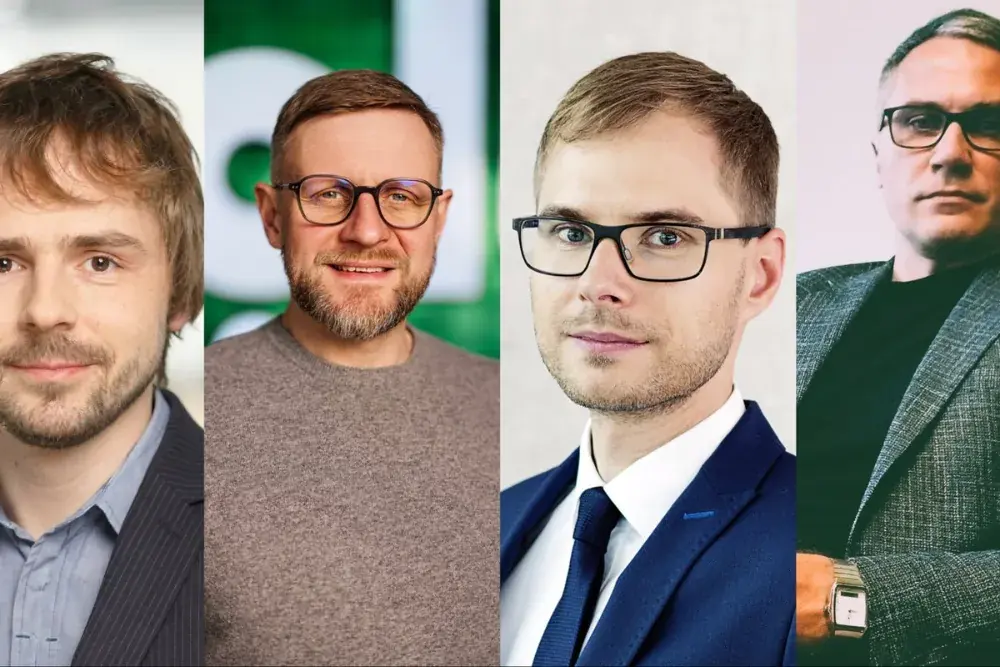
2026 has begun, and at large companies the strategies are set and the budgets locked in. We asked four major Estonian companies, Bolt, LHV, Eesti Loto, and Tallink, what their IT focus areas are for the year ahead. Are budgets growing, what role does AI play, and is the green transition reaching the server room too?
The answers paint a picture of a sector where the keywords are efficiency through AI, shedding old systems, and sustainable IT.
Budgets are growing, but moderately
While earlier years in the IT sector also saw talk of cutting costs, growth is what's planned for the year now underway. The reasons vary, from growing business volumes to major architectural changes.
LHV's IT director Jüri Heero confirms, briefly, that the bank's IT budget is growing this year.
Bolt's head of cloud infrastructure, Guido Kõiv, agrees, saying the growth is driven by the company's expansion. “As we keep adding new services and markets, the IT budget will likely grow in 2026,” he explains. Kõiv adds that although the goal is to operate cost-efficiently, costs inevitably grow as the business expands.
Eesti Loto's CTO Erkki Lindepuu calls its budget increase a “targeted jump.” According to him, the state-owned company is entering a phase of rebuilding its systems, which makes 2026 a necessary investment year. “This is not a lasting cost increase,” Lindepuu stresses, adding that once the new architecture is complete they expect costs to normalize.
AS Tallink Grupp's communications director Meelis Kompus notes, by contrast, that the shipping company's IT budget will stay at the same level as in 2025.
Shedding old baggage, and security
Asked about this year's focus areas, for Eesti Loto the “elephant in the room” is clearly shedding legacy systems. According to Lindepuu, they are moving step by step away from their existing partner's “off-the-shelf product” toward solutions that are more flexible and easier to manage. In parallel, they are rolling out a DevOps model to shorten the time from idea to implementation.
In banking, the focus lies elsewhere. Heero lists cloud solutions, data, and cybersecurity as LHV's priorities. “High-quality data forms the bank's bloodstream, and putting cybersecurity in focus is hugely important for protecting customers and maintaining trust,” he explains.
At Tallink, Kompus points to the need to keep renewing digital environments, to offer a better experience for both customers and employees. Improving the quality of internet connectivity on board the ships also remains a focus.
Artificial intelligence: no longer "whether", but "how"
All the respondents confirm that AI is no longer a thing of the future, but an everyday tool expected to deliver gains in efficiency.
For Tallink, AI plays a significant role in shaping the budget, since, according to Kompus, the goal is to achieve greater efficiency within the same budget limits.
Eesti Loto has decided to put AI on every employee's desktop. According to Lindepuu, ChatGPT licenses have been budgeted organization-wide for all staff. The IT team goes even more specific: developers are budgeted roughly 200 euros a month for tokens. “We're increasingly directing AI toward improving quality: writing tests, reviewing code, and making the development process more reliable,” he explains.
LHV views AI as a long-term investment. Heero estimates that its impact on today's budgets is still small, in the range of 5-10 percent, but draws a parallel with the internet in the 1990s: “The pattern describes exponential growth: small steps at first, then suddenly.”
Bolt's Kõiv adds that they plan to use AI to automate even more processes than before. “We already apply AI in several areas today, and it will remain one of our key priorities in 2026,” he confirms.
The green transition in the server room: the focus is on efficiency and choosing smart infrastructure
Climate goals in IT have long since stopped meaning just a paperless office; they now mean a strategic view of where and how data is stored. The biggest trend is abandoning inefficient, energy-hungry in-house server rooms in favor of professional solutions.
Lindepuu points to a clear direction: “We're giving up our own server rooms, which means both more energy-efficient infrastructure and a lighter management and cooling load.” It's a logical step: running a small server room is rarely energy-efficient these days, whereas specialized service providers have their energy use optimized down to the last detail. Eesti Loto is also looking for a partner to handle used equipment following circular economy principles.
For Tallink too, IT is part of a broader sustainability strategy. Kompus notes that environmental friendliness and efficient resource use need to be reflected across the whole supply chain. That means choosing partners wisely: it matters that the service providers entrusted with their data also share a green mindset.
Kõiv adds that since Bolt is already fully cloud-based, their footprint depends directly on their partners. “Our climate impact is shaped mainly by our service providers' energy efficiency and their investments,” he explains. That confirms that companies no longer look only at price; they demand real energy efficiency from their service providers, whether clouds or data centers.
LHV says the bank's IT operations are not energy-intensive. “We keep our climate focus where its impact is genuinely significant,” Heero says.
Expectations are growing faster than resources
All the executives admit that expectations for IT are growing faster than the resources that can be directed to it. They see the solution in smarter planning and automation.
“There are always clearly more expectations than can be met with the resources available,” admits Kompus of Tallink, stressing the importance of prioritization as a result.
Kõiv confirms the same from Bolt's perspective: “Expectations for IT are certainly growing faster than resources. Our goal is to keep the balance through smart automation: to achieve more with the same team and the same cost base.”
Eesti Loto's CTO Lindepuu sums up the topic pragmatically: although expectations are growing, they do not simply expect “more for the same money” from IT, but tie expectations clearly to the resources provided.