
Published 11.4.2025
Entrepreneurs respond: how could Estonia become a global success story in AI?
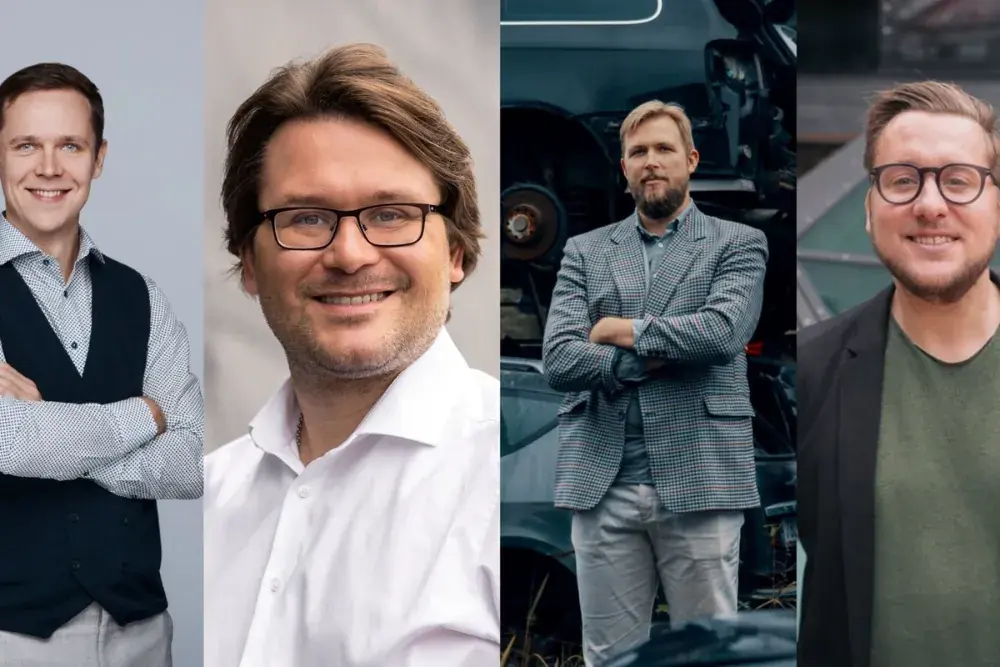
President Alar Karis has called for using artificial intelligence not the most, but the most wisely. But how do you go from being a user of AI to a builder of it? We asked entrepreneurs who are already building AI solutions what they expect from the education system and the business environment. What needs to change for Estonia to become a global success story in AI?
What key skills and conditions does Estonia currently lack for creating, developing and exporting artificial intelligence?
Bolt president Jevgeni Kabanov believes Estonia doesn't strictly lack skills. "The problem is more that Estonia is small, and developing AI needs the same skills every company is competing for. There are few strong machine learning specialists and engineers in Estonia, so demand for them is very high," Kabanov explains.
Martin Piirmaa, co-founder of Fleetbrains, a startup building AI solutions for the automotive industry, thinks Estonia has plenty of strong developers and researchers, but lacks AI experts with specific domain knowledge who can combine deep business understanding with technology. "AI isn't just a data-driven discipline or simply machine learning. It's a combination of several important parts: data, general business logic or structure, and strategic, dynamic, commercial thinking. What matters is how these components are connected so they're useful for optimising and automating operations, letting AI replace human resources or create added value through technology," says Piirmaa.
In fields such as automotive or medicine, for example, Piirmaa says you need people who understand both data and the deeper logic of the industry, and who know the whole field inside out on a global scale, so they can build innovation on that foundation. "At the end of the day, AI is data processing, and to automate models you first have to know and fully understand the whole field," says Piirmaa.
Kristo Peterson, co-founder of the Estonian-Brazilian startup Yera and founder of the AI training company Kasulik AI, agrees. "We lack people with rounded expertise who understand AI's possibilities on a technical level as well as business needs," he says.
"Creation needs creativity, development needs talent, and exporting needs good niche solutions. All three have to be tackled separately, and each is a fairly substantial undertaking," says Rauno Sigur, CEO and co-founder of the technology company DriveX Technologies. DriveX's AI-based software for detecting vehicle damage and reducing costs is used by several international insurance companies.
Sigur says niche solutions can only emerge when talented people are willing to take on less conventional fields, ones others probably wouldn't think to enter, but where demand still exists. "On top of that, as in any field, exporting AI products is definitely held back by a lack of sales and business development skills. We have good ideas, but scaling them to a global level needs people with stronger commercial and entrepreneurial backgrounds, people with experience running international businesses or ideas. We have plenty of people with the relevant know-how and experience, but looking at business leaders on the global stage, we certainly have a lot to learn from elsewhere," Sigur believes.
How could Estonia's education system help produce creators of artificial intelligence, not just users?
Kabanov believes more should be invested in education. "Schools could do more with this, and so could universities, where more should be invested in research. That's where the people who contribute to AI development tend to come from," says the Bolt executive.
Sigur thinks the education system should place more value on personal development, creativity and thinking outside the box. "The school system has certainly developed and changed since then, but when I was last in school myself, I was criticised for wanting to be different from everyone else. A teacher should be a role model, not someone who puts you down," Sigur believes.
Still, he says it's very welcome that Estonia's education system is the first in the world to start offering high school students a GPT tool for learning. "Hackathons could be held to tackle philosophical, environmental, social and of course business or technical challenges. Hackathons and schools could teach the 'Mom Test', how to validate market problems objectively, quickly and well. AI creators need to develop the ability to use different service providers, connect services together and get them talking to each other, and of course to write commands, meaning prompts," says the DriveX head.
Peterson thinks AI workshops would help. "Create very practical, interactive AI training programmes that help people understand both the technical side and how to apply it to bring an idea to life," he suggests. Peterson believes experts and practitioners should be involved in both designing and running such programmes.
Piirmaa believes the education system should invest more than it currently does in teaching technical skills. "AI isn't just writing code, it's also data science, building business models, and even ethical and legal questions. On top of that, schools and universities could encourage more practical AI and robotics projects with companies, so young people can start working on real problems early on," the Fleetbrains co-founder suggests.
As a positive example, he points to the technology school Kood/Jõhvi. "Kood/Jõhvi has definitely taken a big step in this direction, building a foundation for young people's futures through practice and real work, one where everyone benefits, including the state, companies and everyone else involved," Piirmaa believes.
According to Piirmaa, the most important thing is tying together all the foundations of a successful venture: theory, practice and, third, network, meaning contacts within the field. "We should build young people a platform or springboard that makes it easier to form international connections with experts in their field. The idea is only 10 percent, and behind a successful business are components far more important than the idea itself: how you execute it, and how you do that with resources used as efficiently, and as sparingly, as possible," says Piirmaa.
What support or changes would you like from the state to help AI companies grow and expand faster?
Kabanov thinks the state could make it easier to bring in highly qualified specialists. "If we can bring world-class talent here, they end up working for the benefit of the whole country," says the Bolt executive. He also sees open questions in legislation, though at the European level. "The EU's AI regulation has raised a great many questions that slow down fast movement in AI," says Kabanov.
First, Piirmaa says, AI companies need easier access to venture capital and export support. He says many Estonian AI startups want to go global right away, but that's hard without strong investment. "Unfortunately, in this field we're competing with the entire rest of the world, where access to investment and financing is significantly easier, not to mention know-how," the Fleetbrains co-founder points out.
Second, Piirmaa believes the state could invest more in piloting real AI solutions in the public sector. This would give local companies a chance to test and prove their solutions in a "home" environment. "We've done this through the state's e-solutions, and as a result many companies have stepped out onto the home market and achieved very good results," says Piirmaa. Access to data also matters. "For example, the state could make it easier to use anonymised data for training AI models," Piirmaa suggests.
The DriveX head believes that creating and developing deep tech requires a clear, shared understanding, at the European or state level, of what is and isn't deep tech. "Second, technology readiness levels should be placed in an AI context and described specifically. Outdated, generic descriptions carried over from industry or general information technology are a bit dated and cause confusion," Sigur suggests as something that could be done better.
Peterson believes support would also come from politicians and officials showing courage and willingness to apply AI innovation. "That would help create a favourable environment in Estonia where AI companies are partners, and it would allow good initiatives to be launched in strong synergy for Estonia's future," says the AI trainer.
If Estonia wants to become a global success story in AI, what needs to change in the coming years? Where do you see potential?
"Estonia has great potential for developing AI solutions, because the state's e-services are digital, which means high-quality, structured data is definitely more available here than in many other countries," Piirmaa believes.
The Fleetbrains co-founder believes Estonia could position itself as a region where, thanks to a more favourable tax environment and regulated flexibility, AI companies can test and develop their solutions before expanding globally. "We can't compete with the big European or global industries, since that would require unrealistic investment that might not pay off. But I believe the state can definitely support and build an environment in AI where companies with an AI background relocate international businesses here thanks to good conditions and state support. With the right decisions, the state could become a very powerful force for Estonian companies expanding abroad too," says Piirmaa.
Piirmaa also believes the state could work more closely with AI companies, similar to how companies form partnerships and cooperation agreements with each other for better results.
Kabanov wouldn't narrow the question down to AI alone. "Estonia needs to invest to make sure good talent is here. Entrepreneurs will take care of the rest," he believes.
Another critical issue Kabanov raises is US export restrictions on AI chips. Estonia, along with most other Eastern European countries, has been placed on a list of destinations not considered safe for supplying chips essential to AI technology. Chip exports to Russia and China, for instance, are banned outright. Estonia, however, can only receive a fixed number of chips. "It's actually quite difficult now to get hold of the best chips in Estonia. That's not good in any way," the Bolt executive finds.
Peterson believes it's important to involve experts in building AI-focused education programmes. He also brings in a political dimension: political parties prioritising AI as a strategic direction for the future, and being willing to make bold decisions.
Sigur believes the startup sector needs more exits. He says this creates a positive cycle of renewal, where more experienced founders go on to start new ventures. "Many talented, hard-working people are perhaps a bit stuck in older businesses whose potential is good, but smaller than in AI. Second, entrepreneurs who have been through a company's full life cycle can support the young and hungry through accelerators or as angel investors," says the DriveX head.
Sigur sees immediate potential in the defence industry, and in the longer term in climate-related solutions too: how to create products and services with a longer life cycle.
How could Estonia's education system raise creators of artificial intelligence, not just users?
The topic is discussed by Sven Nõmm, head of TalTech's AI focus centre of excellence, project manager Rasmus Kits and project assistant Arianna Jater.
It's good to note that the education system is already working on this. While the Ministry of Education and Research is leading the introduction of AI usage skills into general education, TalTech, for example, is already working on the skills needed to build AI. In summer 2025, Estonia's first bachelor's programme in computer science and artificial intelligence opens. At master's level, coursework related to AI technologies has long existed within TalTech's programmes, embedded across other fields too.
Estonian researchers have been working on developing and using artificial intelligence at various levels for considerably longer than the generative AI tools and chatbots that have come into focus in the last few years.
It's clear that every activity, including development work, requires resources. The main constraint comes from our population and the size of the country. We live in an era where some companies have long been bigger than states. It's hard for a small company to compete with giants whose budgets exceed those of much larger countries. At the same time, small players have their own advantages, such as flexibility and the ability to adapt quickly.
State support is first and foremost a resource, ranging from support programmes to systemic strategies. Right now, Estonia seems to be fairly ahead of the curve here, and attitudes are very positive. There are support projects and initiatives on the market for business, for universities, and, for example, the TI-Hüpe programme for general education.