
Published 18.12.2024
“Every Christmas poem I get ChatGPT to write leaves a footprint.” AI expert Jarmo Tuisk reveals a new angle on why to be careful with artificial intelligence
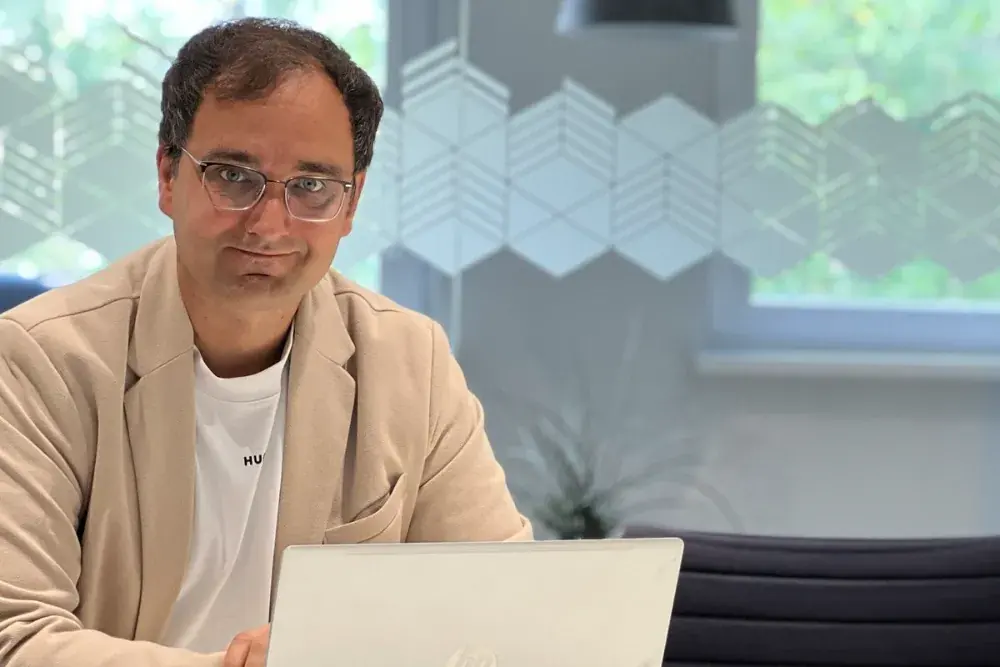
People often talk about the rapid rise of AI in superlatives. That is understandable: artificial intelligence is a genuinely useful assistant in many situations, making life easier and cutting down on tedious work. When the downsides of artificial intelligence do come up, the focus tends to be on ethical questions, the theft of creative work and AI-generated pornography have both made headlines, and on who AI puts out of work. What has stayed in the background, behind this huge leap, is how much we spend to develop artificial intelligence, and not only in money.
Forecasts suggest that next year alone, investment in data centers will exceed the entire cost of the Apollo program that put a man on the Moon. Artificial intelligence’s appetite for energy is growing along with it. Two years ago, AI servers were already using about eight Estonias’ worth of electricity a year. Gartner forecasts that by 2027, the energy consumption of AI servers will reach 500 terawatt-hours (TWh) a year, more than fifty Estonias. That makes artificial intelligence one of the biggest drivers of energy shortages.
“For many people it still comes as a big surprise that behind every word I type into ChatGPT there is an actual calculation running, using energy somewhere, and not only energy but water too, because data centers need cooling,” says Jarmo Tuisk, an AI strategy and product development expert who has trained thousands of people at Estonian companies. How real is the risk that the AI hype is driving us straight into the next energy crisis? In this in-depth interview, Jarmo shares tips for seeing past the “froth.”
In your work, how much do you see people fearing the environmental impact of artificial intelligence? Are companies worried that, given the huge energy cost, AI simply isn’t worth it?
No, that’s definitely not how companies weigh it. In the end, their focus is on doing significantly more work with the same money and time. We don’t really think much about the footprint side of things.
That’s why we’ve deliberately built the various AI risks and challenges into our course. Environmental impact is just one of the risk areas we need to account for.
What’s interesting, though, is that this is the part of our course people follow most eagerly. Most people are already on first-name terms with ChatGPT, but the environmental impact is a new topic for many of them. Once people learn that every Christmas poem they ask ChatGPT to write leaves an energy footprint, and that servers in some data center somewhere have to work harder because of it, it makes them stop and think about whether everything really needs to be generated.
On average, a ChatGPT query uses about ten times more electricity than a Google search. You could just search for a Christmas poem, or write one yourself. Is artificial intelligence being used too casually inside companies too?
You can see people trying to hand everything over to AI, without stopping to think whether it’s actually a job for AI in the first place.
People even ask me whether AI could remove one column from their Excel spreadsheet. We still need to spread awareness of what artificial intelligence actually is. Sometimes it’s simply easier to tell someone that they can delete that column without any AI at all: select the column and press delete.
A year ago, about a quarter of Estonia’s population used ChatGPT. There’s no fresh research, but we can assume that share has risen to about half. Certainly not all of them have looked closely into what it actually is or what to use it for. If you look at what people ask in the Facebook group “ChatGPT ja teised loovad tehisintellektid eesti keeles” (ChatGPT and other generative AI, in Estonian), it’s clear that not everyone understands what AI models are actually good for, and when it genuinely makes more sense to go to Google or Bing instead.
OpenAI CEO Sam Altman recently visited the White House to discuss building several 5-gigawatt data centers in the US, which he says OpenAI needs. For comparison, 5 gigawatts could power roughly three million households. Can the energy sector keep up with artificial intelligence?
The same point came up in a Goldman Sachs report. The sums the power grid needs to adapt to the AI era are significant. Microsoft has even signed direct agreements to restart nuclear power plants. More energy is needed, and specifically near data centers.
Data centers currently use one to two percent of global energy consumption. By the end of the decade, that will grow to three to four percent. It might not sound like a huge jump, but it is fifty percent more consumption than today’s status quo. There is absolutely a footprint here, and it needs to be addressed with awareness. For many people it still comes as a big surprise that behind every word I type into ChatGPT there is an actual calculation running, using energy somewhere, and not only energy but water too, because data centers need cooling.
On top of that, development costs a great deal of money, and the hardware is anything but cheap. Investments already run into 12-digit figures. Does it pay off?
The fact is that new data centers are being built, and they don’t run on thin air. The question is what’s on the other side of the ledger: are there no positive signals at all, is it just shoveling more coal into the furnace, or restarting nuclear plants?
The World Economic Forum has pointed out that by 2030, AI could help cut greenhouse gas emissions by 5 to 10 percent.
Still, I’d say today’s calculations on both sides rest on somewhat shaky ground. Things are changing very fast. Just compare how many resources GPT-4 used against GPT-4o or GPT-4o mini, and the baseline numbers already start to wobble. We don’t know what model energy efficiency will look like in a year or two. It’s even harder to predict what activities we’ll end up doing less of because of it. Someone will probably use less electricity because ChatGPT helped them think through their production process.
The problem is over-exploiting artificial intelligence. AI gets used even where it isn’t needed. What should be done to keep the situation under control?
Well, the hype is at its peak right now, and there’s a strong hope that AI will solve every problem.
You can’t put artificial intelligence in a cage and say “stop using it so much.” Companies have shown that AI does bring real benefit. What’s needed instead is broader awareness of the risks involved and of what’s about to change in society.
Rushing to draw up extra regulation right now is a slippery slope. There’s a saying that Americans innovate, the Chinese copy, and Europeans regulate. That’s how Europe ended up with the AI Act. It includes requirements around human rights. For example, if an AI model helps decide which candidates to invite to a job interview or hire, the model’s creator has to prove very clearly that there is no bias in it. It doesn’t touch environmental requirements, though. No model maker has to report, say, how much energy it takes to generate a hundred words. In the future we might end up with energy labels for models too.
Right now the technology sector is still developing too fast to start imposing requirements. We could start by recommending best practices. That would mean self-regulation: please measure your footprint and publish it.
Once the field’s growth curve reaches a stabilization phase, we’ll need to look at whether to tax higher-energy models more, or otherwise steer people toward more energy-efficient models through regulation. That could become a live topic within five years.
How do you avoid a situation where people try to replace jobs with AI that don’t actually make sense to replace? For example, cases where AI ends up more expensive than a human.
You can’t rule it out. We can never fully control what decisions company leaders make, what to replace and what not to. Technology makes all kinds of things possible. Many decisions get made early, on too little information.
I recently read an anecdote that the IT consultancy Accenture has made more money off AI than OpenAI has, simply by providing consulting services. That’s not really AI’s fault, it’s people’s: we can’t control exactly where they put that AI money.
Once the hype dies down, the patterns that actually stick will become clear. Yes, we’ll very likely see stories where people are sent home, AI agents are put in their place, and then it turns out, oh, that really didn’t work out, we should have kept the people on after all. In this early adoption phase, while people are still learning the technology, we’ll see all kinds of wild stories.
Whether that becomes the dominant trend, I’m skeptical. It’s more likely that some pioneers get burned while others discover the right places and the right things to actually do.
Where might we first see artificial intelligence taking over? Is there still a need for a physical person to stand in front of a classroom?
Education is certainly one area with real potential. On the other hand, education is one part of society with considerable inertia. I recently carried my child’s school bag, and it was heavier than my own work bag. Schools still don’t have tablets. Sometimes technology just doesn’t break through human habits.
I recently read that the Swedish company Klarna stopped hiring new staff a year ago because AI does all the work. I think that’s half true and half just there to make headlines. Today, the people who make headlines are the ones who say AI did this or that.
At the same time, many companies aren’t rushing for headlines at all. They’re running more concrete development programs, trying to work out for themselves what the technology’s fundamentals are and where the possible pilot areas are. The downside of taking it slowly is that you start to feel like you’re falling behind everyone else, since everyone else is already in the headlines saying they’ve adopted artificial intelligence and laid off x percent of staff, while you’re still just running pilot projects!
On the other hand, moving slowly can help you avoid risks and setbacks, such as discovering that you gave artificial intelligence a task without realizing AI can hallucinate. Then you end up in court because a customer is angry that an AI chatbot promised a discount that can’t actually be honored. Something like that happened to the Canadian airline Air Canada, which eventually had to own up to its AI’s mistakes. The bigger a company gets, the more dangerous the risks stemming from the technology become.
Some companies adopt new technology very quickly, while in others it never gets off the ground at all. What does that depend on?
Much of today’s AI trend has been bottom-up. People got their hands on ChatGPT and started doing things with it. Now companies are starting to realize that if leadership doesn’t respond to that trend from the top down, the company ends up in a fairly unmanageable situation where it can’t get a clear picture of several things. First, it loses track of where its data is, because it’s flowing off somewhere through ChatGPT. Second, it can no longer plan what tasks to assign and how fast they’ll get done, when three out of ten colleagues are ChatGPT gurus and the rest know nothing about it.
Because of that, several organizations have come to us from the top, saying they need a more unified approach. That happens once senior management starts to understand what the technology can actually do.
Can we conclude from this that whether we manage to avoid driving into the next energy crisis on AI hype depends on leaders’ ability to understand the technology?
Beyond organizations, it also matters how capable the state is of understanding this in depth, keeping pace with a fast-moving technology revolution, and keeping a finger on the pulse of what’s actually happening.
The ability to tell what’s just “froth” is also critical. Every breakthrough technology comes with a lot of froth, that’s not unique to AI. You need to train a critical eye to see through things that were created essentially just for the headline.
Is today’s decision-making layer on the political side equipped with enough knowledge?
If you asked me to name a politician who is very technologically competent, I’d stumble for a while. Nothing immediately comes to mind, some top-level politician making decisions today who really grasps this world well.
Presumably it’s the same story on the energy side?
There, at least, you see politicians who say they understand the issues. And there are certainly people in support staff and in the ministries who know the subject.
When will AI become smarter than you?
Honestly, I don’t lose sleep over that question. It’s a good one to argue about over a beer. Some people say 12 months, others 24. My view is that sometimes it’s already smarter than me, and other times it’s nowhere close.
Language models may never become more capable than a human. But someone could build a complex agent system that uses language models, image models, and who knows what else, which, put together, talks a lot more sense than I do right now. But that isn’t AI itself, it’s a combination of several systems that a human has assembled.
The honest answer is that nobody really knows. It’s too complex a question.
Jarmo Tuisk is a well-known AI expert with international experience in product management and strategic planning. His expertise covers AI technology development, strategic planning, managing innovation projects, UX/UI design and AI design.
Jarmo heads the AI programs at EBS (Estonian Business School) and is the founder of the Productory AI Agency. He has delivered AI training to more than 2,000 people.
Jarmo is also head of product development at the software company Agrello and has international product management experience from WePower and OPnGO. A background in the public sector, including at the Ministry of Economic Affairs and Communications and at KredEx, gives him a unique view of applying AI across different fields.