
Published 2.11.2023
Interview with the head of the Dutch Data Center Association: Estonia is well placed to make the next leap
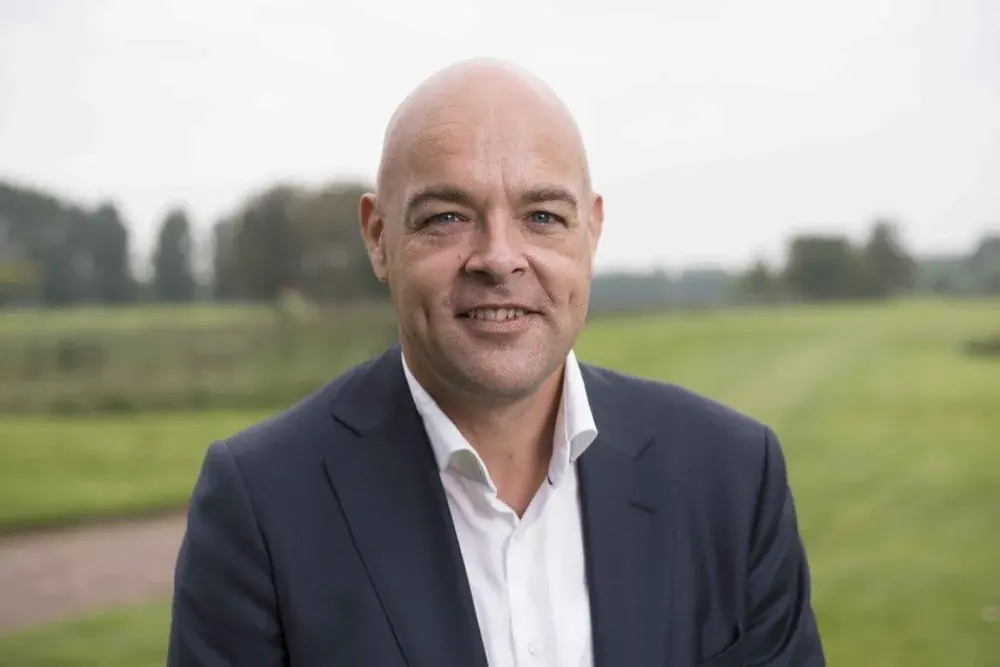
At the end of October, Stijn Grove, head of the Dutch Data Center Association and board member of the European Data Centre Association, visited Estonia for the first time. We asked why the Netherlands has become one of the hubs of global digital infrastructure, what lies ahead for Estonia and which factors will affect IT-intensive companies most in the near future.
Stijn Grove, head of the Dutch Data Center Association and board member of the European Data Centre Association.
Although this is your first time in Estonia, developments here are not foreign to you. How do you see Estonia in the wider European context?
Looking at the bigger picture, all economies are moving towards greater digitalisation, and at a fast pace. Estonia is a curious example here. You are very good at digitalisation, as founding member status in the D5, the circle of leading digital nations, shows. At the same time the infrastructure on which the digital society rests is still developing. But here too great progress can be seen.
Why is that so important?
The quality of digital infrastructure (such as data centers or communication networks) significantly affects reliability and efficiency. The need for better digital infrastructure is in no way specific to Estonia; it applies across Europe. Take internet connections. Without wide-coverage, high-quality connectivity it would have been unthinkable during COVID to organise home schooling or working from home. In some countries alternatives had to be found. In Serbia, for example, school television was launched because it was the only way to reach many children at once. That illustrates the role of digital infrastructure.
How is digital infrastructure developing across Europe?
Unevenly. Some regions have more high-quality infrastructure. A good example is the so-called FLAP region (Frankfurt, London, Amsterdam and Paris), where internet exchange points and dozens of data centers have concentrated. That in turn attracts internet-based business such as streaming platforms or cloud services. Since the growth of the hubs runs into a physical limit, above all in the form of available electricity, regional hubs such as Berlin, Milan or Marseille have been growing actively lately. Many submarine cables from Africa land in the latter, for example.
Naturally the development of these regions is also supported by a large local market. There are many people and large organisations are interested in serving them. Microsoft, for example, has more than 10 data centers in different European countries. Five years ago there were only 2.
Which other countries stand out in the European context?
Certainly Ireland. While across Europe about 3–4% of energy goes to data centers, in Ireland it is already almost 20% today. Behind that is also a tax policy that suits large corporations and draws them there. That is another way to play yourself into being a hub. Sweden, for example, has legislation favouring Bitcoin mining. The technical footprint needed to sustain the digital society is growing everywhere; in some regions it simply grows faster.
We cannot overlook the Netherlands, which has always been one of the leaders in data centers. Why?
The Netherlands has historically been very open to business, trade and the logistics that go with them. Geographically we are close to Scandinavia, the United Kingdom, France and Germany. So it is a natural center. Data centers by their nature are logistics, information logistics. So the Netherlands has been the logical central point where communication networks converge.
But there is a second reason too. The Netherlands is a small country but very open to different opportunities. For example, the Dutch company KPN, which ran the country's telephone networks before they were opened to the free market (as Eesti Telefon once managed the networks in Estonia), did not at the time take as cautious a position on being an internet exchange as the German or French telecoms did. The latter saw it above all as a cost item. KPN was willing to try and did not wait. Today the Amsterdam internet exchange is one of the largest in the world, and it created the conditions for internet-dependent businesses to flourish. Incidentally, Europe's first website was also created in the Netherlands.
Since energy is one of the main inputs in a data-intensive business, how have energy and digital infrastructure been made to work together?
In the Netherlands some data centers contribute to balancing the electricity price by feeding locally generated or previously stored energy into the grid at the moment demand is highest. Data centers are already experimenting with hydrogen-powered generators that would supply the buildings when the normal grid connection is not working for some reason or when it is more sensible to generate electricity oneself. In the coming years a pipeline infrastructure for transporting hydrogen will be built in the Netherlands, so data centers will be able to use that energy source as their main supply. That makes sense, because in the summer months the Netherlands produces significantly more energy than it consumes. While the national need in summer is about 14 GWh, at times we produce 22 GWh. Every year a new wind farm or solar park opens. So work is now under way on the capability to store electricity as hydrogen and on building the infrastructure needed to transport it.
Given the growing energy demand of data centers, it would be excellent if the complexes could generate electricity from hydrogen themselves and use it as needed. Considering that the residual heat of data centers is in turn passed to district heating plants, the hydrogen ultimately reaches homes as warmth. So hydrogen is an important component in building a green future, and data centers have a key role in the green transition.
The Netherlands and Central Europe are undoubtedly far ahead of the Baltics in development. Based on your experience, what lies ahead for us here?
Growth in demand. Investments in digital infrastructure are entirely logical in your position. Since you are already at the forefront of digitalisation, that will only accelerate the process.
A comparable example is Belgium, which has never been a hub for the internet and the businesses that rely on it. Not long ago it was about 10 years behind the Netherlands. Now, however, it is moving at a very fast pace and catching up with the other countries in the region, and outside interest in it has grown noticeably. Large cloud service providers want to rent significantly more data center capacity there than is available locally. While in the Netherlands, for example, there are at times difficulties securing electrical capacity for new complexes, in Belgium that obstacle does not yet exist. Such a scenario may await you too. Demand from both local and international organisations is growing.
Let me give an example. I have an acquaintance who worked as IT director at Booking.com. He mentioned that to ensure reliability their IT systems were not duplicated but triplicated. Considering what a couple of minutes of downtime cost, quadruple redundancy could easily have been justified too. So many organisations need not just a reliable place to keep their IT equipment and therefore their business, but a second and third location as well. Today that is the cheapest insurance. The Amsterdam internet exchange, for example, is in 14 different physical locations, and at least 8 of them are backup.
Undoubtedly rapid development awaits the Baltics. What mistakes could we avoid along the way?
From the point of view of professionalising the digital infrastructure field, you could establish a trade association that would represent its members' positions in dealings with the state, energy suppliers, international connectivity providers and others, have a say in the building of terrestrial and submarine communication cables, and explain to the wider public the field's role in sustaining our daily lives. Given the size of the region, the association could be Baltic-wide. The earlier you start, the better. With the association's support, communication and cooperation between data centers could also be intensified. There is a saying that one data center is no data center, because everyone needs at least duplication to ensure maximum reliability. So every data center also needs another data center.
An association also makes it easier to market the whole region and attract new investors. Iceland, for example, presented itself as a digital infrastructure hotspot even before it had numerous data centers. That started the current boom.
With more data centers and high-quality connections between them, the region also becomes more independent in the digital sense and less vulnerable should external connections be cut. So it is wise to cooperate.
Which factors will have the greatest impact on the data center sector in Europe in the near future?
They are the availability of electricity and environmental requirements. Every aspect of our lives demands ever more electricity, and electricity is the most important input in the digital economy. So demand is constantly growing. Electricity generation from wind and solar plants, however, is uneven today.
Environmental requirements in turn presuppose that we consume ever more green energy and also build with the smallest possible ecological footprint, recycle as much as possible and so on.
We hear that several regulations related to climate goals have come into force or are about to at EU level. Are organisations operating data centers or large server rooms ready to measure their footprint and report the results?
By their nature data centers are very well suited to monitoring all kinds of activity taking place within their walls. Every modern data center has a DCIM system that helps monitor and manage the data center's physical and IT infrastructure. These provide a real-time overview of equipment, energy consumption and environmental conditions and support high efficiency.
That certainly does not mean the necessary data can be obtained at the push of a button, but in essence the information exists. Many other organisations lack that capability. A hospital, for example, may also have a great deal of IT equipment but no overview of the associated energy cost.
The reporting obligation is an opportunity for data centers to show their energy efficiency and to prove it.
Will the reporting obligation eventually reach all IT-intensive organisations?
Absolutely. In the end we are all equally responsible for meeting the climate goals.
Finally. How do you see the general trend at the moment? Will moving everything to the cloud continue, or are we seeing movement in the opposite direction too?
The footprint of cloud service providers will certainly grow, because the workloads moving to the cloud are growing. At the same time we also see organisations already moving in the opposite direction, because they have grown so large that owning IT equipment is at least partly economically justified.
Philips, for example, at one point moved all its IT operations to the cloud because the organisation lacked a complete overview of its IT footprint. Moving to a single platform made everything clear. From there Philips has since moved part of its workloads back to data centers to optimise costs. So the reason for moving back and forth can sometimes be quite unexpected. At sufficiently large volumes a data center is certainly cheaper than keeping everything in the cloud. Naturally it also depends on the IT architecture and the goals. That is why the hybrid model, where different platforms are used in parallel, is the most common today.
In summary, though, Estonia and the Baltics as a whole are well placed to make the next leap. Alongside the digital society and economy, it is important to focus on developing the infrastructure and cooperation that enable it.