
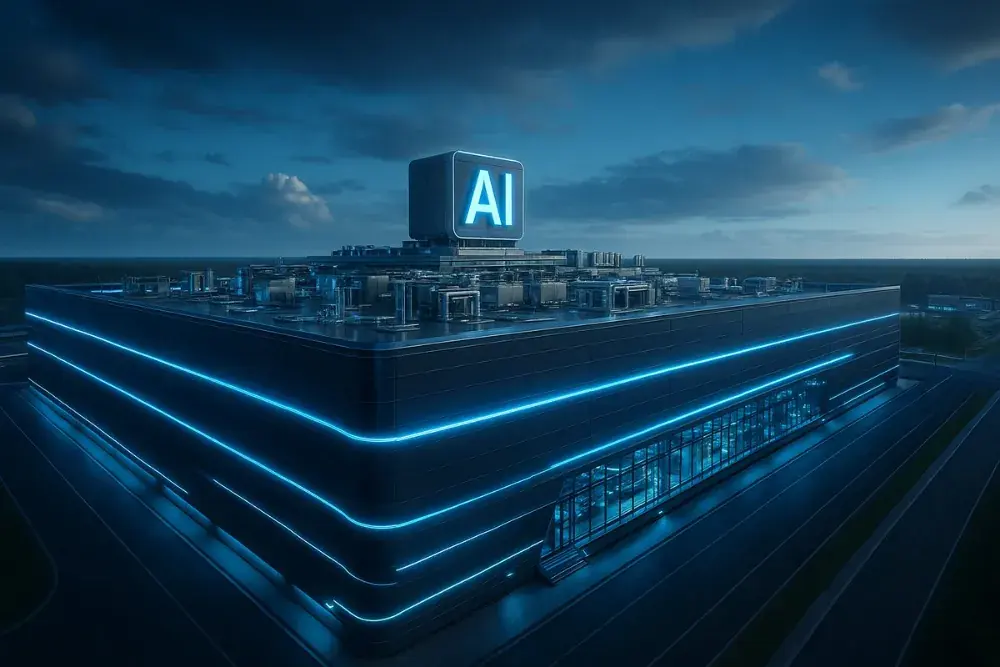
Elsewhere in the world, the AI race is running flat out. Almost every week brings news of another AI gigafactory going up somewhere. In America they are already being built inside tents, in Asia the market is running at full speed, and Europe wants in on the game too. But what actually is an AI gigafactory? And could Estonia ever be home to one?
We discuss these questions with Kert Evert, head of Greenergy Data Centers, and Martin Rungi, enterprise segment lead. The GDC data center just outside Tallinn is the largest in the Baltics, and could prove to be a key factor in Estonia's AI ambitions.
What is an AI gigafactory?
An AI gigafactory is a massive data center or computing infrastructure built specifically to train and run the world's most complex AI models. That means a huge number of graphics processing units (GPUs), energy-intensive hardware, and very fast data connections.
"Today, an AI gigafactory is defined as at least 100,000 chips," explains Martin Rungi. "That's an enormous amount of computing power sitting in a single data center, consuming roughly 300 megawatts of electricity every hour. In America we're already talking about gigawatt-scale sites."
According to Rungi, the rest of the world is racing to do more, faster. "Because data center space at that scale is very hard to find, Meta has set up a data center in the United States inside a temporary tent to house a gigawatt's worth of infrastructure, about 30 billion dollars' worth of machines," Martin gives an extreme example. This is a very risky approach, whose only advantage is speed: you can get the machines running before your competitors, without having built a data center. "You don't need Dominic Toretto or Ethan Hunt and their teams to knock a site like that offline. Everything is bet on speed, and everything else is at risk," says Rungi.
According to Kert Evert, developments in America are speculative, built ahead of demand without a clear business plan. "Whether and how much demand will emerge, and whether all of it is even needed, is very hard to judge," he says. Europe, by contrast, is more cautious and pragmatic. "Here, regulations and actual need are considered first, and only then does building start," Evert assesses.
"European data centers building AI clusters have a very clear focus, for example working with a specific carmaker. The resource goes to a very specific place," Rungi adds.
Could an AI gigafactory be built in Estonia?
Today, roughly 80 percent of the money in this field flows toward America. The price of that is an unpredictable economic environment, where essentially everything can change overnight. So Europe is increasingly thinking about how to build independent, more stable technological capacity of its own. To that end, a 200 billion euro AI gigafactory initiative has been launched.
Estonia has also shown interest. "I welcome the step the Estonian state has taken. We joined the programme and put ourselves on the list. For the first time we're actually in the picture, and we're being talked about as partners in this project. What form and scale that takes depends a great deal on local companies. Right now, working groups are being formed and a partner network is being built. Over the next couple of quarters we'll hear what options Estonia has," Evert explains. One of the AI gigafactories is expected to go to the Baltics or Poland.
For now, Greenergy Data Centers is acting as an advisor within the working group, but the ambition goes further. "We will certainly put ourselves forward as a potential location and service provider for the gigafactory," says Evert.
Rungi adds that people often ask whether they would be ready for such a challenge. "In fact we are capable of running very modern solutions in our environment. It's more a question of client demand. You don't build things like this speculatively, but we can adapt the building to exactly what's needed," he confirms.
This is one of Estonia's main advantages: a modern data center meeting every standard, in the form of Greenergy Data Centers, already stands and is genuinely operating today. Nowhere else in the Baltics can match that level. "Compared with competitors who are only starting to build their facility, we're about three years ahead. We are already a functioning company. We have both power and floor space. That gives Estonia a major edge in securing a potential location," Rungi believes.
Evert also points to Estonia's favourable location. "Of the Baltic states, we're closest to the Nordics. If you draw a 1,000-kilometre circle around Tallinn, we could serve half of Poland and the whole of Scandinavia, not to mention Latvia and Lithuania," he believes. Rungi explains that for a data center, 1,000 kilometres is the optimal distance, where latency, the time it takes for information to travel from one point to another, is relatively low. Energy is also cheaper here than in Central Europe.
Why dream of an AI gigafactory at all?
For most people, talk of an AI gigafactory no doubt feels remote. Rungi thinks it's a very good chance for Estonia to put itself on the map. "We don't have certain natural resources we could exploit, but we have smart people," he says. Beyond being an economically powerful move, it would also bring growth in knowledge and skills.
Evert explains that even setting the gigafactory question aside entirely, Estonia would still need its own smaller AI cluster for local use, a place to securely process data that we don't want, or aren't allowed, to process elsewhere.
"Take government agencies or companies handling personal data, for example health portal information. If we could securely feed that data into a model and let the machine look for patterns and connections, we could build solutions that offer real benefit. For example, a system where a person enters their symptoms and quickly gets a response with a possible diagnosis based on them. That's a very practical, needs-based step that would make many people's lives easier. Today that kind of processing isn't possible, because the right infrastructure isn't there," Evert explains.
Who pays for it?
At the end of the day, the question remains: who invests in an AI gigafactory, and how does it pay off? The joint Baltic-Poland AI gigafactory initiative is currently estimated at three billion euros. Of that, 65 percent is expected to come from private companies and 35 percent from European Union funding. "Most of it is hardware: chips, machines and supporting infrastructure," Rungi explains.
Questions like these often get stuck behind a lack of political will. "If you look at the economic impact of this initiative and put people's minds to work at the ministries, nothing is ruled out. The opportunity is absolutely there, but it requires very strong will at both the state and ministry level, all the way up to the highest political leadership," says Rungi.
He draws a parallel: "Take a simple example. When Estonia hosted Eurovision, the Saku Suurhall arena was built for it. The will was there, and it got done." He says the same logic applies to a gigafactory: "If there's will and cooperation between the state and the private sector, it can happen."
Time will tell. More definite developments can be expected in the first half of next year. Most importantly, Estonia is finally at the table, not just watching from the sidelines.