
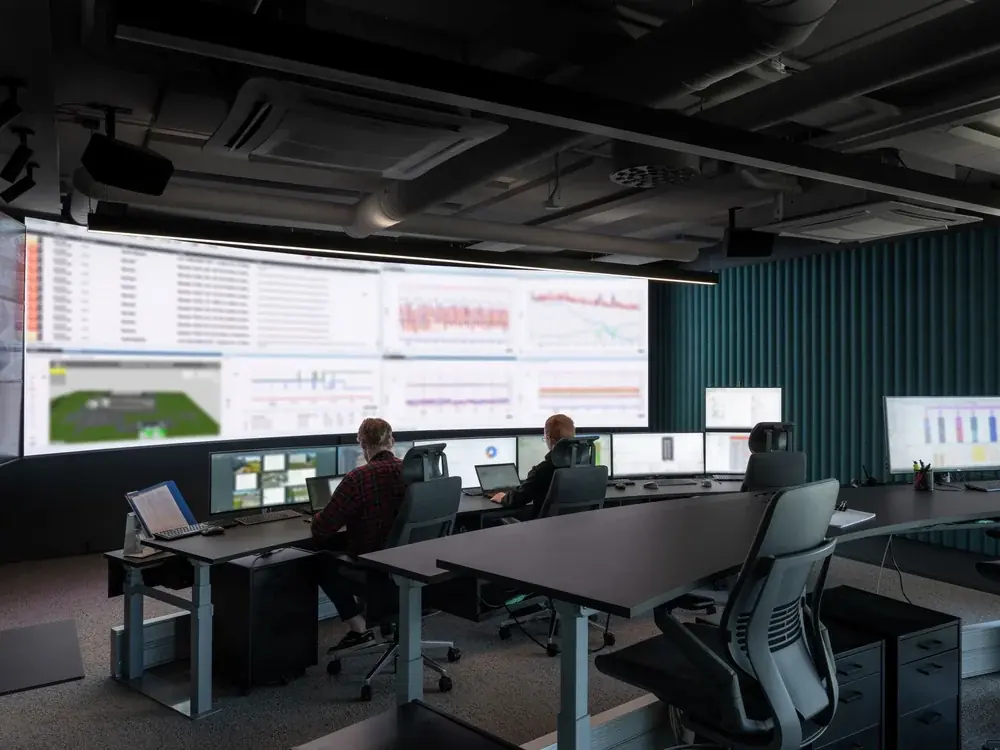
Everyone has probably seen NASA's mission control in some film: a room with a big screen, a host of smaller monitors and people watching them intently, who know the status and the vital parameters of every device on the spacecraft. They are the first to learn whether orbit was reached successfully or the landing on Mars worked. Naturally, they are also the first to know when something went wrong.
A similar control room, with a huge screen and focused people, also exists in larger data centers. Nobody goes to space, but like NASA's staff they play a critical role in the success of the mission. The mission is to keep the vital systems of organisations operating in the digital world running.
Why is it needed?
Everything we see on the internet lives on physical IT equipment, which in turn sits in data centers. If something goes wrong, put simply, a piece of our digital world stops working. To prevent that, we need an operations center.
"Just as the astronauts' peace of mind is guaranteed by the support teams on the ground keeping an eye on everything, the IT managers' peace of mind is guaranteed by the specialists of the operations center," says Toomas Kell, who heads operations at Greenergy Data Centers.
According to him, customer feedback shows this matters especially now, in the holiday season. "IT managers also want to pull the plug for a while with a calm heart and take time off. Keeping your equipment in a data center, you can do that without worry. If problems should arise, you will be told; until then you can rest with complete peace of mind," Kell says.
Constant watch
To justify a large-scale operations center it has to be staffed 24/7. That ensures the best balance between automation and human decisions. In the Baltics' largest data center, information from more than 3,000 nodes, devices and sensors flows into the central point, where software processes it into more digestible signals and infographics. Coloured lines and graphics on the screens show, among other things, the temperature and humidity of the server rooms, the status of the cooling plant and the speed of the cooling fans, right through to the security and fire-prevention systems. An experienced eye can read a great deal from those charts, figures and information, prevent problems or react when needed. Any node can be isolated from the big picture and examined in more detail, down to the level of an individual device or sensor.
"In fact, one proper operations center can coordinate the work of several buildings in different locations. The operations center might be in Estonia and the building being controlled in Poland, for instance. We also plan to monitor and manage the operation of our next data centers abroad from right here," describes Kell, who recently visited a data center in Barcelona to exchange experience, where the operations center monitored and managed the daily work of no fewer than three centers.
The operations center can also be a good source of information for the customer. Dedicated one-way channels provide a continuous feed of the vital environmental readings of the equipment rooms, and the IT manager can keep an eye on the humming machines in the data center and the room environment from anywhere in the world. It does not help with resting, but it gives extra assurance.
"The operations center can also act as an extension of the customer's own hands. If you want to restart a device or change the connections between machines, for example, you do not have to come in yourself. The operations center specialists arrange the work. That saves a great deal of time," Kell explains.
What information does the operations center collect and analyse?
Above all, people and technology together keep an eye on the key indicators of the various devices, systems and equipment rooms: states, pressures, temperatures, airflows, humidity, operating speeds and so on. "The key is comparing the information with how a given device, system or room should be performing. For example, how much water is circulating in the cooling system, the position of valves and taps, the air quality in the server rooms, whether there are compounds that should alarm the fire-prevention systems, whether the oxygen levels in the oxygen-reduced rooms are within norms," Kell gives examples. Information from the security systems flows there too, and the operations center staff have a full overview of what is happening on the complex's grounds. If someone should try to climb over the data center fence, vibration and motion sensors register it in addition to the cameras, so alarms arrive at the operations center from several directions.
"There is an unexpected side to it too. Because our data center is on the edge of Tallinn surrounded by open countryside, the cameras also catch the doings of various animals. We have caught a family of wild boar behind our main gate, the antics of hares and foxes out hunting," the person responsible for the daily operation of Greenergy Data Centers gives examples of the variety of data collected.
Is the future artificial intelligence?
A data center is, after all, a large collection of equipment and automation. Could its management be handed over to a smart AI? The role of AI in the daily work of data centers is undoubtedly a growing trend. Systems become more complex and precise, and new technologies and software solutions arrive that create unprecedented opportunities. The research firm Gartner predicts that by 2025 half of all data centers will use AI and machine learning in one form or another. Only a few years ago the risks seemed too great. The world changes fast, though.
"For example, the GDC data center was among the first in the world to apply Siemens' self-learning software to control and optimise its cooling system; based on previously collected data and its analysis it can decide, for instance, where and how much cool air needs to be directed in an equipment room. Optimising the cooling system also helps extend the life of equipment and systems and reduce operating costs. Google and other technology giants have likewise applied AI successfully to optimise specific tasks," Kell illustrates the constant technological march forward. Still, AI will not take over the full management of a data center with hundreds of customers any time soon, because too much is at stake. A human can perceive context better and, all in all, make better decisions. At least for now. If anything, the opposite is true at the moment: there is a global shortage of highly qualified data center staff. Inspired by that, experiments are under way to replace them at least partly with robots.
Returning to the mission control example from the beginning of the article, it is hard to imagine robots working in NASA's command post or AI running everything. The same goes for a data center's control room. Both the astronaut and the data center customer feel more comfortable knowing that, besides the machines, well-trained people are watching over their well-being.
In summary, the operations center is the brain of the data center. Information from thousands of sources converges there, and the people working there make sure everything performs as it should. The better the command post's work is organised, the better the IT manager can rest.