
Published 25.9.2023
Which way are Estonian IT directors looking as they draw up the 2024 budget?
According to a recent forecast by the US research firm Gartner, IT spending worldwide will reach 4.7 trillion dollars this year. Compared with 2022 that means growth of 4.3 percent. The study shows that amid the shortage of IT talent, more and more IT directors are heading towards technologies that enable automation, with the aim of continuing to grow with fewer employees. But what trends prevail in Estonia, and which way are IT directors looking as they draw up next year's budgets? We asked four large companies operating in Estonia for comment.
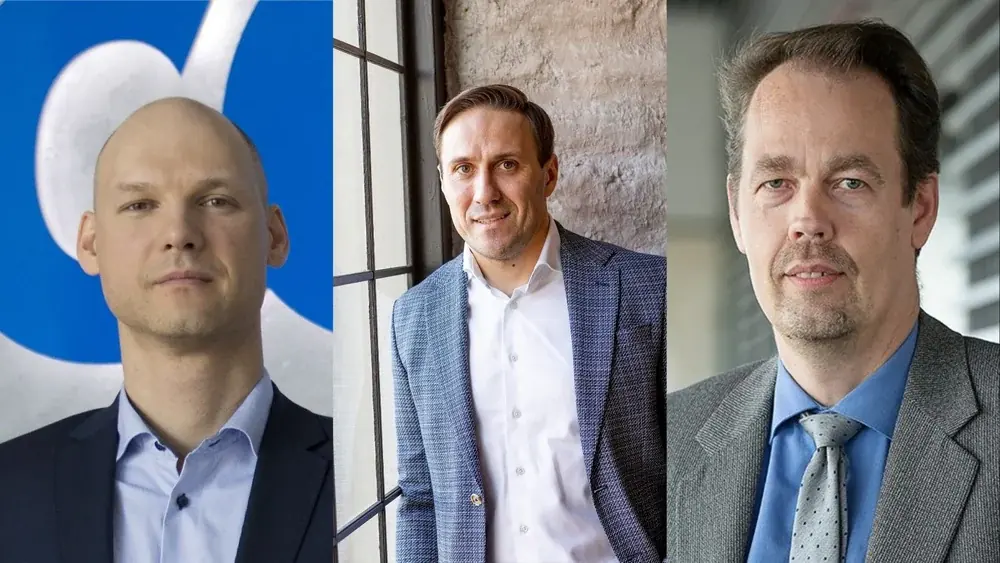
Coop Eesti IT director Kaspar Hioväin, Tallink IT director Martin Mürk, G4S IT director Andres Peiker. Photos: Coop, Diana Unt, G4S
Will next year's IT budget shrink or grow compared with 2023? Which areas of IT will receive the most additional resources?
At Tallink the budget process is under way and the exact direction will become clear in the coming months. "Given the general economic environment, it is likely that the IT budget will increase slightly next year. Preliminary estimates point to growth of about 10 percent," says Tallink IT director Martin Mürk.
According to Mürk, the shipping company's resources are spread across several areas, and no separate larger growth is planned in any of them. "We will certainly continue investing in cybersecurity, because the importance of the field and the number of cyber threats keep growing. Connectivity is also important, since customers expect similar communication services on land and at sea. Creating connections at sea that meet expectations is complicated, and in the ship environment it requires great attention and investment. We have to bear in mind that customers today have more than one device connecting to the internet, and when ships carry up to 2,500 passengers, the number of active devices on board can exceed 3,000," says the Tallink IT director.
At the same time, work is being done to update the environments intended for customers and employees, to meet today's standards in both usability and technical requirements.
Coop Eesti IT director Kaspar Hioväin says that their company's IT budget for 2024 will also grow rather than shrink. "Above all the cybersecurity budget will grow. The reason is the constant growth of cyber risks," he confirms, in line with the Tallink IT director. Hioväin adds that strong wage pressure from staff is also being felt.
G4S IT director Andres Peiker seconds the last statement. "Connectivity and staff will receive the most additional resources. Above all that is due to business growth and inflation," he says. Nevertheless the security company's IT budget will decrease next year. Peiker explains why: "Because some old systems are being shut down and the costs associated with them disappear. In addition, the depreciation of some old investments is coming to an end."
Swedbank said that since the setting of priorities for the new year is still under way, the bank cannot disclose its IT budget. "In the coming year our direction is to help improve customers' sustainability and accessibility through IT development. We continually invest in improving the resilience of our systems, further developing services and cybersecurity," said Swedbank media manager Evelin Kivilo-Paas.
What investments are being made to increase the resilience of IT systems?
According to Peiker, G4S Eesti plans to invest primarily in software and cloud services. Hioväin mentions that Coop is considering setting up a backup data center.
"Considering that several of Tallink's business areas, such as shipping, hotels and e-commerce, operate around the clock, 24/7 reliability has become the norm," says the shipping company's IT director Martin Mürk. Because of the limited connectivity at sea, Tallink mostly uses its own servers. "Still, connections keep getting better, and so we are considering the possibility of partly using cloud solutions to improve resilience," he adds.
Are expectations of IT growing in proportion to the resources provided?
Today most new ideas require the involvement of IT, and so expectations of IT are high. "Since there are often more ideas and projects than available resources, we have to be strategic and prioritise the activities that offer the greatest value to our company," says the Tallink IT director.
Mürk mentions that although the labour market situation in IT has improved slightly, finding and keeping good specialists remains the biggest challenge. "So in my assessment the bigger challenge next year is finding staff, although financial resources are also important to ensure a quality service and innovation," he says.
Peiker and Hioväin agree with him. "The greater shortage in my view is staff; we plan to recruit more developers," notes the Coop Eesti IT director. The G4S IT department also feels a shortage of staff rather than anything else. At the same time Peiker notes that expectations of IT grow more or less in proportion to the resources provided.
How big a role does the green transition play in the IT budget?
According to the Tallink IT director, the 2024 budget takes into account the green transition and tightening climate goals. "Environmental friendliness and economy form an important part of our company's strategy, and so they are also central elements in our projects," says Mürk.
According to Coop's IT director, there is no extra focus on the green transition and tightening climate goals.
G4S takes meeting the climate goals very seriously. "Last year the position of head of ESG (environmental, social and corporate governance, a sustainable approach to running a business from environmental, social and governance perspectives) was also created in that connection," Peiker notes. In his estimate about 5–10 percent of the IT budget is related to meeting climate goals.
What measures have been adopted to reduce the ecological footprint of IT?
"Economical workplace equipment; power save when not in use for a while; cloud instead of our own hardware and data center," Peiker lists, using G4S as an example.
"When procuring hardware we use GreenIT as a partner, which channels all the equipment used by Coop Eesti Keskühistu into reuse," Hioväin gives an example.
At Tallink, one area of focus for reducing the ecological footprint of IT is monitoring the number of devices and their energy consumption. The IT solutions in use help reduce and optimise the ships' energy use. "As one example, we are working on reducing the number of printers on ships and in offices, which supports both energy saving and the promotion of a paperless environment. We also use server virtualisation and consolidation to reduce hardware consumption. In addition we keep up with technological innovations that allow us to choose more environmentally friendly solutions both on land and at sea," says Mürk.
In recent years Tallink has also actively organised digital cleanup days and worked on digitalising document management. "As an example, one of our latest projects launched digital logbooks on the ships, which is another step in reducing paper documents and promoting a more digital environment," Mürk notes.
What does the Gartner forecast show?
According to Gartner lead analyst John-David Lovelock, digital business is changing. "The focus of IT projects is shifting from external outcomes, such as revenue and customer experience, to inward-facing efforts focused on optimisation," he said.
In the software segment growth reaches double digits this year, as companies reallocate spending to core applications and platforms that support efficiency gains, such as enterprise resource planning (ERP) and customer relationship management (CRM) applications. In light of price increases, the growth in software spending continues.
Although the overall outlook for corporate IT spending is positive, inflation continues to affect consumers' purchasing power so much that spending on devices falls 8.6 percent in 2023.
"The devices segment is having one of its worst growth years ever," said Lovelock. "Even if inflation eases slightly in some regions, macroeconomic factors still weigh on discretionary spending and extend device refresh cycles. Device spending is unlikely to recover to 2021 levels before 2026."
What are the observations of the head of the Baltics' largest data center with next year in mind?
According to Tõnu Grünberg, CEO of Greenergy Data Centers, their team is in daily contact with Estonian IT directors, and three observations can be drawn from that. "First, inflation undoubtedly affects IT budgets. Performing the same tasks will require more resources in the new year than this year. That leads either to budget growth or to finding places to optimise," Grünberg begins. He says an outside observer may at times get the impression that money in IT is unlimited, but in reality people look carefully at where it goes, and in the current economic situation ever more carefully.
"Second, we see more plans than before to consolidate the IT footprint. That is done both into the cloud and into data centers. From our own data center we see that thanks to technological progress customers can get significantly more done with the same amount of IT equipment, so a business can be grown successfully without significantly increasing the footprint," the CEO continues.
"Third, environmentally friendly solutions and greater energy efficiency are clearly being sought in IT as well. That is also why people look towards cloud solutions or larger data centers, which can already anticipate the tightening European Union requirements and reporting needs, and keep pace with technological development more responsively. Environmentally conscious companies expect environmentally conscious IT directors who bring the green mindset in already at the planning level," he adds. On the IT infrastructure side, he says both money and attention will again be invested in the new year in ensuring high reliability, because an ever greater number of organisations serve their customers 24/7. Reliability and security, however, have already become a hygiene factor without which successful operations are hard to imagine.