
Recently Lufthansa was forced to cancel the flights of thousands of passengers because construction workers had accidentally cut through a communications cable critical to the company's IT systems. A route running five metres underground seemed well protected from external threats, and unfortunately the connections were not duplicated either.
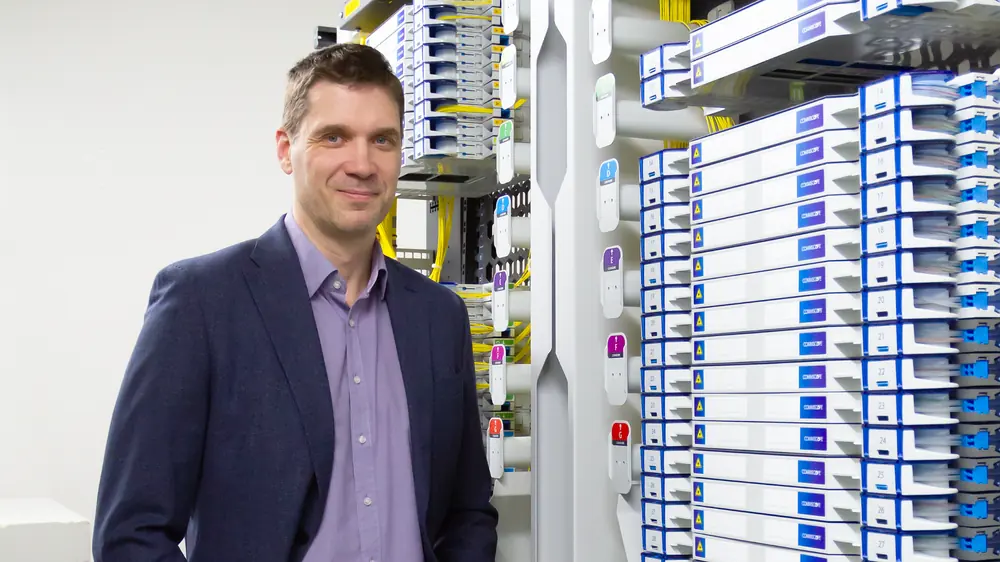
Ove Ant is responsible for connectivity at Greenergy Data Centers. Photo: Andres Oolberg.
The role of data communications in today's society is hard to overstate. When connectivity does not work properly, even a small disruption can cause significant problems. Sometimes that simply means a missed business opportunity, but there are fields, such as aviation, shipping or rescue, where the damage can be very large.
In fact, communications services affect a very wide part of society. "It may seem that a cobbler or a hairdresser, say, does not need a data network for their work. In reality their customer wants to pay by card too," explains Ove Ant, who is responsible for connectivity at Greenergy Data Centers, one of the best-connected points in the Baltics.
A network of networks
A modern communications network is a network of interconnected networks. Leaving aside the defence forces, the police and a few other public bodies, they are built mainly by commercial companies. There is also an extensive academic data network linking 50 million users and about 10,000 institutions (including supercomputing centers) across Europe.
Focusing on networks built for business purposes, these are predominantly mobile and cable networks in cities, between residential buildings, commercial buildings and data centers. The most widespread technology is based on fibre optics, because it has higher capacity and is stable, but here and there older coaxial and copper cable networks are still in use, gradually being replaced under competitive pressure. Networks emerge and are developed on economic grounds: where there is demand, providers appear. Mobile networks are a good example.
Connections that join or cross different countries are somewhat more complicated. There, cooperation between state-owned companies and the private sector is key. "Building international networks is costly, often led by state-owned companies, and has to take the business cultures of different countries into account," Ant explains.
Of international connections, submarine cables are probably the most complex, and their installation is preceded by thorough environmental studies. "Estonia and our northern neighbour Finland, for example, are connected by five submarine cables, and new ones do not appear easily," he gives an example.
Besides the seabed, long-distance optical cables run in the earth wires of high-voltage lines and alongside railways and motorways. Rail Baltic is currently being built, for instance, and that is an excellent opportunity to create a new communications network, because the digging and construction work is being done anyway. The availability of such networks to companies in Estonia and beyond ultimately depends on the owner, or owners, of the infrastructure when investments are made jointly. He who pays the piper calls the tune.
Communication channels must be duplicated
"Looking at the very big picture, the value of communications networks lies in their number and their interconnection. Several interconnected networks enabling data communication from here to Central Europe, for instance, create significant added value," Ant illustrates. Different networks are as a rule joined by data centers, large and small, and that creates a reliable and secure communications ecosystem.
Besides reach, duplication is of critical importance in the context of a data network (here it is worth recalling the Lufthansa example from the beginning of the article). Sometimes a channel has to be interrupted for maintenance of technical equipment; sometimes there are unexpected failures in the form of faults or accidents.
A double connection reduces the impact of such situations on communications. If data flow is blocked on one route, a second or third automatically takes over. "Here you have to make sure the routes are also physically separate. If, for instance, the cables of two different providers run in the same duct alongside the same motorway, it is quite likely that when something happens to one, the other is out of action too," Ant says.
The solution, he says, is to ask the various providers how their connectivity is technically arranged and whether there are overlaps that could put the service user's business at risk. Providers certainly have maps showing where their routes and cables run. If such overlaps exist, it is worth considering an alternative provider who would carry the bits and bytes to their destination by some other route.
The challenges of office buildings
One of the biggest challenges in connectivity is the lack of alternative providers, and hence of competition, in commercial buildings. That situation often only becomes apparent over time, when a company wants to change its existing partner for some reason. To avoid such captive relationships and secure freedom of choice in the future, it is worth asking for different offers right at the start and focusing on both the economic and the technical details. That way you learn immediately that, for example, only one company's cables enter the office building and a company operating there essentially has no choice.
"In fact there is a way out of that situation too. If creating a second connection with fibre optics is not feasible, a radio link is the alternative. Besides a second route, it also provides technological duplication," Ant offers a way out.
Three recommendations
In summary, with reliability, freedom of choice and cost-effectiveness in mind, focus on three main points:
- Higher reliability and a better price are usually the result of competition. Check whether you can choose providers for the connectivity solution you are planning.
- Data connections should be duplicated. If the commercial building does not have two cable-based providers, look into creating a second connection via a radio link over the roof, for example.
- Avoid very strong technical dependence on one provider. The deeper the dependence at the technical level, the more complicated and expensive it is to change partner. The provider knows this, and such dependence may not arise by accident.
"They say the IT manager's peaceful sleep is inversely proportional to the CFO's grey hairs. But by thinking through every detail, you can create a solution that covers the business and technology needs and mitigates the risks, saving a considerable number of nerve cells for both the CFO and the IT manager," Ant sums up.