
What does one hour of downtime mean for your organisation? And one day? What would happen to deadlines, and what would the financial damage be? In the modern world such trauma is caused by faults in IT equipment or in the flow of data, which has become the bloodstream of organisations. Everything begins and ends with information and moving it. There is a remedy against such outages, though: place your IT equipment where its reliability is ensured in more than one way.
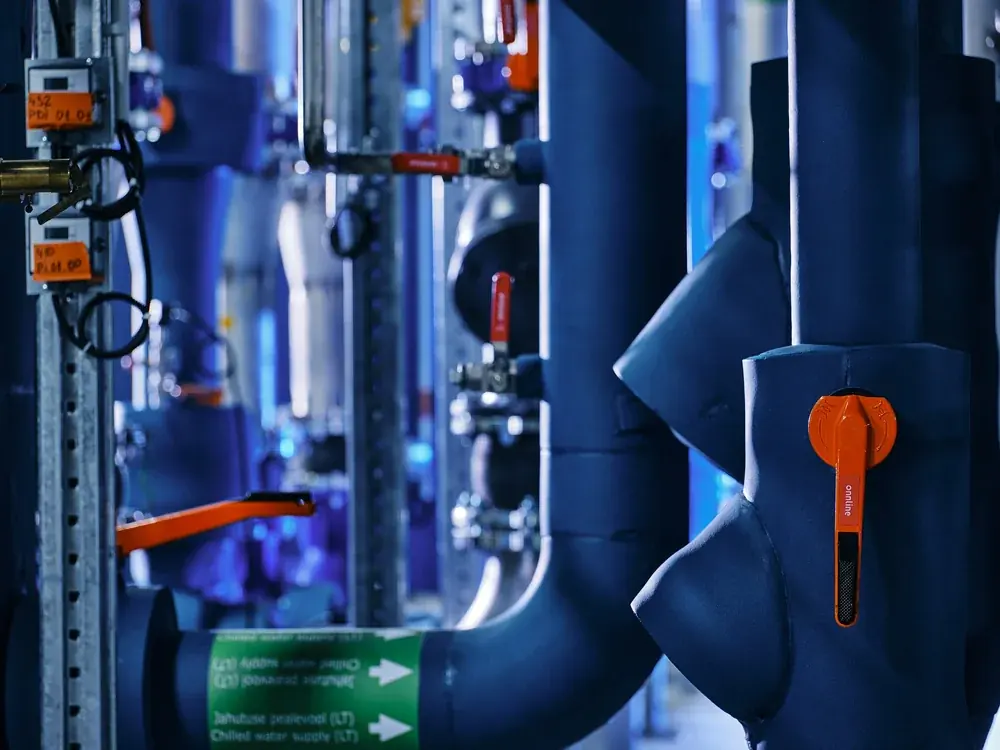
Cooling equipment. Photo: Tõnu Tunnel.
How to survive?
Today many organisations still keep their data, worth its weight in gold, and their IT systems in offices, basements or rooms converted into server rooms from some other use. Understandably, those places are often as exposed to outages as any ordinary building. Things are different in data centers built specifically for the flawless operation of IT equipment.
Last month we wrote about our high-tech security systems. Alongside security, reliability is exactly as important in a data center: what use are top-class security systems if the infrastructure gives up?
Greenergy Data Centers is the first data center in Estonia whose detailed plan and building permit were drawn up specifically around the needs of a data center.
Where does reliability come from?
The keyword here is the redundancy of supporting systems. It means having more of something than the minimum needed. While surplus things are often a nuisance, with business-critical infrastructure you cannot have too much of a good thing. Fault tolerance is simply a must.
Take an ordinary office building, where many people keep their equipment: everything there exists once. Put simply, if roadworks in the street cut through the internet cable, you have no internet connection. Or if a cat jumps on the transformer at the nearest substation, your office has no electricity. It does not take much to bring work to a halt.
It is precisely at such moments that redundancy is the lifebuoy that keeps the data, and the activity relying on it, afloat. When communications cables come into a data center from eight different directions, and two independent connections, backed by UPS units and generators, link it to one of Estonia's most central electricity nodes, there is something to rely on. One careless digger operator or a similar incident is no longer a threat.
So redundancy does not mean excess but better preparation, which keeps IT equipment running even in poorer scenarios. It is the most direct form of prevention.
How exactly does it work?
At Greenergy Data Centers, reliability is ensured by redundant power supply, cooling and connectivity infrastructure, top-class fire-prevention systems and continuous monitoring of the center's infrastructure with more than 3,000 sensors.
Electricity reaching the center's data rooms passes through uninterruptible power supplies, UPS units, which provide power when the normal supply fails for any reason. The UPS units are designed to last until the generators, housed in shipping containers, start up; they can produce electricity for as long as needed. Huge fuel reservoirs have been built underground on the center's grounds, meaning the data center can easily run on fuel alone. That way power is guaranteed even when the lights are out in every home and office.
The same goes for the cooling systems for IT equipment, which are built on the logic that both the shared data hall and the private rooms all have backup units that engage when a unit that normally keeps the temperature in the right range stops working. The largest chillers at Greenergy Data Centers have a capacity of 1.5 megawatts. To draw a comparison from everyday life, the difference in power compared with the mobile phone charger we use daily (15 watts) is 100,000-fold. In case the cooling modules fail for any reason, large tanks of cold water stand ready, whose contents can be used in the cooling pipes until the temperature-control equipment restarts.
As for fire safety, the oxygen content in the data halls has been reduced to prevent fire. Figuratively, that means if you walked into the room with a burning torch, the torch would go out by itself. For a person in good health, though, the environment is perfectly suitable for a couple of hours of work. It can be compared to being a couple of kilometres up in the mountains.
A smartly chosen location
According to international standards there are more than 100 different criteria for choosing a data center's location. It is sensible to keep data away from hazardous traffic and industry, while still close enough to the main transport hubs. It is smart to build the center on higher ground to reduce the risk of flooding and increase the number of days with a decent wind. That allows the data center to be cooled with outside air for most of the year, which saves energy. Estonia's climate is exactly right for such a facility, with only a couple of hundred hours a year when free air cooling is not enough. Incidentally, Estonia is also among the ten most suitable countries in the world for locating a data center.
How much does downtime cost in the wider world?
According to the annual survey of the Information Technology Industry Council (ITIC), 98% of companies say that even an hour of downtime costs them more than 100,000 dollars (about 94,000 euros). Outages can also affect employee productivity, as staff have to deal with restoring systems and data instead of focusing on the core work that would move the company forward.
A study by Vertiv, an American provider of data center equipment and services, found that unplanned outages can cost companies hundreds of thousands of euros: on average about 243,000 euros for partial outages and about 642,000 euros for a complete blackout. The steep price tag depends on the duration of the outage and the size of the company. The main (and most costly) causes of outages were directly related to the vulnerability of the power and cooling infrastructure of IT equipment.
In summary, it is worth asking your data center, cloud provider or the specialist managing the equipment in your office what happens in the event of surprises or accidents. Is there a plan B behind plan A, and preferably a plan C as well? In the end, we would all rather look to the future with a calm heart than count the losses and put out fires.