
If information is the bloodstream of a modern company, moving servers is like heart surgery. Everything has to be done quickly, precisely and in a way that keeps the information flowing. Done well, customers did not even notice the move.
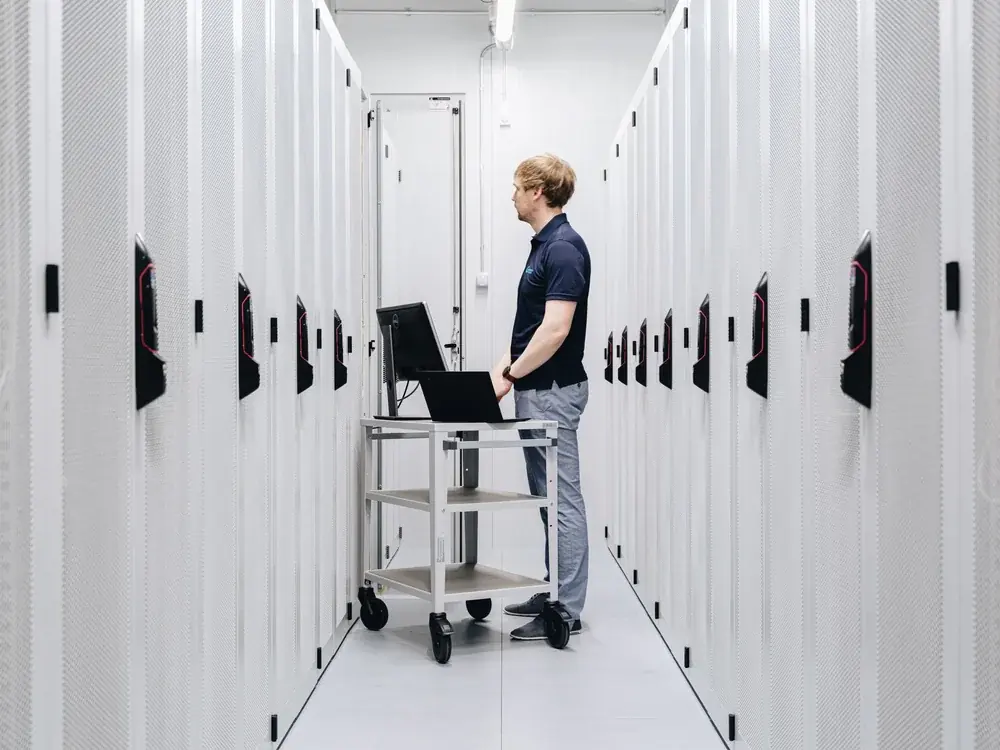
Work in the Greenergy Data Centers facility. Photo: Tõnu Tunnel.
There are various reasons to move. As a rule the common denominator is the wish to increase reliability, efficiency and quality. "We have been through a situation where the cleaner unplugged the servers. We literally started out in a garage, and because of that incident we had quite a few things to smooth over with customers," Rein Post shares his experience. The company he leads, R8 Technologies, digitally optimises the operation of ventilation and air-conditioning equipment. It helps companies from the Arab states and Europe, and soon the USA, save very large amounts of energy and money.
"Luckily we were forgiven, because the incident happened quite early in our history. We promised that nothing like it would happen again and moved our servers to a highly reliable data center," Post explains.
Servers with uninterrupted internet and power are the guarantee of his company's credibility, and faults in the system cannot be tolerated. In Estonia, however, there is only one data center whose connectivity, cooling and power systems are duplicated, in places even triplicated. That brings the risks down very low. That is where the R8 team took its servers.
The process has to be thought through in detail
What does the moving process look like? The first step is to think through the space and power requirements for the servers and reach an agreement with the data center on them. The center, for its part, provides information on procedures and security rules. In a carrier-neutral data center you can also choose your own internet provider.
Once that stage is done, a moving plan has to be worked out. "There should be a dedicated project manager who is responsible for everything and keeps an eye on it all," says Margus Danil, one of the driving forces of the cloud provider Storadera, whose equipment has also been housed since May at Greenergy Data Centers on the edge of Tallinn.
Post of R8 Technologies adds the importance of communication within the team. "The person making the plan can never think through every detail alone. The more things have been discussed with the team, the more easily everyone else can anticipate problems and offer solutions," he describes a proven practice.
Bear in mind that surprises always come up, and reserve time has to be planned for every move.
Although preparations took a whole month because of delivery problems with the new equipment, moving and setting things up in Margus Danil's company eventually took only two days. When to schedule the move depends on the nature of the business. For those whose main work happens on weekdays, it makes sense to move on a Saturday: if problems arise there is still Sunday to react. Sometimes a night-time slot is sensible, and in some cases, as at Storadera, server operations must not be interrupted at all, which the move has to accommodate.
Moving into a data center in several stages
It is often the case that the existing equipment is not enough when moving into a data center and new equipment has to be ordered. For that, the data center has an intermediate store where it is kept until installation.
Sometimes a multi-stage move pays off. "We were in another data center before, from which we brought the equipment over. First we put brand-new equipment into service, then we stopped the old one and brought it over in three parts," Danil gives an example of how to organise the work without interruptions.
Because the security requirements at Greenergy Data Centers are as strict as in a thriller, delivering equipment follows a set procedure. The vehicle's registration number and the details of the people taking part have to be sent to the center the day before, for example.
When the vehicle arrives it drives into the loading area, where the goods are unloaded. The vehicle then leaves, and the center's staff take the goods to the intermediate store, which no outsider can enter. Incidentally, staff are on site around the clock, whether to receive goods or to support installation. Installation can also be ordered as a service.
Unpacking and assembling the equipment
When everything needed has arrived, the data center should be asked to take it to the unpacking and staging area. There the packaging is removed and sent for recycling.
On unpacking, Danil's team also learned a lesson. "The boxes of new equipment contain all sorts of small parts you may not need right away. We did not check all the boxes properly and sent them off to be thrown away," he recalls. "But the data center's system was precise and fast like clockwork, and all the rubbish went straight into the compactor. So we had to source a few parts again later," the Storadera lead smiles.
Once the equipment is assembled, it is transported to its designated place and put into operation at the right moment.
"In the end our start-up took two hours instead of ten minutes. Surprises happen, and you simply have to be ready for them," Rein Post says in hindsight. "But the data center team helped find a solution to everything. Great credit to them."