
Published 27.9.2022
How does a data center withstand an attack by lightning, an excavator or a jackhammer?
Imagine travelling to a foreign country and arriving at your hotel. The roof leaks, breakfast is forgotten and the rooms are not cleaned. A pleasant stay turns into pure stress. When you question your travel agent, it turns out that the quality of this hotel was never checked. They hoped for the best. But generally such problems do not occur…
You obviously would not accept that answer, and you would never want to experience such a situation. Exactly the same applies to a data center.
Just as hotels are indispensable for a pleasant holiday, we need data centers to deliver any e-service to the consumer quickly and reliably. You obviously want someone to have verified the quality and reliability of a data center before you.
So who does the testing for you?
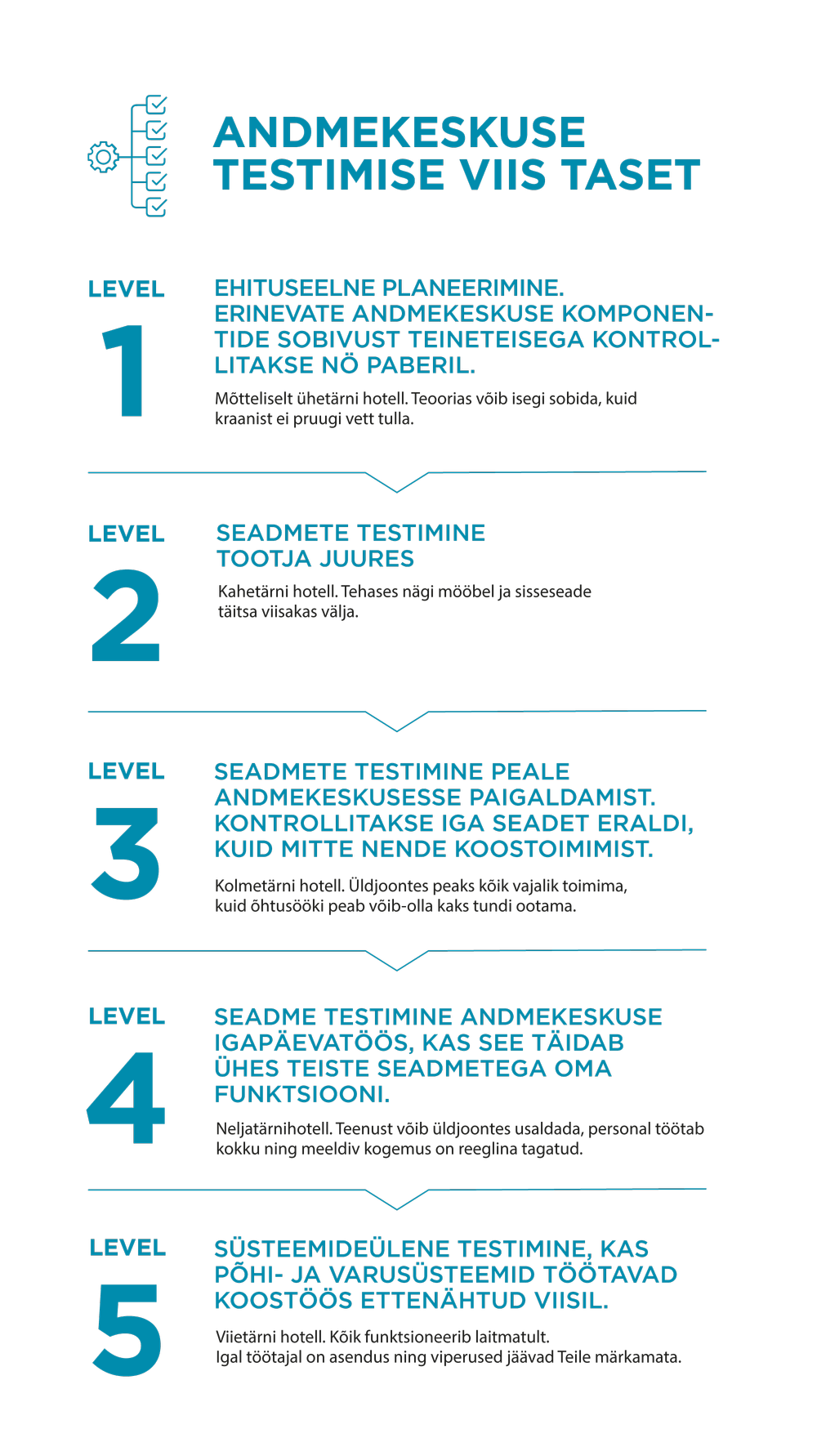
In short, testing is the data center's own duty and responsibility. The golden rule is that if a device or an automation system has not been tested under load, you should not assume it works. That applies to backup systems above all. If your hotel in a warm country promises an air-conditioned room but has never switched the unit on, you will quite probably sweat.
"When tests are carried out thoroughly, the reliability of the data center, and with it of the customers' equipment, grows. Because a data center is a complex ecosystem, both likely and very unlikely scenarios are played through. A lightning strike, like the one that hit a Microsoft data center, is hard to prevent, but many other threats can be. We do everything to be ready for every eventuality," explained Toomas Kell, who is responsible for the day-to-day operation of the Greenergy Data Centers facility. Besides increasing reliability, testing helps optimise the data center's daily operation, which means lower costs.
Merciless methods
In the harshest tests, one of the center's vital components is cut off and the backup systems are watched taking over. Sometimes it goes as far as switching off the data center's utility power and letting the backup systems kick in. Unfortunately, that is the only way to know whether the center's customers can sleep soundly at night.
An exhaustive picture of a data center's reliability comes only from level-five testing, because that is when the truth emerges: does every component behave as intended under heavy load? "Some time ago we carried out the highest-level tests in the Baltics' most secure data center, and playing through the different scenarios at different loads took several days in total. We ran hypothetical situations where someone digs through the center's 110 kV power connection, carelessly drills through the communications network inside the building, or a cooling module stops due to equipment failure," Kell gives examples. "In none of these cases was the operation of the Greenergy Data Centers facility interrupted, because the backup systems engaged. Just as planned."
Rigorous tests are also a precondition for the highest international certificates. The Baltics' largest data center, for instance, is the first in the region on its way to EN 50600 recognition, the highest certificate awarded to data centers, which directly reflects the complex's reliability.
To return to the question in the title: there are measures to prevent lightning damage too, and a top-class data center should certainly cope with the other challenges.