
There are more than 5 billion internet users in the world, and every one of them wants their online activities to run flawlessly, whether buying new sports gear from an online shop or making a transfer to a business partner for a shipment of timber. Beyond surfing the internet, those billions have one more thing in common. They all use, or rather we all use, data centers in one way or another.
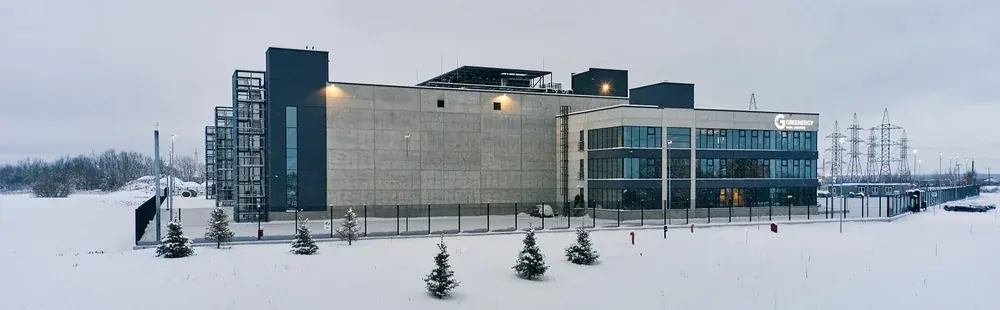
The Baltics' largest data center, opened in February. Photo: Tõnu Tunnel
Every e-service, and every piece of information or action within it on the internet, has to physically be somewhere. As a rule that means servers and related IT equipment that receive, process, store and deliver information. Today that equipment sits in data centers, in refrigerator-sized cabinets standing side by side in rooms, large and small, adapted for the purpose. The Baltics' largest data center, for example, has room for two football pitches' worth of such cabinets.
But why do we need separate data centers? Why couldn't that equipment be in homes or offices, as it used to be?
The more data there is, the more sensible it is to keep it together in premises adapted for the purpose. The equipment that manages today's most valuable asset needs:
- uninterrupted power, and ever more of it;
- constant cooling, because the electricity consumed turns into heat during operation;
- connectivity, so the data can be reached;
- protection, so that only those with the right to access the data can do so.
Uninterrupted power, cooling and connectivity alone do not guarantee reliability, however. If one of them fails, the IT equipment is still out of service for its users. Every system should in turn be duplicated.
It would not hurt to have a plan C on top of plan B. If the ceiling of the room housing the power supply leaks and a short circuit trips the power, an alternative supply (UPS units, generators) has to take over so that the exchange of information on the internet continues. If the cooling system fails, a second, equivalent system has to switch on to prevent the crash that comes with overheating. If a careless digger operator cuts through a cable route, there have to be alternative routes in reserve that still deliver the bits and bytes. If someone with shady intentions wants to get to the servers, effective security measures have to stop them.
In short, all of this is easier, and more energy-efficient, to arrange in a single building complex designed and built to withstand the trials. The more we want to be constantly online at work and at home, the higher the reliability we expect from data centers. Think about how many times you have abandoned a transaction online because something did not seem to work properly. Now multiply that by the 5 billion internet users mentioned above. That is where the role of reliability in e-business takes shape.
How many data centers are needed at all, and do more need to be built?
By various accounts there are currently more than 8,000 data centers in the world, and that is not many. According to the research firm IDC, 1.2 zettabytes (1.2 trillion gigabytes) of data were produced globally in 2010; in 2020 the figure was already 59 zettabytes. IDC forecasts that it will grow to 175 zettabytes by 2025. Over 15 years that is a 146-fold increase.
Estonia, known worldwide as an e-state, had no large-scale complex built as a data center until February this year. That gap has now been closed. The data center, which cost close to 40 million euros, will soon be joined by two more, and inevitably even those will eventually not be enough. The more we rely on data and the internet in our daily lives, the more reliable and secure data centers we need.