
A story from the series "The ABC of the e-world", where we explain complicated things as simply as possible.
You probably use the internet every day. But does the internet exist physically?
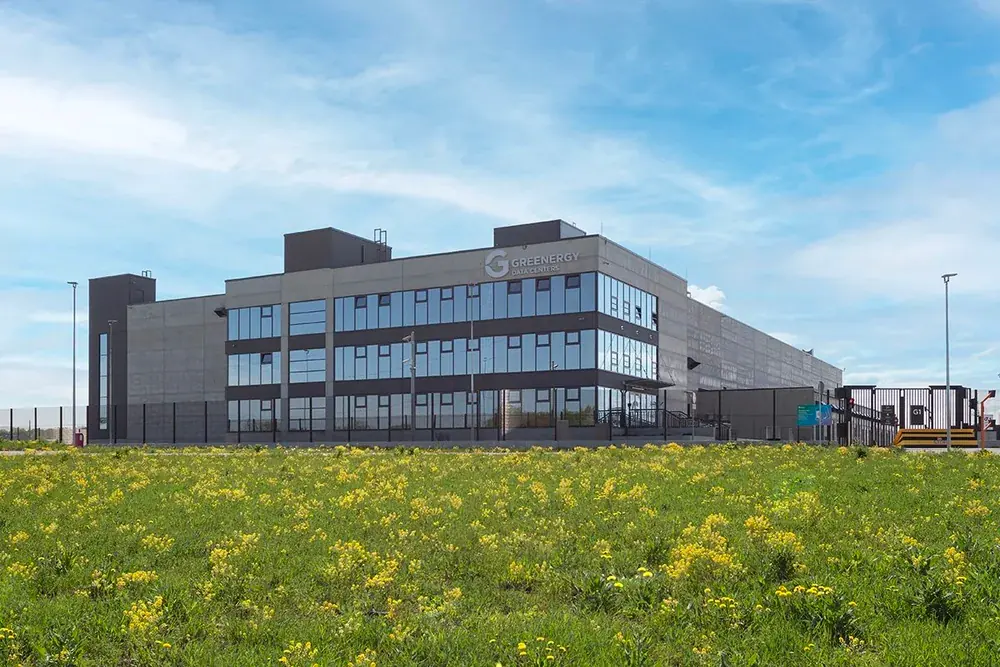
The data center building. Photo: Andres Oolberg.
In reality every e-service, and every piece of information in it, has to be somewhere for real. Every query and its answer. Every picture, text and video. As a rule that place is servers and related IT equipment that receive, process, store and deliver information. That equipment, in turn, sits in data centers.
So when you pay by card in a shop, you are using some data center; when you call a taxi with an app, you are using a data center; when you get an answer from ChatGPT, you are also using a data center. Like the foundation of a skyscraper, this part of our everyday life is usually invisible to the naked eye.
The main misconceptions
According to Tõnu Grünberg, CEO of the Baltics' largest data center, Greenergy Data Centers, there are two widespread misconceptions about data centers.
"First, that data is created in them. That code is written or databases are built here. The name seems to suggest it. In reality a data center itself creates nothing new. We are like bank vaults that hold gold but do not produce it. Second, that data centers manage or filter information. In reality the data centers' customers do that themselves, and they may be companies, government agencies, international organisations and others. Put simply, our role is to provide good internet connections, strict security and highly reliable power and cooling capacity," Grünberg explains.
According to him, a typical data center customer gets one or more equipment cabinets the size of a large refrigerator, which they fill with technology and connect to the network. The customer is responsible for the information and programs kept and run there. The data center helps secure that IT equipment and keep it running 24/7.
The Baltics' largest data center, for example, has room for two football pitches' worth of such cabinets.
"To offer another comparison, a data center is like a bridge and data is the cars. The bridge does not decide which cars drive on it. But without a road the cars have nowhere to drive. Without data centers our world would stand still," Grünberg illustrates.
But why do we need separate data centers? Why couldn't the IT equipment be in homes or offices?
First, technological progress is largely to "blame". IT equipment keeps getting more capable, and with it energy consumption grows. The electricity connections of ordinary homes or offices cannot provide such capacity. Unlike purpose-built data centers, homes and offices usually have a single electricity connection: if something happens to the cable, the room goes dark. And when the IT equipment that e-services run on is down, a large part of the organisation's activity is down too. Modern data centers, by contrast, have several power feeds.
Second, physics is to "blame". The more electricity the equipment consumes, the more heat is produced. IT equipment does not like heat, so it has to be removed. In an ordinary home or office that quickly becomes a problem, because the skills and means to build and manage flexible cooling systems are limited. In modern data centers, cooling is looked after by machine-learning-based artificial intelligence that can keep IT equipment at the right temperature energy-efficiently. The heat produced is also reused, for heating rooms or domestic water rather than simply going outside.
Third, there are economic reasons. Just as it makes sense to run a physical shop in a shopping center where ideal conditions have been created for it, it makes sense to keep servers in a place designed and built for them. On balance it is simply more cost-effective.
But why do we need data centers when we have the cloud?
Having discussed misconceptions above, this one can be added to the list. "Every cloud ultimately needs IT equipment and a data center to serve customers too. Every cloud is a very real collection of technology. Several cloud service providers host their equipment with us, for instance," Grünberg reveals.
The world's largest cloud service providers have hundreds of data centers between them. "When you upload your photos or videos to the cloud, you are in fact, figuratively speaking, uploading them to someone else's computer. In this case the equipment of the company providing the cloud service," Grünberg explains. So clouds cannot do without data centers either.
Are data centers somehow connected to AIs such as ChatGPT or Google's Bard as well?
AIs set the bar very high for data centers. ChatGPT may answer you over the internet with playful ease, but enabling all that takes enormous computing power, both to train the system and to keep it running. To meet those demands, technology giants build entirely separate data centers designed around that purpose, capable of directing considerably more power into the equipment cabinets than before and of removing the resulting heat. The power requirement of such cabinets can exceed 100 kW, which equals the maximum capacity of the electricity connections of about 7 ordinary flats. And training an AI needs hundreds, if not thousands, of such cabinets.
In summary, the internet as we see it on the computer screen really does exist. Every piece of information means data on a physical device. Those devices, in turn, usually sit in data centers. The more we rely on data and the internet in our daily lives, the more reliable and secure data centers we need.