
Where is the world's largest data center? The question itself is simple, so one might think the answer is a quick Google search away. The reality is more complicated, because data centers tend to be secretive about their size.
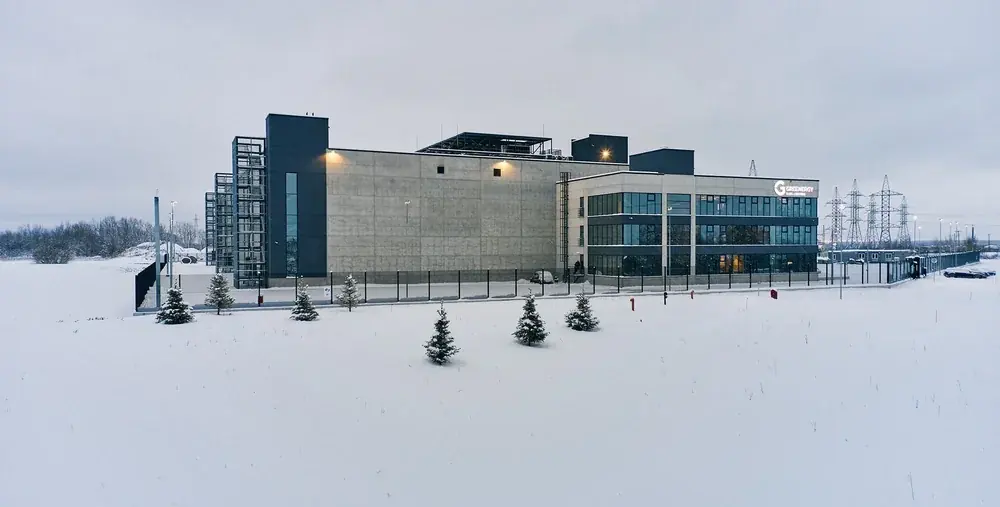
The Baltics' largest data center. Photo: Tõnu Tunnel.
China's "million-square-metre" data park
Information can be found online that the world's largest data center is said to be the China Telecom-Inner Mongolia Information Park, built by the Chinese state-owned communications company. The facility, worth three billion dollars, is said to be in Hohhot, to cover a million square metres and to consume 150 MW of energy in six data halls. For comparison: a million square metres is more than 94 standard football stadiums. So, if the Chinese are to be believed, their data center would be larger than, say, Pedassaar island off Estonia's north coast.
More has been written over the years about similar facilities in China, but so far many such claims have not been confirmed. In the case of the China Telecom data center too, it is not certain what its actual extent is. The company itself is also unwilling to confirm or deny claims about its extent, writes DatacenterDynamics.
Satellite photos suggest the so-called world's largest data center consists of six four-storey buildings, each about 89 metres long and 46 metres wide. A quick calculation shows that each building's footprint is therefore 17,444 square metres, and for all six a little over 100,000 square metres. That is undoubtedly a lot, but almost 10 times less than the million square metres cited in the media. It should be said that satellite photos do not show how much of those premises is actually used for storing data.
Several of the next places in the ranking of the world's larger data centers also seem to belong to China, but firm facts are scarce. The supposed holder of second place is also in Hohhot and is said to be 715,000 square metres, but that story may be inflated too. Satellite images at any rate do not confirm the information; it seems construction of the facility has not yet been completed.
The situation is similar with China Mobile's data centers. Companies often announce how large a facility's total capacity may grow, based on what the planning permission provides for or on what sounds good to investors. Then they grow step by step, hoping to reach that final figure. Whether or when it is actually reached is not so important at first. In China, reaching the goal is made harder by the fact that the north-east of the country has twice as many data facilities as needed. Demand simply cannot keep pace with the companies' utopian plans.
Centrin's data center in Wuhan
Another potential mega data center can be found in China: Centrin's data center in Wuhan. The company, which recently cooperated with SpaceDC, claims its area is about 207,000 square metres. The facility is not finished, though; it is only in its first phase, with a total IT load of 70 MW, and hopes to grow to 225 MW.
Huawei's data campus
Another possible enormous data center is Huawei's "data campus" in the Gui'an New Area of Guizhou province in south-west China. The Chinese maker of telecommunications equipment and consumer electronics often designs its campuses in an almost fairy-tale rendition of European architecture, based on the façades of Prague.
It is a truly distinctive-looking campus that at first glance resembles a Disney theme park or a Hollywood film complex more than anything else, but the company claims it houses a million servers. If local media are to be believed, the campus is currently 480,000 square metres. That does not mean all of it is used for storing data, though: the campus also has 98 training rooms, research and development labs, a base for IT maintenance engineers and much more. Huawei's data campus reportedly receives 10,000 visitors a year, noticeably more than any ordinary data center.
This data campus is probably not the world's largest, but Huawei earns style points for it being one of the strangest. You can see a photo here.
Japan's largest data center
Without any doubt, the AT TOKYO Chuo data center in Japan is among the world's larger data centers. Its total area is 140,000 square metres, and here we really are dealing with a fact. In essence it is simply one hefty cube in the middle of Tokyo.
AT TOKYO is the largest data center building in all of Japan. But is it also the world's largest?
The NSA data center
Let's move to the United States. One of America's larger data repositories belongs to the National Security Agency, the notorious NSA. The government agency under the US Department of Defense tried to keep most of its Utah data center secret, but since it is a gigantic building, that has not entirely succeeded.
The data center is thought to comprise two large buildings, each with two halls, and the surrounding infrastructure, with an area of about 139,000 square metres. However, only 9,300 square metres of that is thought to be data center, with more than 84,000 square metres of technical support and administrative space.
The Chicago data hotel
One of the larger data center companies is Digital Realty, which owns the Lakeside Technology Center. It is an enormous "hotel" operating in Chicago with more than 70 tenants. The building's area is 102,200 square metres, but the question is whether to count a building housing several data center companies as one site or as several different ones.
Europe's largest data center
There are data centers in Europe too, and not a few, but in size they still lag behind the rest of the world. According to several sources, Europe's largest data center is in Portugal and belongs to the country's largest telecommunications company, Altice Portugal (formerly Portugal Telecom). The facility is a little under 75,000 square metres in size.
Altice Portugal's data center is notable because it is not only the largest but also one of Europe's most environmentally conscious data centers. The facility has a rainwater collection system and a garden with more than 600 trees. Solar energy is also generated on site. The facility was strategically placed in the town of Covilhã, the coolest place in Portugal. That allows the facility to use free cooling 99 percent of the time. We have written before on our blog about why temperature is one of the most important risks in colocation.
Facebook's data giant
That one of the world's largest social media platforms needs a lot of room to store data should come as no surprise to anyone. Facebook has built several enormous data centers around the world, the largest of them in Prineville, Oregon, in the United States. Facebook's data repository comprises more than nine buildings and 344,000 square metres, and it keeps growing. By 2023 the company plans to open two more halls of 41,800 square metres each, and this time both are two storeys. That would make 427,000 square metres in total.
But even in its current form it can be said that the world's largest data center cluster under a single brand is Facebook's Prineville data campus.
But what might be the largest single data center building? In that contest too the leader may be the same: Facebook's 170,000-square-metre, 11-storey Singapore data center (although it is only in its first phase).
Giants of the future
In the future, Switch's Citadel data campus may knock Facebook off first place. Switch is a company based in Las Vegas, Nevada, that develops and manages SUPERNAP data center facilities and offers colocation, telecommunications, cloud services and the like. When complete, Switch's campus would comprise 12 data centers, 650 MW and up to 761,800 square metres of data center space. That would undoubtedly make it the world's largest data center complex.
But it is not fully complete, and that notorious "up to" leaves plenty of wiggle room. Currently the campus already has 120,800 square metres of operating data centers. That means it is already an enormous data repository, but not the largest. Switch itself also has a 250,800-square-metre data repository in Las Vegas, which currently outshines its own future plans. For now.
Estonia's largest data center
For a long time the Baltics had no large-scale building or complex built as a data center. That gap was closed this February with the opening of Greenergy Data Centers in Hüüru on the edge of Tallinn. Today it is the most secure, most reliable and undoubtedly also the largest data center in this region.
The Greenergy Data Centers data center holds two football pitches' worth of equipment, and the complex's electricity connections could power an average Estonian town. The first completed building has an area of 14,500 square metres, and two more similar buildings are to be added.
The construction of the data center on the edge of Tallinn was financed by the Three Seas Initiative Investment Fund. The Estonian state is one of the fund's investors.
Does size matter at all?
In short: yes.
"Size often means efficiency, which in the context of ambitious climate goals and the energy crisis is extremely important. It is predicted that by 2030 data centers will already account for 10 percent or more of the world's energy consumption. Size also means the opportunity to expand your business and take additional data center space into use. For a large player it is economically more sensible to implement technological innovations, ensure compliance with internationally recognised standards and attract connectivity providers into the building," Urmo Kanger, head of sales at Greenergy Data Centers, lists the advantages of scale. So it can be said with full confidence that we will keep hearing about large data centers in the future too.