
When a small online shop's page does not open, it causes annoyance, but usually nothing more. Yet there are fields where even a small fault is too much and the movement of data is critically important. For some organisations or services, errors mean major losses or, in the most extreme case, lost lives.
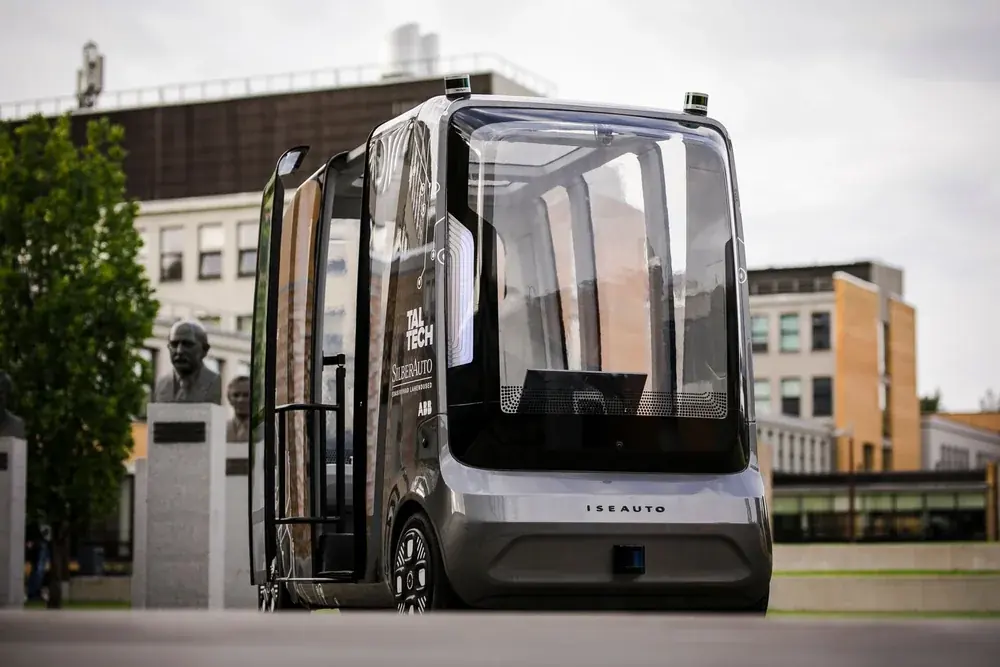
A self-driving car. Photo: TalTech
How much data hides behind everyday activities?
Let's start a little further out, with more everyday topics. One of the simplest activities in our lives is sitting down in front of a screen for entertainment. "To watch a series on Elisa Huub, for instance, a great deal of information is exchanged between the customer's device and Elisa's servers," explains Joosep Põllumäe, head of IT and TV services development at Elisa.
So what actually happens when you want to stream your favourite series? "The customer's device and its ability to decode different video streams play an important role. For that, the device introduces itself to the servers and a stream suitable for that particular device is found in the background. It is also important to check whether the logged-in user has the rights to the requested content, that is, the appropriate service. All of that requires moving both device and user data between different systems," Põllumäe explains.
Besides reliability, secure storage of data also matters in streaming. Information has to be exchanged in encrypted form, and only authorised data processors may access it. But there are also fields where security and reliability are literally vital.
Does a self-driving car go off the road when the data link is cut?
Data and autonomous vehicles are a slightly more complex question, because much depends on what type of autonomous vehicles, and with what functionality, we are looking at. According to Raivo Sell, programme director of the product development and robotics curriculum at TalTech's School of Engineering and professor of robotics, the question is not only technological but also legal: who is responsible, the human or the machine (artificial intelligence).
"The operating principle of autonomous vehicles differs quite a lot depending on their purpose and application," Sell explains. Today's passenger cars (Level 2) use advanced driver assistance systems (ADAS), but responsibility rests entirely with the human driver. Such vehicles mostly use camera and radar technology to position themselves on the road and relative to other vehicles. Typically, road markings are analysed in real time and image processing is done on the road ahead and other objects. Situational awareness is built on that basis and the vehicle's acceleration and steering are controlled. As a rule the human driver is asked for confirmation before a turn (in Europe and America the same car may behave differently according to the legislation).
The most common Level 4 autonomous vehicles are slow-moving minibuses that operate in a defined area or on a route and have pre-recorded information about that specific area. Cameras and a lidar laser-scanning device are usually used. "The vehicle positions itself by comparing a pre-recorded lidar map with a real-time lidar map. The cameras are more for detecting objects and are not directly needed for driving decisions. Nor do such vehicles follow road markings; they already hold that information in memory as a vector map," the robotics professor explains.
It is therefore important that the data on the pre-recorded maps is correct and protected from external manipulation. "If the original map (essentially a point cloud) is corrupted, the result is that the vehicle may lose its localisation during operation and think it is, for instance, in the oncoming lane when it actually is not. As a result it starts moving back into its own lane but may in reality drive off the road," Sell says. So the pre-recorded lidar point cloud used to navigate the bus is a critically important data set that must be intact and protected.
In addition, a so-called vector map may be in use, defining virtual road markings, lanes, pedestrian crossings and other traffic arrangements. "If cybercriminals have maliciously altered the vector map, the result may likewise be a dangerous traffic situation or, in the better case, an obstruction to the vehicle's operation," Sell notes.
So the first thing is to invest in cybersecurity. That means the vehicle's control software has to be built so that critical data and processes are protected against cyberattacks. "There should also be an active attack detection process that monitors unusual network traffic, data integrity and so on," says the robotics professor.
Alongside all of that, an autonomous vehicle must have a basic capability that, in the event of an attack or a threat to data integrity, can safely manoeuvre the vehicle to the roadside without outside help and let the people out.
The more a machine's movement and decisions depend on IT equipment located away from the cars, or on communication between vehicles in open traffic (positioning relative to one another, for example), the weightier the smooth flow of data becomes.
Medicine is moving towards "remote-controlled" operations
So-called remote-controlled medical robotic systems make it possible to perform certain procedures, such as operations, treatments and diagnoses, over shorter and longer distances using wired and/or wireless communication networks.
The first spinal robot arrived in Estonia, at the spinal surgery center of East Tallinn Central Hospital, in the autumn of 2019, and Rasmus Allikvee, spinal surgeon at the Confido medical center, was one of the first to practise robotic surgery in Estonia and the neighbouring countries, Confido reported. "Estonia was then the fifth country in Europe to get such a novel assistant, and it was a very important leap for us in treating spinal diseases. Operations performed with the robot are far more precise and faster than open operations, and patients recover from them faster," Allikvee commented.
What data is needed for such an operation? According to the surgeon, the patient first has a CT scan and the operation is planned on screen. "On the image you can determine exactly at what angle and where the screws should be placed to be most useful. During the operation the robot helps ensure the implants reach the right place in the right position," Allikvee explained.
Speaking about the future of spinal surgery, Allikvee said the role of robots in it keeps growing. "The development of medicine has been tremendously fast in recent years and I do not see open operations ever coming back. If anything the opposite: robots are becoming more precise and skilful, and their use ever more accessible and sensible. Already today robots take part in a third of all operations, and their role will only grow," the surgeon predicted.
Here there is surely no doubt that the flow of data, and the reliability of the IT equipment moving it, must be flawless. Every error would carry a very high price.
So what ultimately ensures reliable data traffic?
On this question attention has to be paid to the software solutions, cybersecurity and communication channels mentioned above, but also to the IT equipment and the infrastructure supporting it. As for the latter, the need is covered by the Greenergy Data Centers facility on the edge of Tallinn, built above all with the highest reliability and security in mind. "We are also the only large-scale complex in the Baltics built for receiving, storing and transmitting data. The reliability and security of digital infrastructure is our main goal and our daily work," explains Tõnu Grünberg, CEO of Greenergy Data Centers.
In conclusion, the more critical the data, the more it pays to ask your service providers what happens in the event of surprises or accidents. Is there a plan B behind plan A, and preferably a plan C as well? We can survive a couple of hours without Netflix, but nobody would want to experience such gaps in communication at the wheel of a self-driving car or on the operating table.