
The 30-degree heatwave may be behind us for now, but you never know when extreme weather will surprise us again. The lucky ones can escape the summer heat into cool lake water, but IT equipment cannot come along. How can you be sure your equipment will survive a heatwave?
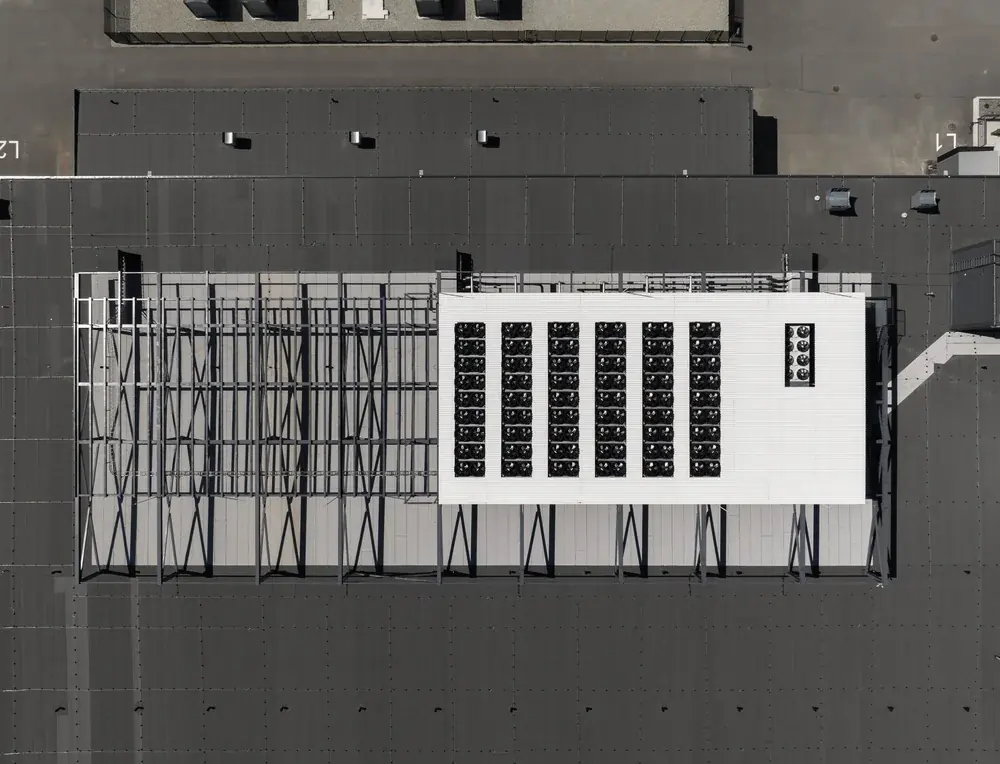
Cooling equipment on the roof of the GDC data center. Photo: Tõnu Tunnel.
Electricity is guaranteed in hot weather too
Let's start with electricity. The reliability of Estonia's transmission lines, transformers and other electrical equipment in hot weather is considered already at the design stage. The requirements assume in advance that the weather may be warmer than a normal Estonian summer and colder than a normal winter. So no separate measures are needed for hot weather. Transmission lines and electrical equipment are also inspected continuously to detect potential problems before they arise. So the power that IT equipment needs is guaranteed even in the summer heat.
Next we come to the IT equipment of various organisations. Literally the hottest place in summer is probably the server room, because the equipment receiving, processing and transmitting data runs constantly. Life on the internet boils 24/7. Server rooms requiring proper cooling are usually located in offices, in data centers or in clouds (which ultimately sit in data centers as well).
Temperature is one of the biggest risks in equipment hosting
"Heating, ventilation and air conditioning, which in our field is summed up by the abbreviation HVAC, is one of the most important sources of risk in equipment hosting," says Ardi Jürgens, one of the owners of Zone Media. Besides air temperature, attention also has to be paid to its cleanliness, humidity and much else.
Zone has been a customer of various hosting providers for more than 20 years, so Jürgens knows the pain points well, including the risks related to HVAC systems. "Fortunately those risks do not materialise often, but they have a very large impact when they finally do," he notes.
According to Tõnu Grünberg, chairman of the board of Greenergy Data Centers (GDC) in Hüüru near Tallinn, heat remains one of the greatest enemies of IT equipment. "When bad circumstances coincide, a hot summer can mean, above all, shutdowns in various office buildings due to overload or excessive temperature. When the equipment stands still, work usually stands still too, which halts the normal activity of organisations operating in the digital world," Grünberg explains.
The recent practice of building managers reducing the activity of ventilation equipment outside working hours can also have an effect. Instead of the expected savings, that practice can bring disaster in some rooms, because the IT equipment did not go home for the evening.
The situation has changed considerably in a couple of decades
Ardi Jürgens recalls that at the turn of the century, hosting premises in Estonia were often nothing more than a room in some building with good internet connections, with a few air conditioners nicknamed "penguins" mounted on the wall. "Conditions were somewhat more businesslike on the premises of the then Eesti Telefon, quite a few of which, as I recall, were in basements and in telecommunications buildings built in Soviet times, where, for security reasons, they naturally did not skimp on concrete," Jürgens says.
According to Tõnu Grünberg, who has long experience in the telecommunications sector, the equipment of twenty years ago differed above all in size and power consumption. "Back then a mobile base station took up a whole room; today the equivalent equipment fits in one cabinet. Cooling systems in those days had modest reliability and were as a rule not duplicated. If something stopped, everything stopped," Grünberg describes.
There is no question that the hosting field has developed enormously over the past decades: providers have become more professional, equipment more reliable and customers more demanding.
As a result, in Jürgens' assessment the likelihood of cooling-related incidents in Estonia has decreased overall, but compared with Zone's experience with providers abroad, they still occur more often here today. Jürgens names three main reasons:
• the need for computing power is great, and technological progress and the demand for efficiency force it to be packed ever more densely;
• a large share of Estonia's data centers are still located in buildings that were not built new for that purpose but adapted to it;
• climate warming is not a myth.
The team of the Baltics' largest data center has taken cooling-related risks into account as well. In their case the hazards were mitigated already at the design stage. "Our server rooms are designed and built on the logic that the power and cooling equipment has capacity headroom, and on top of that there are duplicate units in reserve. So we are ready for a higher load, and if something should happen, the backup systems take over," the GDC chairman points out the advantages of a building constructed as a data center.
In addition, the automation of the cooling systems has been entrusted to artificial intelligence created by Siemens, a computer program capable of learning, which operates the equipment that keeps the temperature in the server rooms. It is an innovative solution in a global context and means energy savings of about 25%.
"The largest chillers at GDC have a capacity of 1.5 megawatts. To draw a comparison from everyday life, the mobile phone charger we use daily has a power of 15 watts, so the difference is 100,000-fold. IT equipment in our rooms is very well protected from the summer heat," Grünberg adds.
We wrote on the blog last month about the reliability of the GDC data center and how to protect your e-business from costly outages.
The right server manufacturer helps mitigate risks, but the main burden falls on data centers
"If you asked me which hosting providers in Estonia I generally worry about, it would be precisely the telecommunications buildings that have been converted into data centers," says Ardi Jürgens. The operators of such "data centers" have to work much harder than the owners of new centers to come through extraordinary conditions with honour. Especially if they have been optimistic about climate warming and have therefore relied largely on outside air for cooling.
Jürgens wishes strength and stamina to all the HVAC technicians who have their hands full during heatwaves. "Our technicians are also on heightened alert during heatwaves to react promptly to possible incidents; we measure both the ambient and the server temperatures in the data centers in real time ourselves," he notes.
For Zone, the choice of server manufacturer also helps mitigate risk. "We have for a very long time used mainly Fujitsu servers, whose newer models are already designed, for environmental reasons, to run at higher temperatures," Jürgens says. Nevertheless, during heatwaves the main burden falls on the owners of data centers.
According to GDC chairman Grünberg, summer poses challenges for organisations operating in the digital field, but they can be overcome: "Just as it is worth putting on protective sunscreen before going to a hot beach, it makes sense to take preventive measures to ensure the reliability of your IT equipment and avoid heat-related outages."