
Published 24.3.2026
Why does a digital society need data centers, and who actually consumes the electricity?
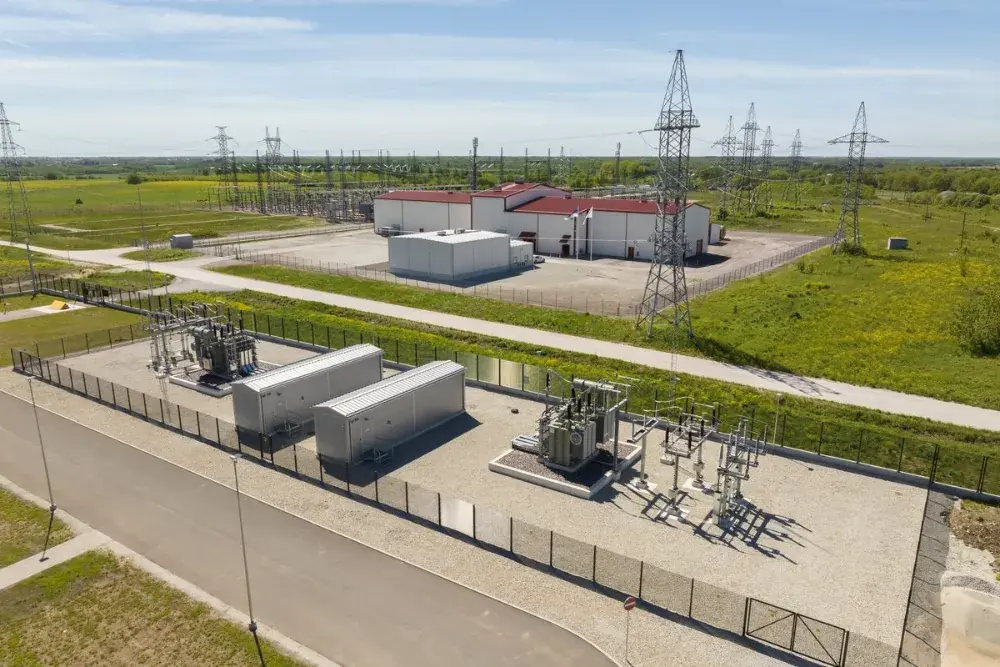
Estonian media has recently reported plans to build another large-scale data center here, one whose energy consumption would reach several hundred megawatts. That news has brought a question into focus: why do we need buildings that consume such enormous amounts of energy at all?
In this discussion, a data center tends to be seen as a mysterious concrete box that consumes electricity on its own. In reality, no data center consumes energy on its own initiative or for its own sake. That entire electricity demand is triggered every second by users' everyday digital habits.
Every digital action starts up a physical server
Keeping our digital society running is extremely energy-intensive. Every time you open social media, watch a series on a streaming platform, send a friend a message, or order food through an app, a server somewhere is doing work.
That is only the tip of the iceberg. Every card payment at the grocery store, every email you read, and every digital signature you give requires real computing power. What's more, you trigger electricity consumption even when you are not touching a smart device yourself. Visit your family doctor? The digital prescription generated by your visit, and picking up the medicine at the pharmacy, sets servers humming. Give blood? The movement of your test results from the lab to the Patient Portal, and their secure storage there, also happens in a data center somewhere. Our digital life triggers energy consumption every second, often without us knowing it.
A data center can be compared to a bridge, and data to the cars on it. The bridge itself does not decide which cars drive over it, nor does it create traffic out of nothing. But without the bridge, the cars would have nowhere to go. “The daily role of Greenergy Data Centers (GDC), the only modern large-scale data center in the Baltics, is exactly that: keeping this indispensable digital bridge running. The data center itself does not generate data. GDC simply provides uninterrupted power and the necessary cooling for the thousands of servers that keep our digital society running. Those servers only do work and consume energy when you click on something, somewhere,” explains Martin Rungi, GDC's key account segment manager.
The cloud is on someone else's computer
It's often assumed that the need for data centers is shrinking because everything is moving to “the cloud.” In reality, every cloud is a fully physical collection of IT equipment. When you upload your files to a cloud service, you are essentially just uploading them to someone else's computer, located in a carefully secured data center.
The same is true of AI's rise. Systems like ChatGPT or Gemini can answer our questions with apparent ease (and sometimes get them completely wrong), but enormous computing power lies behind that. To train AI and keep it running, technology giants are building server racks whose power demand exceeds 100 kW, comparable to the peak power draw of several ordinary apartment buildings. A regular back office cannot supply that kind of equipment with either enough power or the cooling it needs.
The solution lies in strict efficiency requirements
Since we have no intention of giving up e-government or digital convenience, the question of whether data centers are needed turns into a question of how efficient they are. Energy consumption is unavoidable; the question is how smartly and sustainably we handle it. Data centers are estimated to account for close to two percent of the world's total energy consumption today, and, driven by the rise of AI, that figure is growing explosively. That poses new challenges for power grids around the world.
Instead of banning them, the solution is to set extremely strict energy efficiency standards. Building new, modern data centers is actually a step toward a greener digital society. GDC, located in Hüüru just outside Tallinn, clearly sets an example here.
One of the main metrics for data center efficiency is PUE (power usage effectiveness). According to recent studies, the global average PUE has settled at around 1.55, meaning that more than 50% is added on top of the electricity reaching the IT equipment for cooling and system management. GDC targets a figure of 1.2 or lower, which makes its energy cost fully a quarter lower than the average.
Zero water use and 100% green energy
Besides electricity, data centers' water use is a global problem too. Large technology companies spend billions of liters of clean water every year cooling their servers (measured by WUE, or water usage effectiveness). Thanks to Estonia's climate, the GDC data center can use free air cooling, which means the facility's WUE is zero: not a drop of water is used for cooling.
The Baltics' largest data center already runs on 100% certified renewable energy today. The heat generated by IT equipment doesn't have to go to waste either. The building was built with the readiness to route that waste heat directly into the district heating network, to warm nearby homes.
In short: it is not the data center that consumes energy, but we ourselves, through our comfortable digital lives. For that lifestyle's ecological footprint to be as small as possible, our data needs to live in the most modern and energy-efficient conditions available.