
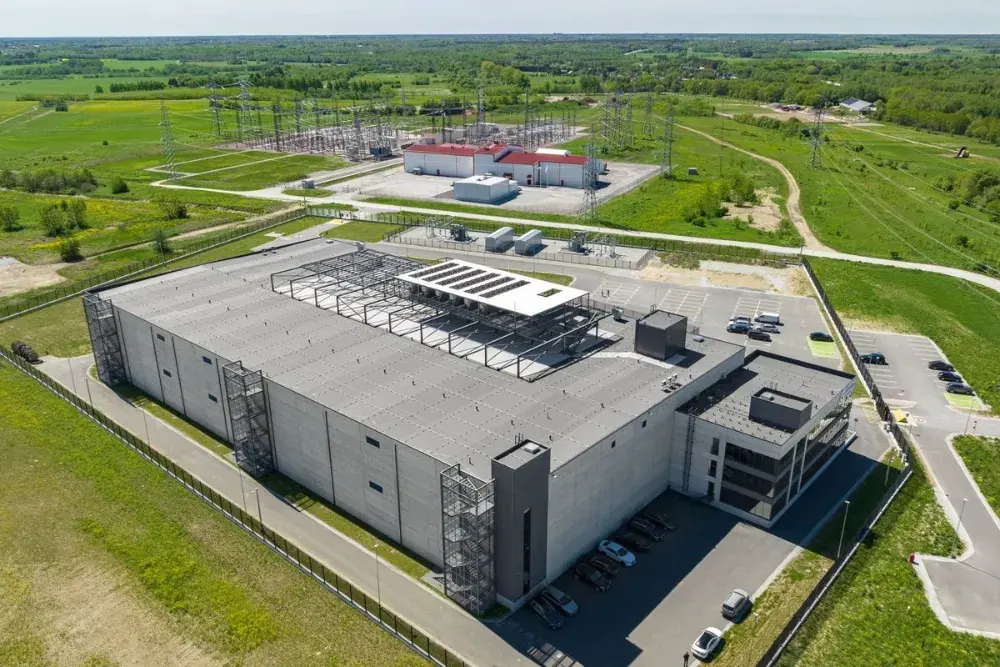
According to research agency CBRE, the major European data center markets have never before had so little supply relative to demand. There is a shortage of data centers and, more broadly, of power capacity. That pushes prices up and sends customers looking for alternatives. So attention is turning to more northerly regions, which have more renewable energy and a climate better suited to cooling systems. Energy there is also often cheaper than in Central Europe. What does Estonia, as one of the Nordic countries, have to offer here?
Enough power capacity
The energy needs of larger data centers can rival those of a mid-sized city. They use as much electricity as tens of thousands of households combined. While Estonia currently has one large-scale data center, Greenergy Data Centers near Tallinn in Hüüru, other parts of the world have considerably more. In some places, so many that building new ones has been banned for a time, because there simply isn’t enough electricity, or because transmission capacity is the bottleneck. There are even reports of new housing developments being held up by a lack of power.
This is largely down to AI’s explosive growth, which needs significantly more energy for its work than traditional IT systems. Since the equipment AI needs typically sits in data centers, this has a major impact on their energy consumption. Scala Data Centers, for instance, recently announced a data center complex with a combined capacity of a staggering 4.75 GW (for comparison, Estonia’s peak electricity consumption is about 1.6 GW)!
In Estonia, and in the Baltics more broadly, data centers don’t yet play a major role and make up a very small share of overall electricity consumption. That is also an advantage for the region, reinforced by the steady rise in renewable energy production. In 2022, renewables made up 38.5 percent of Estonia’s energy consumption, putting it among Europe’s top five. Under the Ministry of Climate’s targets, Estonia’s electricity production is to be fully carbon-neutral by 2040.
Estonia currently has the capacity to allocate tens to hundreds of megawatts of electricity to data center use.
Competitive electricity prices
Since energy is a data center’s main input resource, its price is critical. For a comparative picture, it’s worth looking at Eurostat statistics. In the second half of 2023, the European Union’s most expensive electricity for a business (with annual consumption of 500 to 2,000 MWh) was in Ireland (26.91 cents/kWh), followed by Hungary (26.08 cents/kWh), Austria (24.31 cents/kWh) and Liechtenstein (23.84 cents/kWh). In Germany the figure was 18.90 cents/kWh. On top of these numbers come grid fees, excise duties and taxes, which vary by country and can sometimes add up to as much as the electricity price itself.
In Estonia the price came in below the EU average, at 14.47 euro cents per kilowatt-hour (the average was 17.71 cents/kWh). Estonia also benefits from strong security of supply, backed by domestic production and two separate connections to Finland.
So the price of energy on offer in Estonia is quite competitive compared with other European countries.
A sustainable energy sector
When it comes to the green transition and the sustainability of its energy sector, Estonia is among the best, ranking in the top ten according to the World Economic Forum. Per the same source, Estonia has made rapid progress by prioritizing off-grid renewable energy to improve access to green power and the sustainability of the electricity grid. Among the countries in the top 10, Estonia’s progress over the past decade has been the fastest.
The same report also puts Estonia in the global top five for energy security, alongside the United States, Australia, Norway and Malaysia. The report attributes the high rating to mature energy infrastructure and a diverse mix of energy sources and import partners.
An environmentally friendly country
A Yale University study named Estonia the world’s most environmentally friendly country. The assessment covered 58 indicators across eleven categories, including climate action, air pollution, waste management, the sustainability of fisheries and agriculture, forest condition and biodiversity protection.
The logical conclusion is that operating in Estonia helps any business meet its ESG goals.
Strong connectivity to the rest of Europe
Estonia’s location on the edge of Northern Europe provides good connectivity to both Scandinavia and Central Europe, over both submarine and overland cables.
International giants such as Arelion, Cogent, RETN and others offer their services here, and connections can, if needed, be combined with physically separate routes. The Baltics’ largest data center, for example, has more than 10 connectivity providers, and the center itself is provider-neutral. That means every customer can choose the partner that suits them, or bring their own.
As close to Central Europe as Madrid
For many international companies, a fast connection to Central Europe matters. Physical distance plays a role here. In terms of distance, Estonia can be compared to Madrid in Spain, both are roughly the same distance from Frankfurt. Estonia’s climate, however, is far more favorable for running a data center energy-efficiently, with no need to use water in the cooling systems. At the Baltics’ largest data center, run by Greenergy Data Centers, the favorable climate means additional mechanical cooling is needed for less than 15 percent of the year. Cooling equipment usually just needs the low temperature of the outside air.
A developed digital society
Estonia also stands out for its highly developed digital society. Advancing the digital sector is a clear national focus, and it has earned the country global recognition and a reputation as the world’s best-known e-state.
Estonia’s strengths show up in its position on international rankings. For example, it ranks first on the DESI digital public services index (2022), third in cybersecurity indices (the National Cybersecurity Index and the Global Cybersecurity Index, both 2022), and it also ranks highly on innovation indices, ninth in Europe and sixteenth in the world (based on the 2023 Global Innovation Index results). This favorable business environment has put Estonia at the top for unicorns per capita, and employers rate Estonians highly for their entrepreneurial attitude and work ethic.
In short, Estonia and its neighbors have every prerequisite to grow their influence as providers of environmentally friendly, reliable IT infrastructure. Greenergy Data Centers is one of the first examples of that potential being realized.