
By the end of 2025, an estimated stack of DVDs almost as tall as the Tallinn TV tower will be created in data every day. Many organisations contribute to that, and all of them have to keep their growing data volumes somewhere. Broadly, an (IT) manager has to choose between a public and a private cloud. In the first case the service is often bought in from a large company (such as Google, Amazon or Microsoft), and for the sake of simplicity one accepts astronomical costs in the future and less physical control over one's data. In the second case the data is kept on one's own equipment in one's own office or in a data center, where an investment in hardware is needed at the start, but the result is sustainability for years with a reasonable cost base.
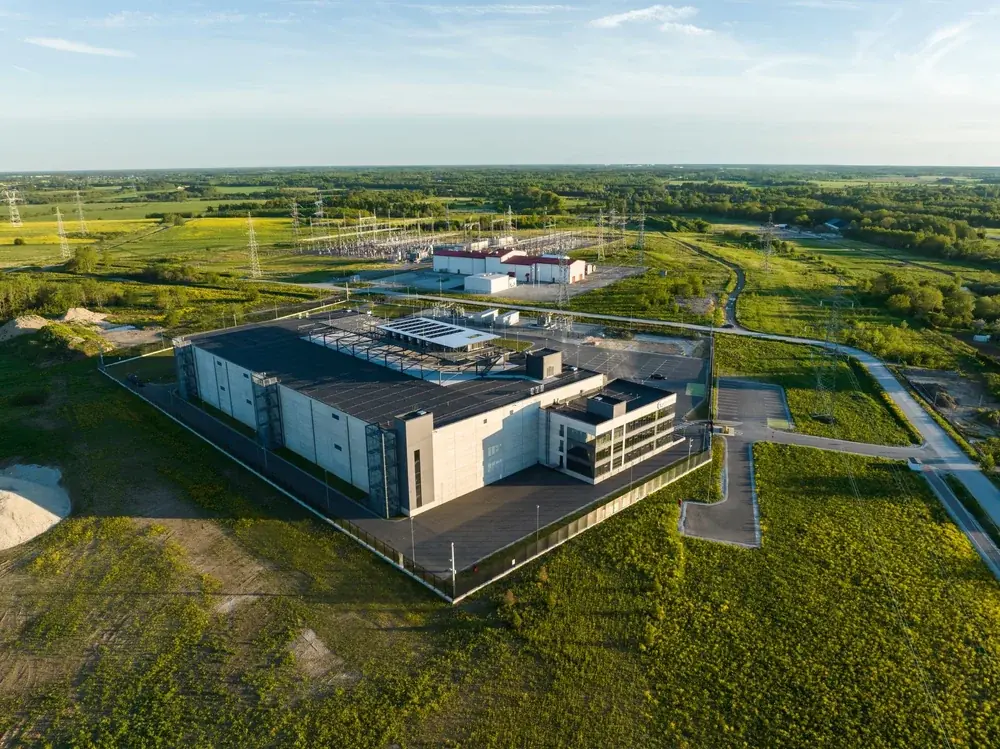
The GDC data center with the substation next to it. Photo: Tõnu Tunnel.
In favour of the public cloud are quick adoption and the flexibility to raise capacity for short periods. For tiny volumes, the price as well. The strengths of a private cloud are higher security, because the equipment and its location are under your control. If the private cloud is kept in a data center, a smart choice adds even better security, high reliability, a wider choice of connectivity providers and, at larger volumes, a better price too.
If you have decided in favour of a private cloud and a data center, how do you choose the most suitable one on the market?
A short cheat sheet
When choosing a data center, people often go by traditional selection criteria such as duplicated power supply, a good internet connection, an efficient cooling system and decent security. Since the choice is made for years, though, it is worth diving considerably deeper.
Power
- Ideally the data center should have several independent electricity connections to a substation of national importance. That is protection against a careless digger operator.
- In addition, UPS units to smooth out fluctuations and cover minor interruptions. It is good if the UPS units are distributed across the facility, otherwise all the eggs are in one basket.
- In addition, generators to cover longer interruptions. Naturally there must be several generators too.
- A modern data center uses only electricity from renewable sources.
- Power usage effectiveness (PUE) is 1.2 or lower. If PUE is below 1.2, then for every kWh that goes directly into running IT equipment, less than 20% is added for cooling, connectivity, security and reliability. That is an important component of the ecological footprint of your IT equipment.
- To reduce the ecological footprint, it can pass on residual heat for heating nearby buildings.
Cooling
- Like the power supply, cooling systems should be at least duplicated (N+1). A technical fault or maintenance must not affect the operation of your equipment.
- The data center keeps running even when the daytime temperature in Tallinn rises above 35 degrees.
- The cold air for cooling and the hot air removing residual heat are strictly separated, and the temperature of the equipment and the environment is under constant monitoring.
- The cooling system is smart and can make decisions itself, directing cold exactly where it is needed most. That is pure energy saving. AI-based solutions exist for this today.
Security and reliability
- The data center is in a secure location away from potentially hazardous traffic or industrial units.
- The outer perimeter and the interior of the data center must be equally well physically protected.
- Only visitors with special authorisation can enter the data center, and authentication is biometric. That means outward resemblance to the person on an ID card is not enough.
- 24/7 manned security. Ideally armed as well, to raise deterrence.
- The whole site is covered by cameras with motion and heat sensors whose images are analysed by computer, because even several people could not review that information in real time.
- The customer can add security to their server room or cabinet as they wish.
- The data center's infrastructure is separated from the public internet, so the system cannot be entered from outside and a device switched off.
- The rooms are guarded by various fire-prevention systems (fire alarm, VESDA, oxygen-reduced air in the server rooms).
- Equipment and automation are tested and maintained regularly.
Connectivity
- The data center is well connected to Estonia's communication hubs and to other countries.
- Communication cables enter the data center along different independent routes and from different network nodes. Again, protection against a careless digger operator.
- The data center is carrier-neutral, meaning the services of different companies are offered on equal terms. If desired, several partners can be used in parallel.
- Carriers can compete freely in the facility, which creates the conditions for better price offers.
Convenience
- There is room in the data center to grow and to expand your IT footprint significantly when needed.
- The facility is in a good location logistically. It is convenient to get to.
- Customers have decent workrooms, storage, staging rooms, meeting rooms and break rooms at their disposal, so nothing has to be done on your knee.
- The facility operator can receive and store your goods.
- Equipment can also be managed remotely, meaning you have 24/7 support from the data center's specialists, who carry out your work orders.
The more points you can tick, the better prepared you are for the future. The whole modern economy runs on electronic communication and data, so you can regard your IT equipment as key employees. The better they feel, the better the results.
Greenergy Data Centers, the largest and most secure data center in the Baltics, either already meets these requirements or is about to. According to sales director Urmo Kanger, the bar has been set as high as possible: "The goal is not merely to be up to standard today but to meet high demands in five years' time as well. That is why future-proofing has been written into our design from the start, and the platform for keeping up with the times is excellent," Kanger describes. In his words a data center is like the city of Tallinn, which is never quite finished, because technological progress and new possibilities constantly move things forward, and services are continually developed together with customers and partners.