
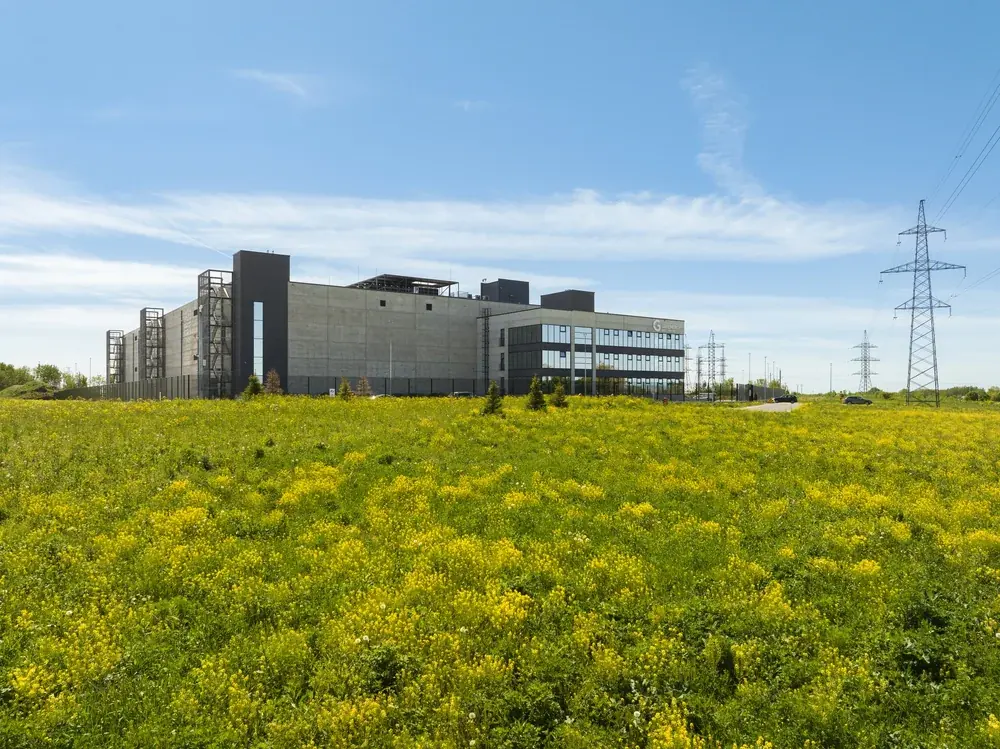
Keeping our digital society running is energy-intensive. Very. An estimated three percent of annual global energy consumption goes to data centers, where the internet we see on our digital devices physically lives. The aviation industry's energy use, for example, is of roughly the same order. It is forecast that by 2030 the share may have risen above ten percent. So there is no question how important it is for data centers to use green energy, and to use it as efficiently as possible.
The Greenergy Data Centers facility in summer. Photo: Tõnu Tunnel.
Although the sustainability of data centers has received ever more thought in recent years, and progress has been made, designing, developing and operating truly green data centers remains a major challenge. The transition to carbon-free data management requires changes in how infrastructure is planned and built.
How is a data center's energy efficiency measured?
Data centers and server rooms must meet high energy-efficiency standards tied to PUE (Power Usage Effectiveness). The lower the PUE, the better. In Europe, new data centers that have joined the Climate Neutral Data Centre Pact have a 2025 target of PUE 1.3 in cool climates.
What does that mean? If the PUE is below 1.3, then for every kWh that goes directly to running IT equipment, less than 30% is added for cooling, connectivity, security and reliability. The corresponding global figure in 2021 was 57% on average.
In warm climates the target is 1.4: in the heat, cooling inevitably takes more than in the cool. The same targets apply to existing data centers, but by 2030.
The Greenergy Data Centers (GDC) facility in Hüüru next to Tallinn, opened this winter, targets a PUE of 1.2 or less. That means electricity costs a quarter lower than in an average data center. GDC's aim is to use electricity as efficiently as possible.
Ideally every organisation should know the ecological footprint of its data, regardless of whether its servers sit in its own office, in the cloud or in a data center. That footprint is probably easiest to calculate in a data center.
Data centers are thirstier than you would think
Several factors play a part in a data center's environmental footprint. Energy consumption is a large part of it, but by no means the only one. Data centers also consume water, and in larger quantities than you would probably guess. In the 2018 financial year, for example, Google used 15.79 billion litres of water and Microsoft 3.5 billion litres, most of it in data centers.
It is no surprise that the availability of water is a serious problem in the context of climate change, especially in so-called third-world countries. Global water use has grown sixfold over the past hundred years and grows by 1% every year. So if water use could be cut back somewhere, that would be good. There is a separate coefficient for water use efficiency: WUE (Water Usage Effectiveness).
Where does all that water go?
The problem is that most data centers use water for cooling, a constant water cost (and an electricity cost too, since the water first has to be chilled). Cooling water is sprayed into the air or evaporated so that heat is carried away from the servers more effectively. In the latter case the water has to be heated to evaporate, which also consumes electricity. A relatively small 1-megawatt data center uses on average 26 million litres of water a year for such cooling, writes the research-based website The Conversation. The hotter the climate the center is in, the more cooling is needed.
The GDC data center in Estonia points the way with a different solution: no water is consumed for cooling, because the building uses free air cooling. That means GDC's WUE is already zero (in many other places people struggle hard to bring that number down).
Here we should thank our poor skiing weather, because Estonia's climate is exactly right for a data center. Data centers must be neither too warm nor too cold; an optimal range is needed where you neither have to cool nor heat all year round. In Estonia there are on average only a couple of hundred hours a year when free air cooling needs a supplement. We have written earlier on the blog about the GDC data center's cooling systems and how they help ensure reliability.
Reusing heat energy
In a data center, the operation of IT equipment turns electrical energy into heat. That heat can in turn be reused. In practice this means, for example, directing waste heat to a nearby heating plant, from where it is distributed to households. That saves a great deal of the energy normally spent on raising the temperature of homes. Facebook's data center in Odense, Denmark's third-largest city, for instance, should be enough to heat 6,900 local households all year.
In Estonia a similar capability has been built into the GDC data center, and once sufficient load is reached the heat energy produced there can begin to be reused.
Electricity has to come from renewable sources
Today it has become the standard that data centers run (or at least should run) on certified green energy. The Climate Neutral Data Centre Pact mentioned earlier stipulates, for example, that 75% of the centers' electricity needs be covered by renewable or hourly carbon-free energy by the end of 2025, rising to 100% by the end of 2030. The Baltics' largest data center, GDC, already runs solely on certified green energy.
In summary, data centers have a growing role in achieving ambitious global climate goals. The more energy it takes to support our digital way of life, the weightier the ecological footprint of data centers. Customers' choices play an important role here too: the more energy-efficient data centers are preferred, the more of them get built.