
Published 6.2.2024
What does a working day look like in the operations center of the Baltics' largest data center?
Every website, online shop, Facebook or other service on the internet has to physically be somewhere. As a rule that place is a data center, where service providers install their equipment.
At the heart of the data center is an operations center that keeps watch around the clock to make sure the whole machinery works as it should: that the climate systems keep temperature and humidity within the required limits, that voltage and current do not fluctuate, that nothing overheats, that the doors are locked and that nobody moves about the building who should not be there. The list could go on for quite a while.
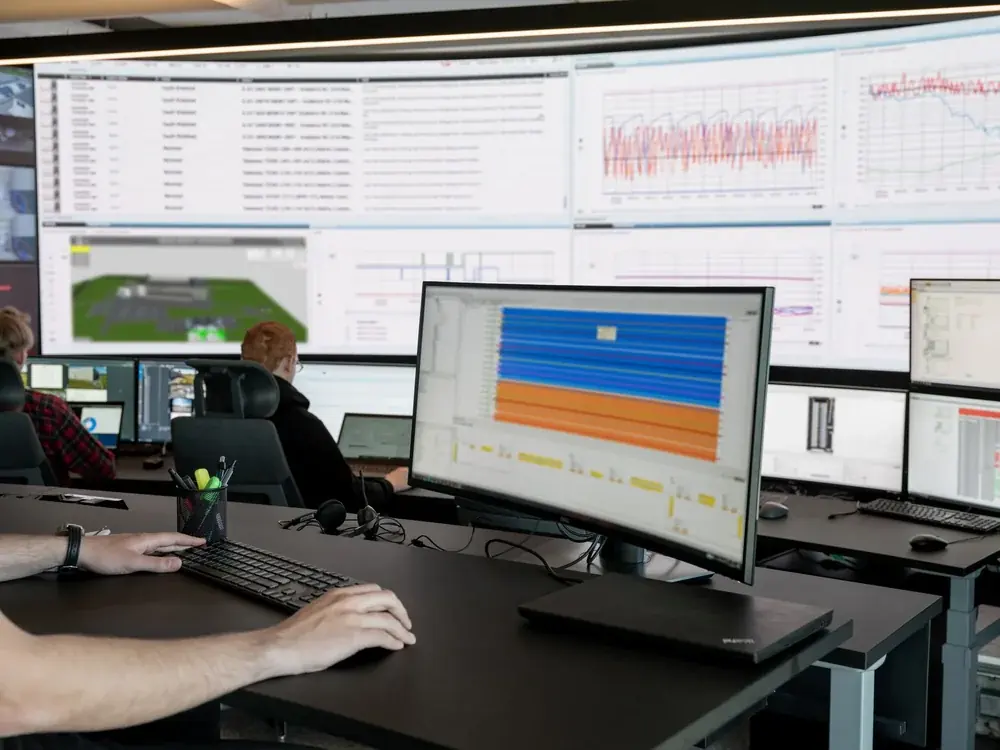
The screens of the data center's operations center show plenty of visualised information. Photo: Tõnu Tunnel
In the operations center of the Baltics' largest data center in Hüüru on the edge of Tallinn, those duties are shared between five engineers. "When our system works, the customers' equipment works too and the whole world can consume all kinds of digital services without worry," says one of the five. In line with the company's security policy we withhold the name of the engineer who introduced the work of the operations center.
Something is always beeping
The whole working day is accompanied by ceaseless alarms, not because something is constantly "on fire", but because the equipment and systems continually report in, and regular maintenance and work take place. Information reaches the operations center from more than 3,000 sensors. "The building breathes!", as they say in the operations center.
Take temperature: to keep a room (not only in a top-class data center but why not at home too) at a set temperature, it has to be either heated or cooled. Every time the temperature rises and the cooling switches on, the engineers in the operations center receive a notification. A quiet moment when nothing beeps is rare in the work of the operations center.
The best tester of the water-leak alarm is said to be the cleaner: as soon as they run a mop over the floor of the service corridor, an alarm arrives in the operations center. "The camera also throws up a picture of where the cleaner is moving. If a hare or a roe deer moves behind the fence at night, we see that immediately too. That way we know all the systems are working," says the engineer. If you put such sensitive sensors in your own home, you could not pay the security company's bill. In the data center you cannot even strike a match without something raising an alarm.
The data center could manage on its own
In theory the operations center would not be needed at all. "This building is so thickly packed with automation from end to end that it could manage by itself. The NOC (network operations center) staff only make sure everything works as it should and consult specialists when needed," says the operations center engineer.
At Greenergy Data Centers, though, the operations center staff are not merely dispatchers who receive a notification and pass it on; when needed they get hands-on themselves. "During the day it is easy: you go to the next room and ask the technical department for help if you cannot get to the heart of the matter yourself. At night, when nobody else is in the building, you have to work it out yourself and decide whether to wake up a specialist or whether it can wait until morning," says the engineer.
Greenergy Data Centers opened its doors at the beginning of 2022. In two years it has not yet happened that an operations center engineer had to call someone in at night. "At night we have had to phone and have received instructions. For example: watch this temperature until morning. If it drops lower, call again. Then you focus your monitoring on that," the engineer says.
Formal education does not provide all the knowledge
The particularity of the operations center engineer's work is that specific IT knowledge is not enough here. Nor is training as a cooling engineer or in power engineering alone.
"In a data center you need knowledge of electrical, climate and cooling systems. On top of that, managing IT and security systems. We have an oxygen-reduction system for fire prevention and a gas extinguishing system for putting out a highly unlikely fire. A NOC engineer has to be able to relate these systems to each other and grasp the wider picture," says the engineer.
A simple example: if the system raises an alarm that the temperature in a room is too high, the engineer has to track down what is wrong. Is a cooling unit not working, has a door been left open, and so on. You have to be able to deduce the causes.
To help customers you need to know how different IT equipment works. If a customer calls at night to say some device is not working, you go and check whether the right lights are on, restart the device if the customer wishes or replace a part (fortunately video calls have been invented, so more precise information can be obtained from the customer).
So it is no wonder that no school diploma delivers a NOC engineer's knowledge base. "The range is so wide that you could not attend every school to learn it," says the engineer, whose first technical education is from Tallinn Polytechnic School… though not in any of the fields mentioned above. "I have held many different jobs, from telecoms fitter and telecoms technician to engineer. My father worked in construction, so I have been somewhat familiar with building (electricity, climate and so on) since I was small. I have learned more on the job," the man explains where his store of experience has come from over the years.
That does not mean only people with decades of work experience get a job in the operations center. Young people straight from university are often faster learners, because the study habit is still fresh. "Often someone who has worked in one field for decades does not want five more topics on their plate," the engineer says. The work of the operations center is also a good springboard for a young person. "Here you get the grounding. For example, on the job you understand what attracts you more. If automation attracts you, you go on to become an automation technician or engineer," says the engineer. There is always the possibility to move within the company too.
Falling asleep is not possible
Work in the operations center is organised in 12-hour shifts, nine to nine. During the day there is more bustle: customers have to be received in the building and helped with various questions and concerns. How much action is there on night shifts? "Hopefully not much action; I have noticed that when I come to work at nine in the evening, the period of active work lasts until about one. After that you may start making mistakes; staying awake at night tires the mind. It is not for nothing they say a sleepless night equals mild intoxication," the engineer says.
"Around six in the morning, when nobody has come to work yet, sleep may start creeping up. When the first people arrive at seven, you go to the next room, exchange a few words and the sleepiness is gone," the engineer recounts. It has never happened that someone actually fell asleep at their post. "You cannot fall asleep here; some notification immediately starts shouting and gets you up!" he laughs.
Night work does not suit everyone. The plus, as with any shift work, is more free time. An operations center engineer works two days and has three days off.
In summary, engineering work in the operations center of the Baltics' largest data center is intense and full of challenges, but above all it is a field with prospects that builds a versatile store of knowledge. There is a lot of data and more keeps coming, so work in data centers will not run out any time soon.