
Published 20.12.2024
What challenges did 2024 bring? Toomas Kell, one of the leaders of Estonia's most modern data center, opens up
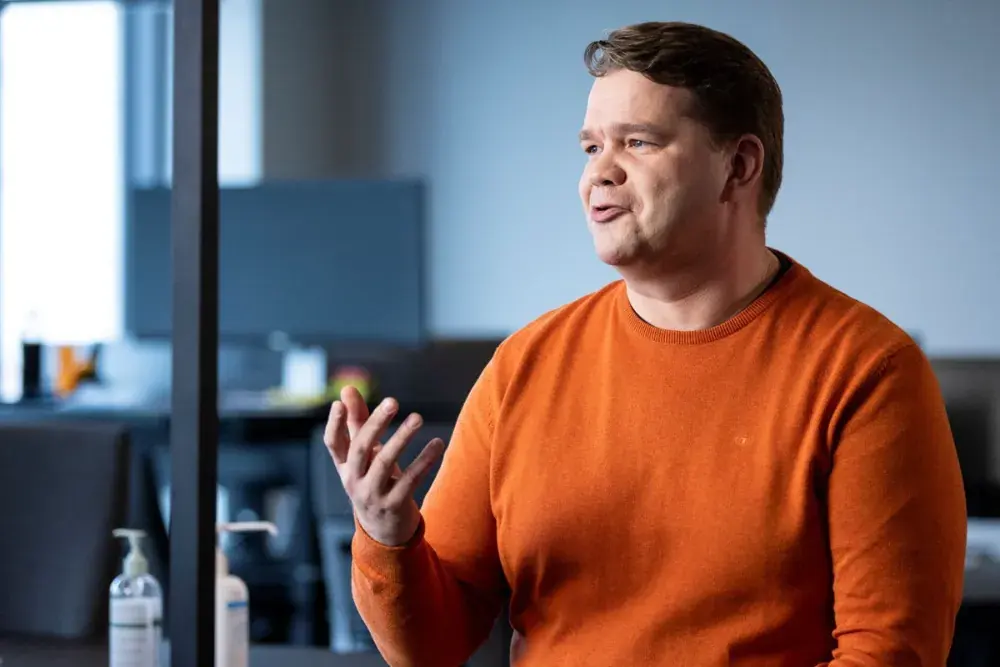
There was a time when you could build a server farm and then quietly sell it off space by space. In today's world, the winner is whoever adapts fastest. You can't plan too far ahead, is what Toomas Kell, operations and technology director and board member of the Baltics' most modern data center, has learned from the year now ending.
"There aren't many Estonian companies that can show 100 percent growth over the past year," he notes. What is the trick behind Greenergy Data Centers pulling that off?
In this year-end interview, Toomas Kell talks about what the rise of AI has actually changed, how to keep pace with EU requirements, and how he views the year ahead, one that brings tax increases and major shifts in world politics.
How much has the rise of AI changed your work? How much can leaps like this be factored into business plans in advance?
The classic hosting service used to work like this: you build the room and the infrastructure, put in, say, 100 rack slots, and then start selling until the room quietly fills up. And that was that.
In today's world, it's fairly unthinkable to build a lot of infrastructure far ahead of need. AI hardware technology is advancing at a furious pace, day by day. If a client comes to us today and says they want 10 megawatts of power and cooling capacity, using specific processors, by the time we've worked out a technical solution, how to build the room, what cooling is needed, where to route the cabling, a new processor type has already come out. In the worst case, that means starting the whole solution from scratch again.
That means you can't plan too far ahead, but at the same time you have to be very fast, flexible, and able to build out as quickly as possible. That shift in mindset has been the biggest change for us, the one we're least used to. We're trying to adapt to the new situation.
Adapting to new situations has followed you from the start. The war in Ukraine began the same month you opened your doors. Have difficult times proven your strengths, or exposed weaknesses?
I believe both. The start was tough, because we were built on the premise that we sat at the crossroads of trade between east and west. Russia's invasion of Ukraine automatically turned Estonia into a periphery.
This cascade of crises has created a great deal of fear in people, but from our point of view, opportunities too. One new fear that's become much more prominent in recent weeks is disconnecting from Russia's electricity grid. Lately, people have been asking more often how long our fuel reserves will last. At moments like that, it's good to be able to put those fears to rest and meet every client's needs.
This autumn we actually went through the not-so-easy exercise of reviewing our headcount. It's a hard truth to admit, but we actually manage perfectly well with fewer people. By setting clear priorities and valuing each other's time, we get all the routines that ensure service quality done more efficiently and more transparently. That has given us a fresh start, and our financial results have improved too.
How has the outgoing year gone?
Fairly well. Compared with a year ago, volumes have roughly doubled. There aren't many Estonian companies that can show 100 percent growth over the past year.
Internally, we've spent a lot of time optimising and refining our processes and how the organisation works, to achieve even better cost efficiency and, through that, give clients the best possible price-to-quality ratio. The goal is to cut away parts that don't make sense in day-to-day work. It's been a year of difficult choices.
At the start of the new year, you'll mark three years in operation. How have expectations of data centers changed over that time?
A data center's ability to respond to client requests matters more and more. That's a new nuance that has emerged over the past year. Clients want as much as possible, as fast as possible. While negotiations with larger public sector or business clients can take up to a year, AI and HPC (high-performance computing) clients want to sign within a very short time, reaching in three to four months a volume we would normally build up over a year or two. One of the biggest requests to land on our table this year was for 22 megawatts of power. That's practically double our current maximum capacity. They asked whether it could be done in six months.
That's an entirely different playing field from our usual hosting service, the one we've focused on so far and built our strategy around. There are a great many different nuances involved. As data volumes and computing power grow at a furious pace, the power density of equipment racks grows too. That, in turn, brings a chain of new challenges: how to cool the equipment, how to secure power and connectivity, and various operational questions, among others.
How prepared are you for these challenges?
Fortunately, we're in a good position, both at the national level and at our location in Hüüru, where dozens of megawatts of power capacity are still available, now and in the future. In London, Frankfurt, Dublin, Paris, Amsterdam and elsewhere, we're already seeing data center projects put on hold or even stopped outright, because there simply isn't enough power left even for the local population and the infrastructure that supports it. In that sense, we're in a fortunate spot.
Where are we less fortunate?
Our big drawback is the geopolitical situation. Nobody is rushing to get here.
Compared with the Nordics, our energy is also more expensive. That's why there's currently pressure to build data centers in Finland, Sweden, Norway and Denmark, where energy is in places even half the price of ours. That's probably not going to last very long though, given the pace at which load is being added there. Compared with Central Europe, on the other hand, we're still doing very well.
What role does Greenergy Data Centers play today, and what added value does it offer the market?
We remain the foundation of Estonia's e-society. Our goal is to guarantee our existing client base, in Estonia and elsewhere in the Baltics, connectivity, security, power, and a building and operation that meets international requirements.
Looking to next year, ESG will only become more prominent. That means outsourcing this kind of service will sooner or later become unavoidable, doing it in-house simply gets too complicated. Even today we see our clients asking more and more compliance questions.
This year, eight large companies had to file a sustainability report. Next year, there will be more than three hundred. That puts company leaders in front of a difficult choice: try to achieve compliance with every requirement themselves, and there are a great many, or move certain activities outside the company.
How do you make that choice when the moment comes?
That's where it matters who is certified and who isn't. Experience shows that European Union regulations, whether ESG or the EED (Energy Efficiency Directive, editor's note), will increasingly constrain us in the future. We've done a lot of groundwork so that we fit within those limits with as little effort as possible.
Not a day goes by without someone asking us for advice on how we've solved something. People also come to see and learn on site. We're not talking about schools and universities here, but rather fairly closed organisations, institutions and working groups who come to take a look at what we do.
It's also happened that during the certification of our building, it turned out the certification requirements had to be adapted to us instead, since in places we're a step or two ahead of the requirements. In the Baltics, we're definitely setting the direction.
You've talked about plans to expand outside Estonia. Is that already a focus?
We've reached a certain plateau and learned the lessons we needed to take the next step. Today we're already quietly working toward setting up the next data center somewhere, and that location definitely won't be Estonia.
Does that mean the Estonian market is becoming too small?
Our market isn't just Estonia. Of course the goal is to get the most out of the Estonian market, but in our view, the larger volume will still come from outside Estonia's borders. These days, it doesn't much matter whether a data center sits in Helsinki, Stockholm or Tallinn. It doesn't matter to us where the client is, either. Some services do require proximity, but the question of latency is often overblown. In reality, it makes no difference whether ChatGPT answers 0.001 milliseconds faster or slower. Unless it's a life-critical service, such as driving a car online, which needs very low latency, it genuinely doesn't matter.
We've written before on the blog about where data is a matter of life and death.
How do you feel looking toward the new year? New taxes are coming, and the political situation in the world is shifting.
At the end of every year, I look toward the new one with a fairly positive and hopeful outlook. In this business, we've learned one thing clearly: you have to adapt an awful lot, and the faster you do it, the better. You can't rebuild the building itself, but there's plenty of room to adapt in how you operate the business.
From the company's perspective, it's certainly important that we have the strength, both mental and financial, to keep delivering all of this and keep going with enthusiasm. If the spark disappears from your eyes, something's wrong in the house.
We live in exciting times, and there's a lot of change happening. As a technical person, what interests me most is the sheer speed at which things change in the technology world. Over the coming years we'll be focusing heavily on foreign markets, and we're trying to bring in a couple of larger clients who bring several megawatts at once. Making sure we can deliver the whole process, from design and build-out through certification to operating the entire concept, that's the most exciting part for me: making sure the whole thing still works exactly the same way a year from now, when we're having this conversation.