
From an IT perspective every manager has three choices: keep the equipment critical to the organisation on their own premises, in a data center, or not own IT equipment at all and move the IT systems to the cloud instead. As a rule it is a fundamental choice that one sticks with for years. One of the decision criteria here is naturally price.
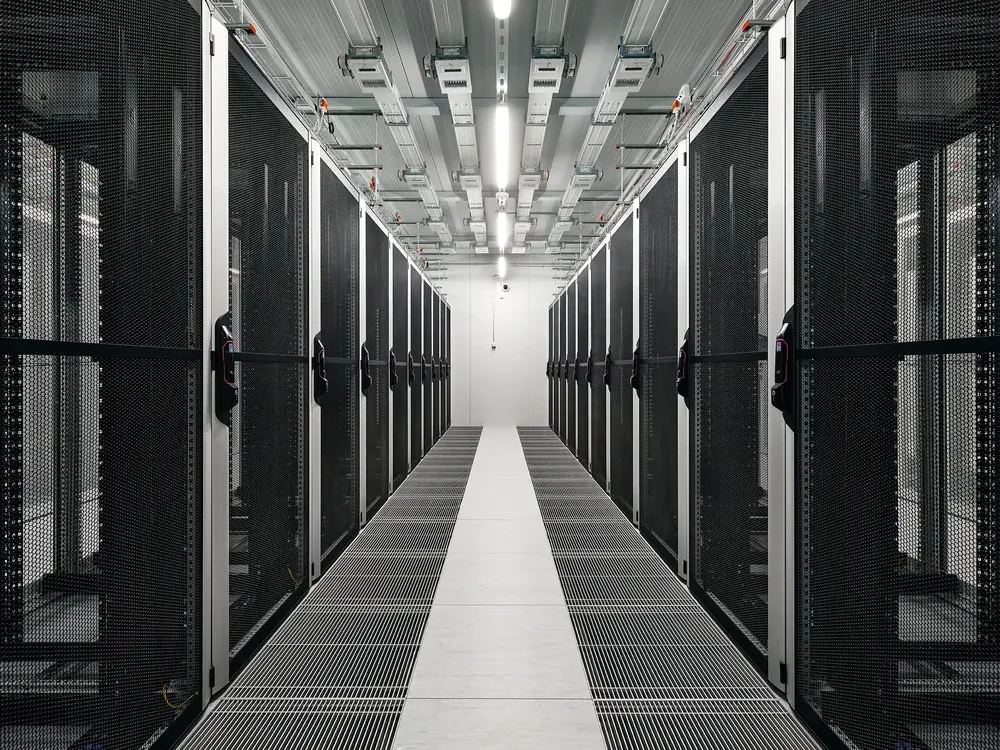
A server room for 40 racks. Photo: Tõnu Tunnel.
While to learn the price of a data center service you simply ask for a quote, and the cost of the cloud can be found out from another organisation with a similar profile (to get a real-life view), with building a server room the story is somewhat more complicated. Since our staff have that experience, we have done the work for you. Below you will find the answer to how much it costs to build a modern, reliable, future-proof and energy-efficient server room, what steps the process consists of and how long it all takes. A well-made server room successfully passes reliability, energy efficiency and security audits alike.
What do we mean by a server room?
Here a clear distinction must be made between a server room and a communications room, to which requirements several times more lenient apply. In building the latter, many steps that ensure energy efficiency and high availability are skipped, and the price falls accordingly. Rooms of that type often contain only cabinets and, at best, air conditioner(s) and UPS unit(s), and conscious (or unconscious) compromises are made on reliability and cost-effectiveness. With that solution there is often no overview of actual energy consumption either, because it goes into the general electricity bill.
Nor is it rare for communications rooms to quietly grow into server rooms. So the costs are spread over a long time and the total cost is in fact unknown.
A proper server room built for at least ten years includes from the start a room or rooms built for that purpose, with duplicated power (such as a backup generator) and cooling system, a proper fire-prevention solution (approved by the Rescue Board as well) and monitoring and security systems. All systems are maintained and audited regularly, which besides security and reliability also secures the certificates that support the business.
How to decide whether an organisation needs a server room?
It all starts with a risk analysis: what are the expectations of the services and of the equipment serving the IT systems, and which threats are acceptable. Is a couple of hours of downtime acceptable, for example, or is 24/7 reliability without any deviations expected? If services and equipment have to run 24/7, duplicated supporting infrastructure, that is, communication and power connections and cooling systems, must certainly be considered. When operating on your own premises you also have to know in advance how large you will grow, because later expansion of the server room and supporting infrastructure is quite complicated and costly. Besides the growth of the IT footprint, the growth of staff must also be taken into account. If the number of employees means the office space has to be changed later, taking the server room along can be quite a headache.
"I know of examples where a company built a server room on the fifth floor of an office building. When the rent and the size of the space no longer suited at some point, they wanted to move. The office owner demanded that everything be moved out. The server room too. If you go, you go with all your things. Moving it, however, was not possible because of services running 24/7. So they sat on that space for 15 years and rented additional space in other buildings nearby. In the end all new equipment was bought and a new server room built at the new location, and the move became reality," says Kert Evert, one of Estonia's most experienced builders of server rooms, from his own experience.
"A fairly common scenario for growing organisations is as follows. You start with one rack, it becomes two and then three. Then you discover there is not enough cooling capacity and rebuild it. Then there is not enough electrical capacity and you rebuild that. And so the snowball rolls. Somewhere in every building, though, a physical limit appears and you can no longer expand. So when building yourself you have to be able to assess your growth potential or build in parallel a system that can house further growth," explains the head of development of the Baltics' largest data center.
The process of building a server room
As always, everything starts at the beginning, with the brief. Its input has to come from the organisation itself. For example, it is decided that four racks of 6 kW are enough for operations (in reality that means operating at a maximum of 4.8 kW, because a workload of up to 80% is usually assumed). "The alternative is to inflate the capacity just in case and opt for 8 kW racks (the cabinets in which servers, storage and network equipment are placed), for example, but that means considerable extra cost, because electrical and cooling systems are built that will not be used to the full for a long time. The investment, however, has to be made right away. Running more powerful equipment also uses more energy, so the efficiency figures of the whole system are lower and the ecological footprint of IT heftier," Evert explains the background of that scenario.
Once the brief is together and the necessary decisions made, the design phase begins. The design has to cover power, cooling and ventilation, dimension the UPS units, choose the fire safety solution and the security systems of the equipment rooms, and decide on backup power, which may be diesel generators with fuel tanks, for example. In addition, one has to bear in mind what requirements the server room places on the building more broadly, both structurally and, for example, in terms of fire safety. If the organisation has a project manager who deals with the matter daily, designing a server room in an office building takes about six months. That follows from the fact that the whole is ultimately made up of several specialist designs. Each field is drawn up by the relevant specialist.
If the aim is the best end result, the next step is validating, that is, evaluating the design. For that an external consultant has to be hired to check whether the designers of the different parts have taken everything into account and arrived at an end result that meets the standards. A good example here is accounting for the effect of short-circuit currents on the server room. If a kettle in the office kitchen short-circuits, for example, how does that affect the IT equipment?
Validation is followed by procurement. The procurement process is as a rule more complicated than design. Where the design was probably put together by five or more specialists, now exactly the right person has to be found to review and evaluate the incoming offers and confirm that what is offered matches the design. The alternative is to leave that task to the project manager, but they then have to be experienced in very different fields, and such people are few. The third option is to hire an external consultant to do that work.
Once the tenders are done and the best among the bidders identified, the detailed design must begin, which now takes the specific products into account. With the completion of that work a detailed understanding also emerges of how much everything will cost.
Why does the price only become clear so late?
The price depends on the products chosen, and the systems needed for their operation can only be settled based on the equipment's requirements. So the final price emerges only after the detailed design. "Let me give a real-life example. You chose between different UPS units, and the one that seemed most suitable and coolest lacks protection against short-circuit currents. That means adding a separate switchboard. If it turns out a switchboard cannot be added after all, different UPS units with short-circuit protection have to be chosen. But those cost more," Evert illustrates. All in all, the active planning phase may end up taking 9–12 months. For a smaller server room the time may be shorter, but not significantly. All these steps still have to be gone through regardless of whether you have 4, 40 or 400 racks.
Design is followed by construction
Then the construction schedule becomes clear, which follows from the detailed design and the delivery times of equipment and installers. "For example, the waiting time for UPS units can be 3–6 months. So a suitable supplier has to be found who can deliver the equipment to the construction site at exactly the right time so that the work does not stall. Getting all the equipment suppliers in sync is, in my experience, quite a challenge, but certainly doable," Evert shares.
Then construction begins, the duration of which depends on the size of the server room and the equipment chosen. In an ideal world this is the simplest phase, because all the nuances were covered in design. "For example, when a 3D model is used, the problematic spots where different systems get in each other's way or otherwise do not fit together have already come to light and been resolved," the server room expert advises.
In construction, the fees of the various experts who accept specific works and confirm them with their signature must also be counted as a cost.
"During construction there will certainly be decision points that need quick resolution. Here the site manager's knowledge may not be enough, and to move forward help then has to be sought from experienced consultants. Any delegation of responsibility is as a rule again tied to considerable costs," Evert gives an example from his own experience.
Certifying the server room
For an organisation with international ambitions this is elementary today. The certification process starts already with planning and ends with checking the working server room. For example, to obtain the EN 50600 certificate for a data center, the facility must operate without problems for at least six months. Obtaining the certificate or certificates usually requires hundreds of pages of documentation, and considerable costs come with that too. Keeping the certificates, that is, conducting future audits, must also be added to the running cost line.
Running costs
The final cost of a server room should also include its running management costs. One of the most important components is regular testing and maintenance of the support systems created. A generator, for example, is only useful if it is regularly maintained, checked and guaranteed to be in working order. Periodic replacement of fuel must also be ensured when the load is low.
Regular maintenance usually means contracts with various partners who then visit the site according to the agreements. The running costs must also include the salary of the person managing the server room, and since someone always has to be on hand, at least two experts covering for each other have to be found.
Total cost
An overview of the work stages described above and the costs of managing a modern server room with 4x6 kW racks (holding about 75–100 devices such as servers, disk arrays and network equipment) is in the following table. Prices are indicative and given as orders of magnitude. Exact figures naturally depend on the details of the project.
Generalising from that, it can be said that the cost of construction is around 850,000, and the rest is made up of operating the data center over 10 years. Bear in mind that the smaller the server room, the higher the cost per kW or MW.
In general the rule in the data center world is that building 1 MW of Level 3 (or Tier III) data center costs about 10–12 million euros for larger projects (according to DC Byte, a company focused on data center market analysis). While before COVID a fall in prices was already noticeable, the crises that followed one after another have turned prices upward again.
To assess whether building yourself makes sense, it is always worth comparing it with the alternatives. For example, buying the same volume of service from a top-level, certified data center is about 40–50% cheaper.
In summary, the solution chosen as a rule depends on the organisation's needs, risk analysis and the possibilities of its own premises. We are happy to help with total cost calculations and with compiling comparison tables that take the various details into account.