
Published 21.7.2022
"This is all very interesting, but we have seen enough of your kind", or how Estonia's first world-class data center was built
"This is all very interesting, but please come back when we can walk around your building ourselves. We have seen enough of your kind," was the usual answer 4 years ago when Kert Evert went round Estonia's large companies presenting the idea of moving, in a couple of years' time, into the first modern large-scale data center to be built in Estonia. Few believed a project of such scale would come to fruition in a small country like Estonia. The required investment was enormous, there were no specialists in the field and a market for such capacity had yet to be created. The doubters were wrong.
Kert Evert on the data center construction site.
It all started with telephone relay exchanges
"I was about 7 years old. At the time Tallinn's telephone service still ran on relay exchanges, where you could connect people by plugging wires into the wall. Younger people have probably only seen those strangely clattering exchanges in films. My uncle worked in one such exchange and took me to work with him from time to time. That environment was very captivating. My home too was full of all kinds of bits of technology, which at the time I only knew how to take apart," Kert Evert, the originator of the idea of the Baltics' largest data center, which opened in February, describes the moments where it all began.
Evert, who has worked in the telecommunications sector all his life, has over 20 years probably climbed almost every mobile mast, apartment block roof and dim basement, wherever IT equipment needing installation or maintenance was located. "Together with my small team I have, for example, replaced 700 Tele2 base stations one after another. Essentially that meant taking down and putting up a whole network piece by piece," Evert gives an example.
With his involvement the first truly modern server room in Estonia was also built in the early 2000s, and the first experiences came of what it means when the roof leaks in buildings not built for the purpose and water drips onto the equipment. That does not mean just a bad day for the machines; ultimately it affects thousands of people and their daily lives. "At that time the lack of data centers clearly held companies back. For example, one large organisation with an international background could not move its office because the top floor of the office had over time grown into an extensive server room that could not be put anywhere else. Equipment just kept being added. When a new device came, another cooling unit was put on the wall. That solution did not exactly shine in efficiency. Had a fire broken out there, the gas extinguishing system would probably have blown the windows of half the floor out onto the street," Evert recalls how the idea of a world-class data center right here in Estonia matured.
He first proposed the idea to his then employer in 2015, but it found no support because it was not the company's core business. "What also made it risky was the fact that enterprising people kept appearing who went round the data-intensive large companies assuring them that a large-scale data center was about to be built any moment. So it was unclear whether someone was already investing. What did not follow, however, was construction," Evert describes. Naturally that sowed a great deal of distrust and doubt. Since nobody got round to acting, he decided to take the reins himself, eventually gave up his day job and devoted himself solely to building a world-class data center in Estonia.
An earthworm farm and a data center
As in life generally, when you do the right thing the world rushes to help through coincidences. That is how Kert Evert got to know the Finnish businessman and investor Leif Hildén, a man with a wide outlook and circle of acquaintances. "Leif wanted to buy a summer house from a friend of mine, but my friend spoke only Estonian and needed an interpreter. So I helped arrange the deal. Later Leif asked for more help in dealing with the local municipality and sorting out the paperwork. And so we stayed in touch," Evert says of the acquaintance that led to finding the first investors.
Some time after resolving Leif Hildén's property matters, Kert Evert introduced him to the data center idea. At the time the plans did not involve only building a data center; it was to come in combination with enormous greenhouses that would have used the data center's residual heat. The by-product of one line of business would be the input of the other. The idea felt fresh, and Leif Hildén put him in touch with another Finnish businessman and investor, Tero Viherto, who incidentally is involved with Greenergy Data Centers to this day.
"The idea of combining a data center with lettuce growing actually came from Leif's plan to set up vegetable growing in Estonia. Researching online at the time, I found similar solutions elsewhere in the world. There the plants were actually inside the server rooms. In my plans they were naturally to be separate. There was also the idea in the air of setting up an earthworm farm and producing vermicompost," Evert smiles. He says the use of a greenhouse for residual heat has still not been entirely buried but is waiting for its time. Theoretically it would be entirely feasible.
Finding and convincing the first investors was done with fairly simple means. People were found through acquaintances, and 3D models and presentations created with Google SketchUp helped in convincing them. It worked, and as the next step MCF Group Estonia OÜ was founded in June 2016.
The first plans.
Since it was impossible to get bank financing for such an ambitious project without real cash flows, more investors had to be found. "Unlike for many other founders, that went very smoothly. About 90% of contacts with potential investors ended in a positive decision. At the same time we chose them carefully. Every investor had to bring expertise to the company as well as money. In the end the plan to build the data center had 28 investors, including top specialists in data center construction, financial planning, security, law, construction, electricity generation, sustainable management and several other fields," Evert describes the early days. Besides the Finns, several Estonians were also in the group. Bringing in that expertise removed the need to buy millions' worth of consulting for this project.
"Naturally there were also those who did not understand the need to build a data center. One investor who withdrew from the project, for example, justified the decision by saying that nobody would soon need data centers because everyone was moving to the cloud," Evert recalls.
Out of the shadows
The most difficult part of building a truly reliable data center is probably choosing the location. "Internationally, more than a hundred criteria are considered in that process. I have driven round a great many places in Estonia and can confirm that the current location in Hüüru on the edge of Tallinn is the best. It is next to one of Estonia's most important electricity nodes, on a high and secure limestone bank, and close enough to all the important transport hubs. It does not get much better," Evert describes the result of the long search.
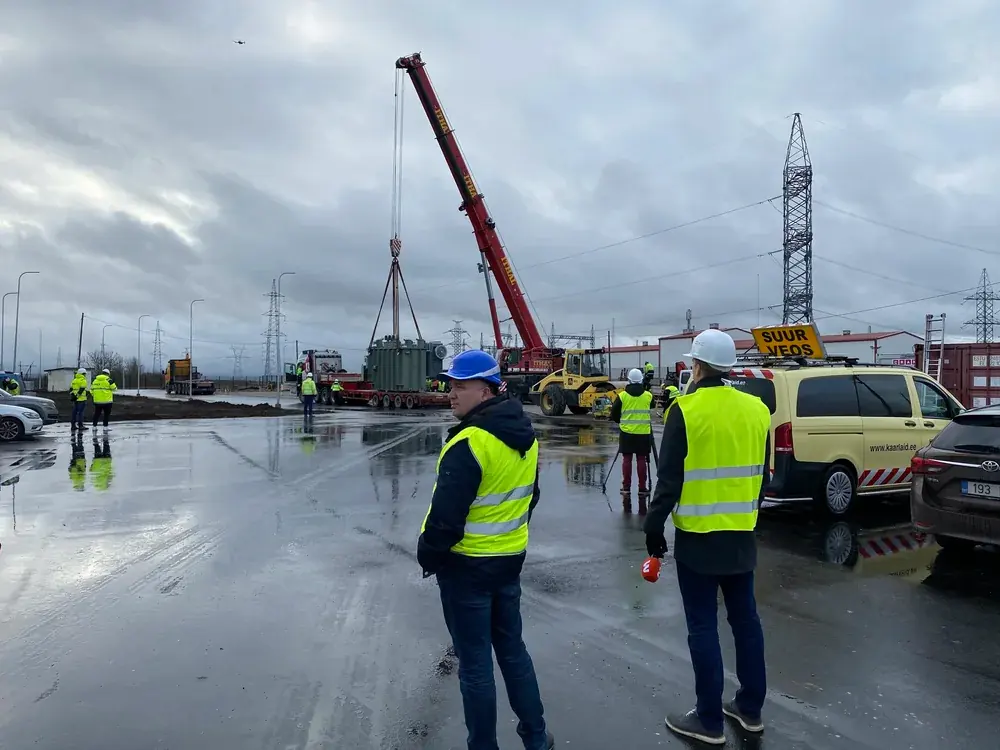
Building the data center.
Finding the location was followed by adopting the detailed plan, design, obtaining the building permit, and then came the most important decision: whether to put the spade in the ground. That meant considerably larger investments and the risks that go with them. From there, there was no turning back. "That day-long meeting in Finland is probably one of the hardest of my life, because so much was at stake. By evening the decision was made together with the investors to go ahead," Evert recalls the turning point. Besides starting construction, it also meant assembling a larger team and starting the search for anchor customers. Naturally nobody at the time knew exactly what building or operating a data center meant. That meant ambitious, bright-eyed people joined the team who were ready to do something completely new. A large part of the GDC data center's current team dates from those times. Every person knows their field thoroughly and at times literally every nut and bolt in the large complex.
In finding customers, prejudice was the obstacle at first. Since several parties had previously promised to build a data center and then dashed expectations, there was great scepticism. So it was decided to take every step as openly and transparently as possible. It was important to show publicly that work was under way.
The first public appearance, announcing that a 100-million, extremely energy-efficient data center would be built in Estonia, was on the front page of Äripäev on 27 November 2018. "In fact we took a big risk with that, because we did not yet have a building permit and theoretically someone could have thrown a spanner in the works. On the other hand the pressure to go public was great, because again there were whispers that others too were planning a large data center in Estonia. To reassure investors and slow down competitors, the project had to be brought out of the shadows," explained Evert, who says the feedback was fairly pessimistic: yet another pointless project that would go nowhere. "Such feedback does not discourage me, though. On the contrary. It gets me going and motivates me," laughs the man who today is already planning the construction of the next data center.
The best of 700
In total, experts from six countries were involved in the design and construction of the Baltics' largest data center, and construction lasted three years. "Nowhere did we take the path of least resistance; we constantly pursued the best possible solutions and the highest reliability. Naturally that brought challenges. One example is the novel oxygen-reduction system in the server rooms, which rules out fire breaking out (but is still safe for people).
"We are the first in Estonia to apply this system. Unlike others, we do not add nitrogen to the air but remove oxygen from it. Getting that solution to work was quite a trial, because the batteries, for example, are in the rooms of the UPS units (which provide power during short interruptions to the electricity connection). Over time batteries give off hydrogen, which in certain quantities and conditions is dangerous. So those rooms have to be ventilated regularly. But how do you ventilate a room where, to maintain the reduced oxygen level, there must not be even a small air leak?" Evert illustrates the tasks that needed solving.
Solutions were of course found. According to the German specialists who certified the GDC data center, it is among the best of the more than 700 data centers they have reviewed, in both concept and execution. That is great recognition of the work and ingenuity of the complex's builders.
The completed data center. Photo: Tõnu Tunnel.
By ladder to the second floor
There were exciting episodes during construction too. In the complex on the edge of Tallinn the server rooms and the office are side by side but were designed separately. When both designs were finished and put together, it turned out they did not match, and it was impossible to get from the office to the second floor of the server room part of the building without a ladder. The reason was that while the floor heights in the office building were 3 metres, in the part of the building housing servers they were 6 metres. The solution was to reduce the floor area of the office building and add a third floor. Now you can move around the building without a ladder.
Bringing in a major investor
"We knew that at some point a larger investor would be needed to complete the project. With the support of small investors it would have been unlikely. We held several negotiations on the subject. There were several interested parties. At one point Üllar Jaaksoo came to visit us and said the Three Seas Initiative Investment Fund might be interested in putting money in here," Evert says of the last weighty step in completing the project. In the fund's favour were its strong international background, the large share of institutional investors and the involvement of various Central and Eastern European countries. Also Jaaksoo's vision that, beyond the first data center, a network of green and energy-efficient data centers could be built across the whole region.
The negotiations led to an agreement. Thus in December 2020 Greenergy Data Centers acquired MCF Group Estonia, and the Three Seas Initiative Investment Fund in turn acquired a majority stake in Greenergy Data Centers. That secured the funds needed to finish building the data center and to expand in the future. Today, besides the major investor, only Kert Evert himself and one of the first investors, Tero Viherto, remain among the shareholders.
"Getting the major investor on board required an enormous amount of work. In parallel I had to drive the construction of the data center and, on the other hand, coordinate the review of all the technical and strategic documents and the negotiations. At that time I agreed with my family that they would move to Saaremaa for about a year. I focused only on work. Naturally that eventually led to burnout, and after bringing the investor on board I set new personal rules. I can confirm from my own experience that work and rest are equally important, and only that way can a person truly perform effectively," Evert shares his advice.
That is not the only lesson from building the data center, though. The second recommendation is to share both information and tasks more. "Technology people" tend to get carried away easily and then want to do everything themselves. That is not realistic, though. The key is surrounding yourself with good people and delegating.
The third lesson for a construction project of this size is having a financial buffer. Counting pennies eats up time and energy as well as nerves. A buffer means faster decisions, which is as a rule more beneficial in the end.
"There will certainly be more lessons. Because this is only the beginning. There is no idling, and the next big goal is to reach the ribbon-cutting of GDC's second data center. We have the skills and knowledge for that. And the comfort zone does not suit me very well anyway," Evert concludes.
All in all, Kert Evert, who led the construction of the Baltics' largest and most secure data center, never once doubted that it might stall. He was convinced from the start that somehow he would get it done. No matter how. Naturally behind that success is a strong team that has made sacrifices and contributed more than a classic salaried job requires. Estonia's first large-scale data center in Hüüru is a tribute to them all!