
Published 17.2.2024
Birthday interview: Estonia's largest data center completes its second year of operation!
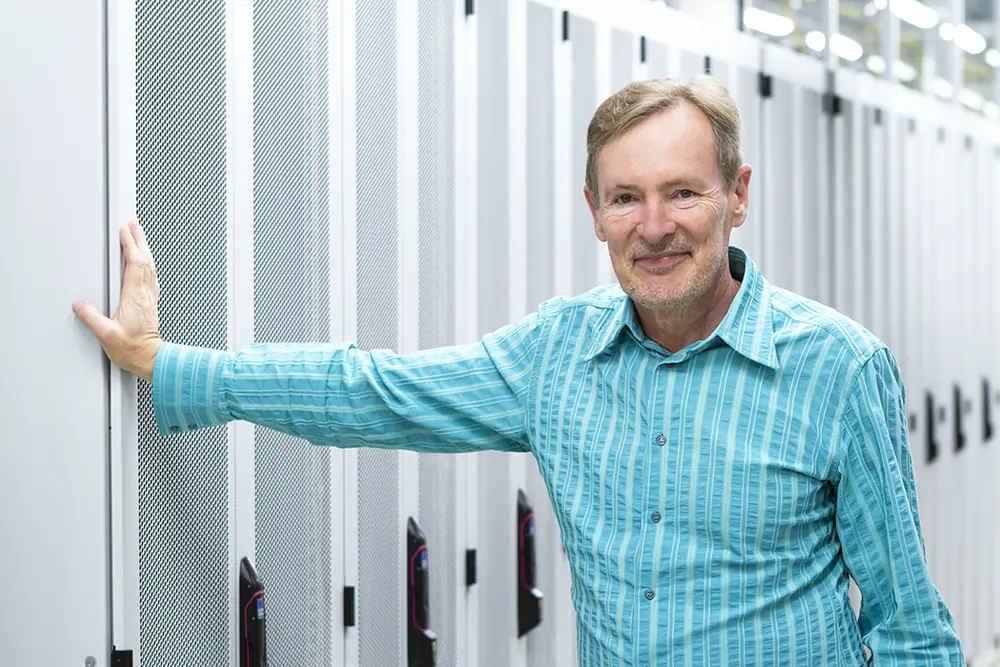
Only a few years ago Estonia had no large-scale data center built for the purpose and meeting modern requirements. When Kert Evert came out with what then sounded like a crazy plan to fill that gap, few believed anything would come of it. The doubters could only be convinced by success.
Tõnu Grünberg, CEO of Greenergy Data Centers. Photo: Andres Oolberg.
Today, 17 February, marks two years since the landmark day when the ribbon was ceremonially cut in front of the data center in Hüüru on the edge of Tallinn.
"We are the foundation of the e-society. Every country should have at least one such complex," says CEO Tõnu Grünberg, under whose leadership Greenergy Data Centers has turned from data center builder into operator and grown its turnover to seven figures.
On the facility's birthday Grünberg talks about the challenges that have had to be overcome in two years, how the arrival of the first large-scale data center has changed the Estonian market, and the plan to expand beyond the country's borders.
The data center field has been characterised in recent years by rapid growth and technical development. How have expectations of your sector changed?
We see the advance of the green world: energy efficiency is in the foreground. Since data centers are large energy consumers, every watt saved matters. Buildings are also expected to run 100 percent on green energy.
The International Energy Agency recently published a fresh report on global energy consumption trends, and data centers were among the topics highlighted. While in 2022 data centers' energy consumption in Europe was between 3 and 4 percent, by 2026 it will exceed five percent. That illustrates well why so much attention is paid to greenness.
Today it is still partly a matter of conscience, so to speak, which many data centers, including ours, consider important, but in the future energy efficiency will be written into law. From the consumer's perspective it is critical that facilities meet the norms and standards and are certified.
Demand for data centers is growing globally, with no sign of slowing. Artificial intelligence has changed the game somewhat, because it places quite different demands on data centers: much more electricity and cooling capacity. That has set the sector buzzing.
Given the situation in the world, expectations of reliability and security have also risen.
Have you had to rebuild anything to meet expectations?
No. Those requirements are already built into the Greenergy Data Centers complex. When planning the data center we foresaw these developments and can meet all the heightened expectations.
How much has Russia's war in Ukraine changed how you operate?
Although we are only a few hundred kilometres from NATO's eastern border, it has not noticeably affected us. What people think about more in today's geopolitical situation, and what is also felt in Estonia, is cross-border connectivity. The vulnerability became especially clear last autumn in light of the damage to the submarine cables in the Gulf of Finland. Imagine that a company's or a country's digital infrastructure is located abroad and the connection to Estonia should be cut. That would have serious consequences. In that context it is sensible to keep at least part of the footprint locally in Estonia, or at least to think such scenarios through.
It has changed things to the extent that, when building international digital infrastructure, large companies, or why not countries too, think about things that previously received less attention.
What role does GDC play in this region today?
We are the solid foundation of the e-society. We are the only large-scale complex in Estonia built as a data center and meeting modern requirements. There are no others like it here. In addition, we have become an important hub for connectivity too.
I believe our entry to the market has created an additional opportunity for local companies with international ambitions. Keeping their IT equipment with us makes it easier to do business in certain fields, because we have the necessary certificates and the ability to meet high standards. It can also be looked at the other way round: now foreign companies have a reason to develop their business in Estonia, because the quality is at hand here.
We have also changed the market a little. We brought top quality in the global sense here. That has made local IT directors and IT companies think differently and see the world differently, broadened the picture a little. We see that wow effect in everyone who has visited here over the two years.
In addition, for the first time in Estonia a wider ecosystem or business environment is forming around a data center, where the companies located with us create new partnerships and services among themselves. In that sense we are more than just a hosting provider.
What added value can you offer the market now, after two years of operation?
The team's know-how has matured to the point that today we are quite capable of identifying our customers' needs and thinking along in finding solutions. It is not just "look, here is floor space, take it!". We can understand and calculate different alternatives for storing data, explain what one or the other means, see the bigger picture. We communicate daily with different organisations and thereby gain a unique perspective. We see what is needed, where the bottlenecks are, but also the blind spots that go unnoticed.
We have built a very unique store of experience and knowledge in our team. Today we have a team focused on operating the data center that understands the nuances of this business and keeps learning.
What were the most important goals of the first two years of operation? Were they achieved, and to what extent?
What cannot be got around is quality. We promised to keep the service available 99.982 percent of the time and we have kept the promise: the service has been 100 percent available. That is something to be pleased about.
We have also grown our turnover strongly and continue to bring new customers on board. In short, we are progressing according to our business plan.
Two years ago your building was still relatively empty. What is the situation today?
Our building is modular. That means everything is finished on the outside and the systems are up, but in the area intended for server rooms there is still free space. We build it out in stages according to market needs. Initially we built out one third.
We have a positive problem: the built-out space is starting to run out. So we are in a phase where we begin expanding internally. We can successfully apply our earlier construction experience here. It does not interfere with day-to-day operations.
What have been the bigger challenges?
The biggest challenge was leaving the construction phase and becoming an operator. How to organise all the processes, get everything working nicely. There is certainly still room for polishing here, but we have the direction.
Ensuring quality does not come by itself either; it is the result of continuous work. Of course quality was, so to speak, designed into the data center, but it has to be maintained daily. That means testing, maintenance, monitoring and all kinds of other preventive work.
Third, proving ourselves. When we were still building this building there were many doubters who thought not a single customer would come here and the business was in no way sustainable. Now that new customers keep moving into the building, including very prominent ones, the attitude in the market has visibly changed. We are taken seriously.
In one sense that is understandable: when someone comes to do something new, the easiest thing is to doubt them. The only thing we could do was prove the doubters wrong.
Our customers' feedback confirms that too. We are pleased to note that we have exceeded expectations and our customers are very satisfied.
What are this year's goals?
Since the Estonian market is small, as the next step we will increasingly look outward. Our data center is so large that in terms of capacity we exceed Estonia's current need. Perhaps not tomorrow's, but today's capacity certainly. If we now build out the remaining two thirds, there would in fact be room here for customers from outside Estonia too.
We have also just launched our partner programme, which all IT companies that provide services to end users are welcome to join. With it we want to make hosting IT equipment part of more companies' service portfolios, make it easier for them to find partners, and enable more businesses to benefit from the business environment forming around the most modern data center in the Baltics.
And building: that is this year's keyword. We are in a construction phase again, but this time on a smaller scale.
Is the Estonian market already becoming too small for you?
In a sense, yes. If you want to develop as a company, expansion is the only option.
We do have room to build two more buildings just like this one on the same plot. Whether there is a need for that, time will tell. If a customer comes who needs 2–3 megawatts of capacity to develop artificial intelligence, for example, then perhaps it is worth building here. For now we do not see that need; rather we look elsewhere ourselves.
In your vision you also plan expansion in Eastern and Central Europe. Does that mean you are looking for foreign customers or will actually build something there?
We are looking for customers primarily for this building, but our vision of expanding into other countries remains in force. That need not mean directly building new data centers, but acquiring already built facilities, merging, adapting them to our standards. It depends on the opportunities that arise.
That remains our plan and also the vision of our investors, the Three Seas Initiative Investment Fund, that we should do so.
In closing, what can we wish you for the new year of operation?
Security, reliability and efficiency! That our building is always running and connected to the world. Available and connected, as our mission says. That is the most important thing in our business, and that is how we create the most added value for our customers too.