
Published 18.12.2025
"The big fish are looking towards Estonia": Greenergy Data Centers' chief reveals what will happen in 2026
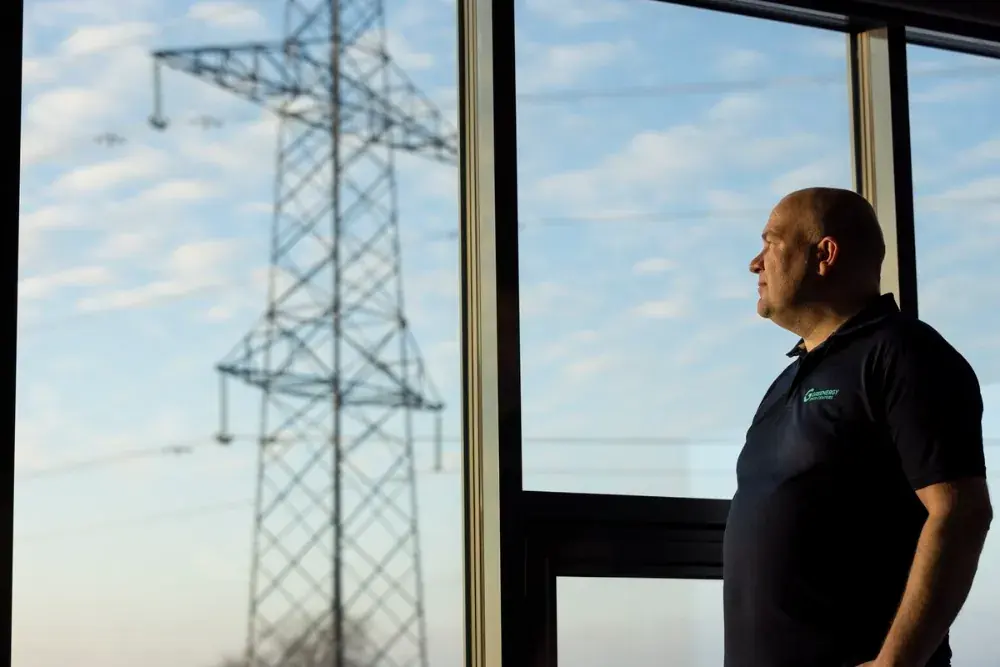
For Greenergy Data Centers (GDC), the Baltics' largest and most modern data center, 2025 is not ending with a quiet wind-down, but with a sprint. Something big is happening in the market. Where the Estonian data center once had to introduce itself to the world, the roles have now reversed: the big fish are looking towards Estonia.
GDC's chief Kert Evert speaks candidly about why, this year, the working days at the company are longer before the holidays than ever before. The goal is clear: to bring to Estonia in 2026 an AI capability not seen here before.
The end of the year is usually a time for taking stock, but for you it seems to be the opposite: the pace has actually picked up?
Times are extremely fast-paced, and the year has ended at full speed. A lot of new customers have arrived, and there's a clear trend: the move toward testing AI infrastructure. Customers have started to get curious about how these things actually work in practice.
In several cases, sandbox setups, or test environments, have already been built. That's the groundwork needed to understand how much resource is actually required to build a proper AI infrastructure.
Why is this testing so important right now?
We know the demand exists, but customers don't yet know how to measure that demand. There's always talk of some thousands of GPUs and outlandish megawatt figures. The actual usage, we can say today, is still smaller.
That conservative approach, in the form of these sandboxes, is exactly the right place to work out the real need. Based on that, customers can assess the actual size of infrastructure required, avoid overinvesting, and make the right decisions.
Customers already have their first GPU clusters up and running, and local infrastructure has actually started to emerge too. New layers are already being offered as a service, and it's great to see.
At the start of the new year, you'll mark four years in operation. How much has the picture changed in that time?
The biggest change over the past year is that where before we had to justify and prove ourselves, today GDC has become the default choice. Customers know about our data center and understand very well what we do here and why.
A year or two ago you still had to pull customers in this direction, go and persuade as hard as you could, and often it still didn't work. Now the situation is different. People come to us, ask very specific questions, and things move along at a fairly brisk pace. We no longer have to "talk anyone into it."
Internationally too, this has been a year where essentially every month we've received at least one inquiry about large capacity. We see growing interest in doing big projects aimed at Estonia, Latvia, and Lithuania. GDC has a unique opportunity here, because we have the resources and can react quickly. While it's hard to get anything elsewhere in Europe, where timelines for big projects run up to three years, and in established markets, because of grid capacity constraints, the more extreme examples stretch to 5-10 years, we can get things done faster. Depending on scale, our launch time could be one to two years.
We've come to understand that this year was still spent by international customers on, so to speak, testing the market and mapping out resources: looking at where things are and what's available at all. The real things start happening in the new budget period, meaning 2026.
Has customers' strong interest in AI forced you to rework your bigger plan too?
We've had to adjust our original plan. But this is exactly where our big advantage shows. Because the data center and its whole infrastructure were planned from the start with expansion capacity in mind, we're now at the moment where those old decisions are paying off. Thanks to that far-sighted design work back then, we're able today to increase the data center's capacity in a relatively fast and simple way.
The end of the year has really been dominated by development work, getting ready for 2026.
So what will 2026 bring?
We do see a larger AI cluster coming to Estonia. We're no longer talking about test environments here, but a tens-of-megawatts "AI factory" running in Estonia. In other words, we're working to get Estonia, so to speak, stamped with the label that something big involving AI is anchored here. That's one of our biggest goals for next year.
None of this is easy; a lot of work and effort has gone into it. But as they say, nothing is over until the last note has sounded. It's still too early to announce anything concrete today, since the preparatory work that precedes signing is still ongoing.
A year ago you talked about plans to expand beyond Estonia. Is that still on the table?
That's not our focus at the moment, and we've pushed it lower down our priorities. That doesn't mean we couldn't use our expertise elsewhere, but we're not planning physical infrastructure outside Estonia today, at least not in 2026.
The change in priority comes from the fact that GDC has come into the orbit of interest of many major players, and this is exactly the moment to seize. We need to get things sorted out in Estonia before going elsewhere. Our hands are already full enough getting this "Estonia thing" done. At the same time, jumping abroad would require a kind of time we simply don't have right now. We're putting all that energy and resource into Estonia, to get something big done here. That's hugely important to us.
To do big things, your base needs to be solid. How is GDC doing overall? Are the days when you had to prove yourself in the market at any cost behind you?
In the local market, we've proven year after year that we do what we promised, that we're reliable and secure. Where before we had to justify and prove ourselves, today GDC has become the default choice. Customers know about our data center and come to us on their own.
That's a fundamental change compared with a couple of years ago. Where before you had to, so to speak, pull the customer in, explain and persuade as hard as you could and it still often didn't work, now people come to us on their own and ask very specific questions.
Financially too, we're getting to where we wanted to be. Where before you'd meet the opinion that “this thing is about to collapse,” that has now faded from the arguments against us. People no longer point fingers claiming we're about to go bankrupt. The stability we've achieved is exactly what gives us the chance to look toward bigger goals.
What has brought about the change where you no longer have to "pull" customers in?
Behind it is strategic work and a shift in our mindset. Where before we were very strongly caught up in our own self-image, today we focus very clearly on the customer.
We've listened to customers to understand what they actually need and what their budget is. Quite a few customers have said it's a pleasure to work with us, because they don't have to worry about their trust being abused. Our starting point is that we genuinely try to fix some real problem, and we work out a financial model that suits both sides together with the customer.
A recent customer satisfaction survey confirms the positive trend too, with an NPS score of 93%. Anyone who knows the NPS metric knows a number like that is in the realm of “fiction.” You could go so far as to say today's GDC customers are happy, which of course makes “clearing that bar” again in the future harder. For our part, we'll do everything we can to repeat a similar result in the years ahead.
For years the mindset has been that everything has to move to the big international cloud. Now that money is being counted more carefully, is that trend reversing?
Financially, times haven't been very easy for many start-ups. We're seeing the first breakthroughs, attempts to be less dependent on the big international clouds. Service fees at the major cloud providers keep creeping upward.
Where before, in Estonia, people mostly looked toward the international cloud, now the first real comparisons have emerged proving the opposite: it's possible to manage money significantly more efficiently and get a better result by running your own infrastructure instead of buying a cloud service. Before, everyone rushed there on the principle of “because everyone else is there”; now people are starting to think about whether they can do it more efficiently.
There's been a change at the state level too. Where until 2024 the position was that “as long as the data is in the European Union, everything is fine,” today it's understood that sensitive data should really stay in Estonia. Credit here to the Ministry of Justice and Digital Affairs. That's a significant step forward, meaning Estonia's data center business could grow on the strength of the local market too.
To close, what's your feeling heading into 2026? Will Estonia get its own Nokia?
GDC has come into the orbit of interest of many major players, and that's exactly what needs to be seized. That's what we're putting in the effort for, and why we're pulling these long days right now.
It's not easy, because there are so many moving parts in the process. We're not just talking about the price of electricity here, but also expertise and time. We've brought in outside partners, and a fair amount of work is going into making it succeed in the end.
Investments in our sector are significant, and all of that has to be justified. It's exactly the same question people used to ask, why don't Meta, AWS, and other giants come here? The answer is that the need actually has to be created first. GDC has put a fair amount of time and resource specifically into proving that the need is here, particularly on the AI side.
If I try to sum up everything said here in one simple sentence: it's been an extremely busy year, and as a result there are several projects on the table. We've been working on them behind the scenes for a long time, and we believe some of them could come to fruition in 2026.
Finally, I'd like to thank all our customers for their trust, express deep gratitude and praise to our hardworking team, and wish everyone a pleasant holiday season!