
Published 30.1.2023
Artificial intelligence is making data centers resemble science fiction films, but it has its price
Aircraft essentially already fly themselves, and we have come very close to self-driving cars. All of that is becoming reality thanks to the wider application of machine learning and artificial intelligence. Will the same fate befall the data centers that are the foundation of our e-societies? Will our digital infrastructure start thinking for itself and become independent, so to speak?
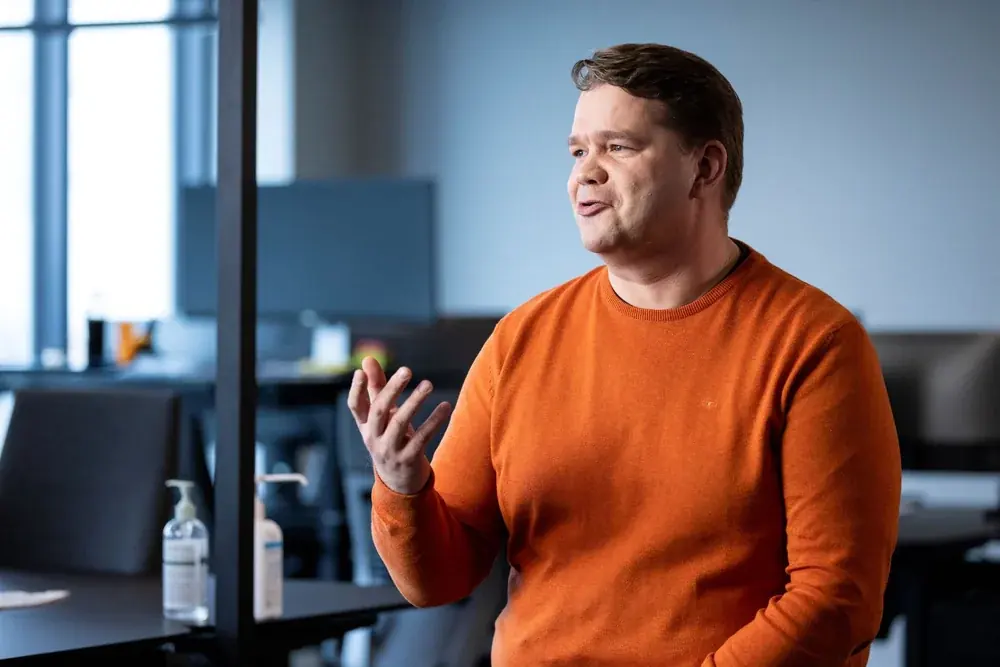
Toomas Kell speaking about the most modern data center in the Baltics. Photo: private collection.
Somewhat provocatively, one could say yes: artificial intelligence, also known by the abbreviation AI, has already become a significant game changer.
Optimisation beyond human capability
Today's AI allows technical systems to perceive their environment, process information and solve tasks. With the help of sensors the computer collects data, processes it and reacts to it. By analysing the effect of their previous actions and working independently, intelligent systems can adapt their behaviour and evolve. That means the ability to learn. Artificial intelligence is indisputably at the heart of the digital transformation, because it makes it possible to grasp, manage and respond at lightning speed to significantly larger and more complex quantities of information than a human can.
Data centers, in which, put simply, the internet physically "lives", are by nature complex, multi-layered systems of technical equipment. Given that, applying AI sounds very logical, because there is plenty of room for optimisation. Naturally, in this case it has to be done without giving an inch on reliability.
The big players are also finding a place for AI in their data centers
"Large data center operators such as Meta or Google have for some time been looking for, and finding, ways to make data centers more autonomous. On the one hand there is a desire to adopt new technologies, and on the other to ensure the flawless operation of ever greater computing power and a longer life for the equipment," says Toomas Kell, who is responsible for the day-to-day operation of Estonia's most modern data center, Greenergy Data Centers. So applying AI is part of a much broader trend.
"In data centers AI can, for example, monitor and predict electricity consumption, forecast the cooling need at different points in the server rooms and adjust the flows of cool air, or control the removal of heat from liquid-cooled equipment, predict the lifespan of equipment depending on its use, and the list goes on," Kell explains. The result of the smart machines' work is ultimately measurable in energy efficiency and working hours, that is, in money.
AI improves both equipment lifespan and security
Going into more detail, AI gathers feedback from the data center's rooms and equipment and regulates the data center's operation on that basis. "As a result, for example, our staff are freed from regularly checking and readjusting the environmental parameters of the server rooms," Kell explains. Nor does the operations center have to keep a constant eye on every individual reading.
By ensuring an optimal operating rhythm, AI extends the life of equipment, which then needs replacing later, which in turn saves money. AI also optimises maintenance cycles: "For example, if annual maintenance is otherwise prescribed for a device, AI calculates, based on the device's load and analysis of the alarms, errors and so on that occurred during operation, when it would be most optimal to do the work. Perhaps the real maintenance need arises only after three years instead of one," Kell explains.
Help with security
The benefit also shows in ensuring security. Moving around the data center building you have to pass through various airlocks, which are accessed with biometrics or access cards. On entering an airlock, AI monitors via video whether the number of people who registered matches the number of people actually in the room. If not, there is no way through, and the operations center receives a signal about suspicious movement. The smart machine also helps keep an eye on the data center's hundreds of security cameras and spot threats instantly. Think how many people it would take to watch 200 or 400 video feeds in parallel, for example.
In addition, AI can help calculate, for example, when additional electrical capacity needs to be added due to growth in the load of a customer's IT equipment, or where in the building it is sensible to place a new customer. That in turn provides input for the most efficient use of the data center's capacity and for construction or development work.
"None of that means people no longer have to come to work, though. Far from it. AI has to be watched to make sure its decisions are correct. People, however, tend to monitor the bigger picture rather than constantly a large amount of smaller data," Kell notes. So the saying that AI takes people's jobs does not hold; rather, the person using AI takes the job from the person not using it.
Four risks
Everything good has its dark side, though. So risks have to be mitigated when using artificial intelligence too.
The first risk lies in correct configuration. A human must certainly have the ability to check the source data and algorithms on which AI bases its decisions. "To mitigate that, every organisation can set up its own processes for how and when those decisions are reviewed," Kell offers a solution.
Second, it must be determined how much decision-making authority AI has. "Here a clear weighing of benefit against possible harm comes into play. AI can also simply offer a person different options to choose between. The ability to interrupt the artificial intelligence's activity must certainly remain," he adds.
Third, the use of AI must not lead to learned helplessness. Every organisation must retain the ability to understand and analyse processes and their relationships outside the computer as well. "Using artificial intelligence does not mean smart, highly paid people can be made redundant. Rather, AI should empower them," Kell comments.
Fourth, the communication between different smart software systems has to be defined very precisely. Since AI is used for very different tasks, it may happen that systems with several different operating principles coexist at once. For example, solutions from different manufacturers work differently, and connecting them can be a challenge. One option is to prefer systems from the same manufacturer.
"At Greenergy Data Centers we chose Siemens for that," says Kell. "An important role was played by the fact that the company has continuous technical support available in Estonia, which is one of the most important components in operating the system."
The future increasingly resembles a science fiction film
Looking at the very big players such as Google, Facebook and a few others, in places they are moving to almost fully automated, autonomous data centers.
Here one has to bear in mind, though, that such data centers serve only one company, which opens the way to extensive standardisation. An institution serving several customers has to take different interests and needs into account, and there the benefit may not outweigh the risks.
AI in a data center means, above all, efficiency
In summary, AI has already found its place in data centers. The result of its well-considered application is:
- higher energy efficiency, which saves electricity and money. At the same time it helps meet tightening environmental requirements;
- less routine work, which motivates employees to learn and contribute at a higher level;
- predicting system bottlenecks before they become problems, which increases reliability;
- greater security, because machines can do significantly more at any given moment;
- extending the working life of equipment through needs-based maintenance, which avoids unjustified spending and consumption.
So applying AI is a growing trend that helps balance the IT world's footprint on both the environment and the wallet.