
Published 13.3.2023
INTERVIEW with Tõnu Grünberg, head of the Baltics' largest data center: how to find customers in difficult times?
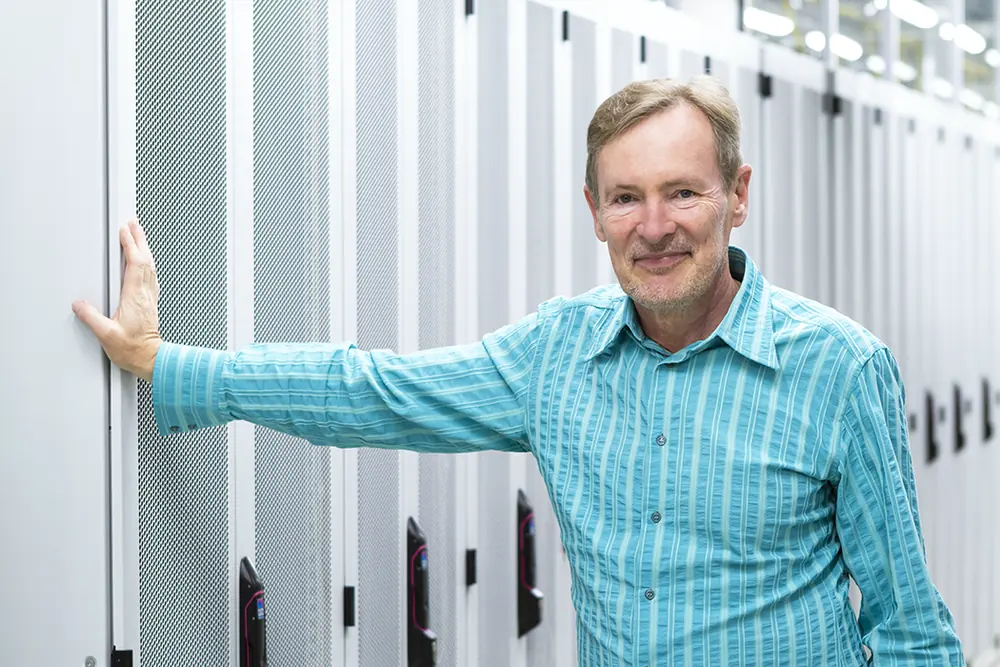
A year ago the Baltics' largest data center opened its doors on the edge of Tallinn. If Greenergy Data Centers (GDC) were to be described in one word, it might be future-proofing. Never before has there been a large-scale building in these parts designed specifically as a data center: GDC's cooling systems are controlled by artificial intelligence, the complex has been awarded the highest certificates, and it is protected with top technology and armed security. Against all that, the opening of the data center coincided with Russia's war in Ukraine, a Europe-wide energy crisis and the chip shortage. CEO Tõnu Grünberg talks about how GDC has coped with the trials and what the year ahead brings.
You have now been on the market for a year. What is the feedback, is such a data center needed in Estonia?
As of today it can be firmly stated that it is. When the construction of the Baltics' largest data center in Estonia was still being planned, there were of course question marks over whether there would be enough interest to fill such a large space (the building has a total of 14,500 square metres of floor space, about two football pitches). Fortunately the first year has shown there is no shortage of interest and new customers keep joining. Filling the data center naturally takes a certain time, but at the same time we see the sales pipeline filling at a good pace since the second half of last year.
In fact we have been received very positively and awareness of us has grown considerably.
You certainly had forecasts of how quickly the building would fill up.
Naturally we made forecasts, some of which, looking back, hit the mark and some did not. In the big picture we are on track. Modularity works in our favour. That means that although customers are in, we have fully built out only part of the data center's server rooms and part is still taking its final shape. So we have the room and the capability to grow and respond precisely to the market's expectations.
What kinds of companies are interested in you?
We have very different customers. Among them large ones, such as SEB bank, or still-growing businesses, such as the cloud storage provider Storadera. Understandably we cannot name many of them publicly because of confidentiality obligations. They come from different fields; besides the financial sector, for example, IT, energy and telecommunications. Naturally also commercial companies offering various services.
I have noticed that several organisations have come to us with the idea of setting up a so-called backup data center at GDC that would ensure continued operation in the event of surprises. In the course of closer acquaintance and understanding our value proposition, however, that plan has changed. In the end we are used as the primary data center after all.
All in all, the cross-section of customers is fairly diverse. It is important to add that we also check the background of all customers, and not just anyone who wishes to gets into our building.
How has the war in Ukraine affected your business?
The war in Ukraine began immediately after the opening of our data center. At first it negatively affected the interest of some customers with international reach, but by today those fears have largely dissipated. I do see, though, that while at the end of the last decade the green agenda and environmental protection were rising strongly, now security and reliability have become weightier. If we ask customers today what is most important to them, environmental footprint is not number one, as it was before the war.
What have you had to reshape in your operations as a result?
Truth be told, nothing, because both reliability and security have been at the forefront of our plans from the start. As proof, in our first year of operation we achieved 100 percent reliability, meaning we operated without interruption and were not down for a single second. Those who have visited us can confirm that our security measures resemble those of a defence organisation. So those points are covered.
On the other hand, environmental protection and efficiency have not disappeared from the map either. As the data center's load grows we are moving steadily closer to the goal of operating about 25 percent more energy-efficiently than the industry average. That means we can keep the equipment located with us running with a quarter less electricity than data centers on average.
One of last year's keywords was the energy crisis. What did it mean for you?
It obviously affected every organisation that consumes more electricity and made us too find more flexible solutions. In the end electricity is one of the basic resources for us and our customers. So we currently offer both packages with an unfixed price, which of course became very unpopular at one point when prices shot sky-high, and packages with a fixed electricity price. Now the electricity price is in turn on a downward trend and interest in the exchange-price package is growing again. I believe electricity will remain an important topic for a long time yet.
Can a new rise in green topics be predicted too?
International customers continue to show great interest in environmental protection, and Estonian companies too are increasingly aware of energy efficiency. It is just that, as mentioned earlier, in today's complicated world security and reliability are currently in the foreground. I believe that when the war ends and energy prices come down, the survival moment, so to speak, will pass and there will again be a time when people think about the future and make long plans. We continue with our green mindset, even if today it may not be customers' first priority. One day it will be vitally important again.
We hear that at the end of last year a three-year audit of the data center concluded. What did it result in?
First, we have the so-called usual ISO standards, such as the quality management standard ISO 9001 and the cybersecurity standard ISO/IEC 27001. But what is unique, and what we worked seriously for, is the European Union's special data center certificate EN 50600, which nobody else in the Baltics or in Finland holds.
It is an extremely thorough standard that looks at the data center as a whole, including security, reliability and environmental friendliness. In short, it is a complete X-ray: if something is wrong, instructions are issued and it is reviewed again. We were audited by the German company TÜV Informationstechnik, one of Europe's main players in data center auditing. German thoroughness is well known; nothing escaped their notice. Even a label that had been stuck on crooked drew attention. In fact the process was very useful, because we got to prove ourselves.
Is anyone actually interested in the certificates?
Absolutely. Anyone can declare themselves compliant with any standard. But if you say you are certified against one standard or another, that is a different matter entirely. The most recently obtained EN 50600 proves that our promise of quality is justified and an independent party has audited us.
What plans are you making for the year of operation that has begun?
We continue in two directions. First, building out server rooms according to customers' needs, and second, expanding the circle of partners and diversifying the services offered.
In a sense a data center can be viewed from two perspectives. On the one hand it is an ideal environment for hosting IT equipment, but on the other that environment offers many opportunities for creating synergy and offering added value. For example, bringing in different carriers and offering customers greater freedom of choice, or enabling hardware or software procurement through partners, or creating direct connections between customers without using the public internet, and so on. A very diverse ecosystem of IT services is already developing in the GDC data center. As time goes on, it becomes ever more attractive.