
Published 29.7.2026
From utopia to reality: Greenergy Data Centers gets the Baltics' first AI factory
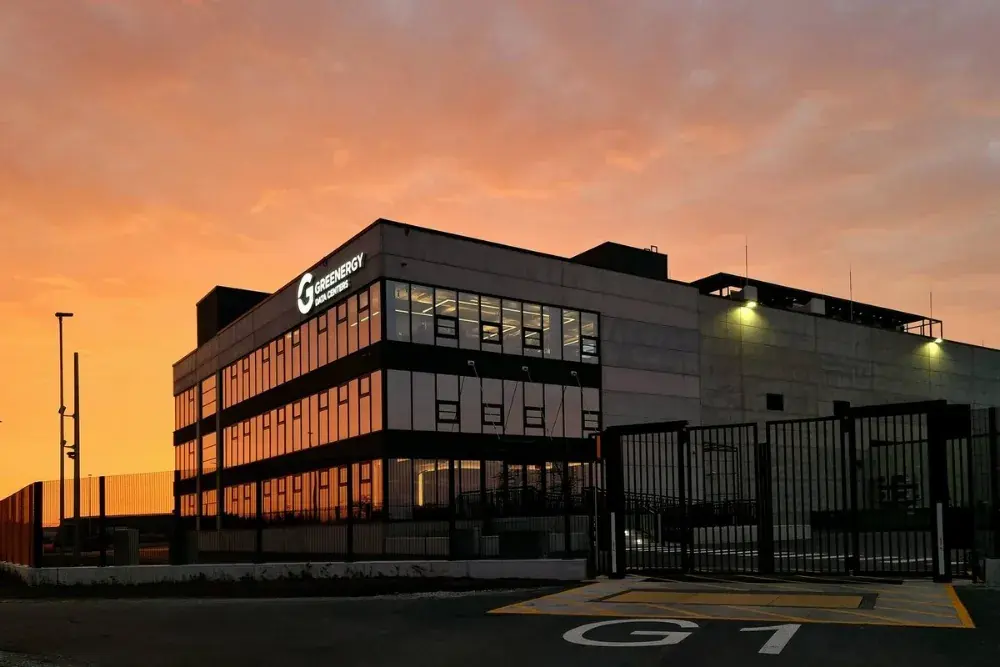
Ten years ago, in 2016, MCF Group Estonia began developing the Hüüru data center. Years of preparatory work followed: finding the site, designing, and planning something that seemed impossible to many at the time. In 2020, the effort joined forces with Greenergy Data Centers, and with investment from the Three Seas Fund, that ambitious vision was finally cast in concrete.
Today we know the complex simply as the Greenergy data center. The next major milestone is now clear too: this November it becomes the Baltics' first data center offering AI infrastructure.
We sat down with Kert Evert, the data center's driving force, to look back on the past decade and talk about what lies ahead for Estonia and Europe's AI landscape.
Ten years ago, when MCF Group Estonia began building the Hüüru data center, the Estonian market was in a very different place. How did you dare take on such an ambitious project, with growth potential of over 300 MW?
When MCF Group Estonia began developing the Hüüru data center infrastructure complex ten years ago, building infrastructure with long-term growth potential of over 300 MW seemed unrealistic to many. At the time, the entire Estonian data center market's demand was only a fraction of that.
It would have been easy to design only for the demand of that moment. We decided to design for the future instead. Ten years later, we see the real value of that decision.
When MCF Group Estonia began developing the Hüüru infrastructure complex, there was no AI boom. There was no GPU race. There were no AI clusters spanning tens of megawatts. There was only a belief that Estonia would need more in the future than the market of the day was asking for. That is why the infrastructure complex was planned from the start with a long-term vision allowing growth beyond 300 MW. Now we see that belief was justified.
The journey from paper to a real, working data center, the largest in the region, has certainly not been a simple success story throughout. How did you get through the harder times?
The years in between were not easy. There were skeptics. There were people who thought the project was too big, too ambitious, or simply ahead of its time. There were periods that called for hard decisions, adapting to a changing market, and proving day after day that the vision was right.
Today there is not much left to argue. The infrastructure is there. The customers are there. The partners are there. And most importantly, the result is there.
The greatest thanks belong to our team. To the people who believed in this project when it was hardest to carry out. To those who designed, built, operated, sold, served customers, and solved problems at a time when the results were not yet visible. It is just as important to recognize the new colleagues, partners, and investors who have joined us in recent years and brought new knowledge, energy, and experience.
No data center is built from concrete, steel, and electricity alone. It is people who build it.
Let's turn to today. This autumn you're taking the next huge step. What does the near future bring, and what role does bringing in a new investor play in it?
While others were talking, we got it done. A year ago we talked about a possibility. Today we can talk about a result. In November 2026, Greenergy Data Centers becomes the Baltics' first AI factory able to serve international AI companies. This is not a speculative development or a hope that customers will eventually turn up. The first customer is already in place, and the infrastructure is being built to serve real demand.
This next stage of development was carried out jointly by Greenergy and Tensor Estate. Tensor Estate acquired a stake in the company and, alongside the investment, has led negotiations with international AI operators. Beyond capital, Tensor Estate brought international AI sector contacts and the conviction that something playing at a European level can also be built in Estonia. That contribution helps bring to Estonia a capability that puts us on the European map as a serious AI infrastructure location.
Everyone is talking about AI right now, but often only from the angle of software and consumption. What should the broader role of the Estonian state and the local technology sector be, so that we don't remain spectators in this race?
There is a lot of talk about AI right now. Even more talk about investment. In my view, instead of asking how to use AI, we should be asking how to create the conditions for AI-related investment, jobs, knowledge, and infrastructure to be built here.
Too often the discussion focuses on how we can be part of the global technology chain. A much more important question is what role we play in that chain. Are we simply technology consumers? Or can we create an environment that attracts investment, where new services are created, and where the next generation of technology companies is born?
Europe's competition in AI is no longer just about algorithms. It is about energy, infrastructure, expertise, and investment. Countries that can bring these components together will gain the most from next decade's economic growth. Estonia has an opportunity here. We are small enough to be flexible. Digital enough to be trusted. And ambitious enough to think big.
How does your current big step, bringing in the Tensor Estate investment and building the Baltics' first hyperscale center here, support that bigger picture? Are we really reaching the European map already?
What matters to us is that Estonia is no longer a bystander. Estonia has moved to the forefront of AI infrastructure development in the region, and that did not happen by chance. Behind it is ten years of work, hundreds of decisions made, strong partners, and a team that has been willing to keep going even when others doubted. Combine the Tensor Estate investment, the involvement of international AI customers, and Estonia's largest certified data center infrastructure complex, and we are talking about a real chance for Estonia to become one of Europe's significant AI infrastructure locations.
Behind the birth of the Baltics' first hyperscale AI infrastructure is ten years of work, dozens of partners, investors, and customers, and above all people who have been willing to believe further ahead than next quarter's results and dared to make decisions that only bear fruit years later.
If ten years ago we helped put Estonia's data center market on the international map, our next stage of development helps put Estonia on the AI infrastructure map. And perhaps the most important thing to know is that today we are no longer talking about what could be done someday. We are talking about what is already being done in Estonia.
International customers largely fall into two categories: hyperscalers and neoclouds.
What is a hyperscale data center?
In Estonian it could be called a hyper-scalable or giant data center. While ordinary data centers host standard IT systems and servers, hyperscale is on a completely different scale. These are massive facilities built to supply enormous amounts of computing power and electricity, measured in tens and hundreds of megawatts. That scale, and the ability to grow capacity quickly, is essential to power the huge GPU clusters needed to train AI.
What is a neocloud?
Neocloud (a next-generation cloud) refers to a new type of cloud service provider. While traditional technology giants, such as Amazon Web Services, Microsoft Azure, or Google Cloud, offer universal cloud services for absolutely everything, neocloud companies have emerged specifically from the needs of the AI era. They specialize in providing the specific hardware (high-performance GPUs) and software environment needed for AI development and machine learning, often doing so faster, more flexibly, and more cost-effectively than the established giants.