
Published 22.5.2023
Five myths about data centers! Are clouds really killing off data centers?
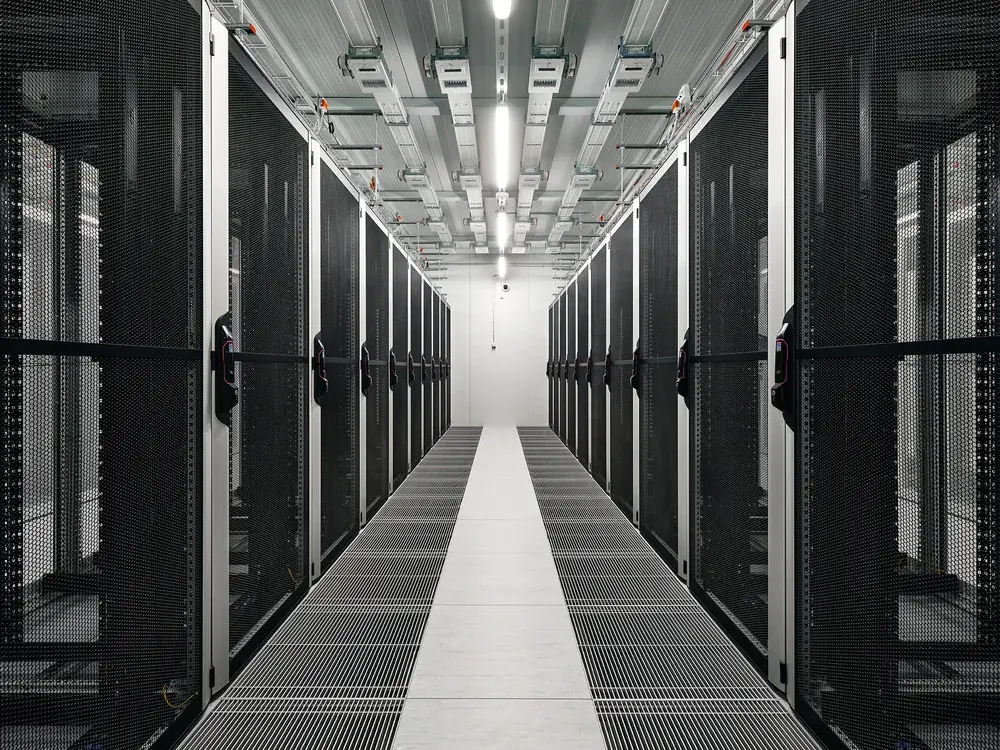
Data keeps growing and the IT equipment associated with it has to be placed somewhere. Understandably, that raises questions and doubts, which are not always closely tied to the truth. Let's go through the global myths that are often associated with data centers!
A private room in the data center. Photo: Tõnu Tunnel.
Myth 1: clouds are replacing data centers
When a company wants to expand its IT capability beyond the servers in its office, a cloud service, with its low entry costs, is initially the easiest choice. The cloud, with its pros and cons, has been talked about a great deal over the past five years, and that has probably given rise to the view that the future lies only there.
Even Kert Evert, the originator of the idea for Estonia's largest data center, has recalled that one investor who dropped out of the project justified the decision by saying that soon nobody would need data centers because everyone was moving to the cloud.
In the slipstream of the cloud talk, the fact that clouds also have to be physically somewhere, and that every cloud ultimately needs IT equipment and connections, often fades into the background. Hence the saying that "the cloud is just someone else's computer". Today those computers are as a rule located in… you can probably guess… data centers. So there is no one without the other.
A data center is, by its nature, the foundation on which IT equipment, and the e-services that reach millions of users from it, stand.
Myth 2: data centers are hostile to nature and swallow the vast majority of the world's electricity
Keeping our digital society running is extremely energy-intensive; there is no getting around that. Still, data centers account for an estimated two to three percent of global energy consumption. We have written about this at greater length on the blog before.
In recent years ever more attention has been paid to the efficiency of data centers. For that, PUE, power usage effectiveness, is examined. The lower the PUE, the better. In Europe, new data centers that have joined the Climate Neutral Data Centre Pact have a 2025 target of PUE 1.3 in cool climates and 1.4 in warm ones.
Whether energy efficiency comes to the fore in data centers depends largely on the market. If customers demand the smallest possible ecological footprint, it will be offered. If it stays in the background, the shift towards greener digital infrastructure happens more slowly. Many data centers already use certified green energy and apply energy-saving technologies, such as AI-based optimisation of cooling systems and heat reuse. The rapid development of technology, and of AI, has greatly helped in creating smart systems.
How much energy can be wasted by old or poorly designed systems, found in office buildings or converted server rooms where equipment is also kept, is a whole other story (we have written about that on the blog before too, from the angle of cooling systems).
Myth 3: data centers are the preserve of very large companies only
True, technology giants cannot do without data centers. We have all heard of the gigantic data centers of Microsoft, Facebook and Google. Last year Google invested 9.5 billion dollars in its data centers and offices, 750 million of it in building a huge new "data campus" of four buildings. (The reason, incidentally, is the leap in demand for Google Cloud Platform (GCP), which further confirms that there is no cloud without a data center.)
In reality, though, data centers are also used by considerably smaller companies that need security, high reliability and physical access to their equipment. In Estonia alone there are dozens of companies that limit themselves to one or two equipment cabinets in local data centers. In data centers, capacity can be adjusted to the company's needs, so you can easily start by renting one or two cabinets rather than investing millions in building your own data center.
Myth 4: data centers can be fully automated
Although automation has become ever more important in the operation of data centers (we just mentioned AI-controlled cooling systems), there is no data center without people. There is talk of technological progress, energy use, security and reliability, but practically never of the human resources needed to keep it all running. Type "data center" into Google image search and see how long you have to scroll before a picture shows people as well as infrastructure.
In reality no data center is fully automated. As in other fields where the advance of AI is feared, technology is more a useful helper than a competitor taking work away from people. Even designing a data center is too complex and nuanced a task for AI. From builders to technicians and engineers, people's skills, knowledge and judgement are irreplaceable in building and operating data centers.
Myth 5: anyone can build themselves a data center
Here it must first be understood that all sorts of rooms tend to be called data centers, rooms that may have been converted to store data but in fact ensure neither reliability nor security. Practically anyone really can build those.
Proper data centers, however, are subject to high requirements for their power, cooling, security and communications systems and for the building itself, which not everyone can meet. Those make building such centers very costly. Building and operating data centers requires large investments, technical know-how and the corresponding infrastructure. High-level knowledge of data management, security and performance optimisation is needed, and a number of legal and regulatory requirements have to be taken into account. Suitable sites for a data center are also few.
According to international standards there are more than 100 different criteria for choosing a data center's location. It is sensible, for example, to keep data away from hazardous traffic and industry, while still close enough to the main transport hubs. It is smart to build the center on higher ground to reduce the risk of flooding and increase the number of days with a decent wind. That allows the data center to be cooled with outside air for most of the year, which saves energy. Estonia's climate is exactly right for such a facility, with only a couple of hundred hours a year when free air cooling is not enough. Incidentally, Estonia is also among the ten most suitable countries in the world for locating a data center.
There are certainly organisations in the world that can and have built themselves a top-class data center, but as a rule it is not feasible or economically sensible.
In summary, even where the myths about data centers have a grain of truth, it has mostly been "lost in translation" and blown out of proportion. Clouds are not killing off data centers, storing data energy-efficiently in data centers does not cause an energy crisis, a data center can be used even if you only need a few equipment cabinets, and certainly not everyone can put up a proper, reliable and secure data center.