
Enefit, Energy
Published 25.8.2023
How are the IT systems of Enefit maintained?
Whether lights in our rooms stay on and the electricity we use is conveniently accessible no longer depends solely on the reliability of stations. The role of the IT infrastructure is equally important, as it runs systems that help to secure the generation and distribution of power and ensure the reliability of the services provided to business and private customers by the largest energy group in Estonia.
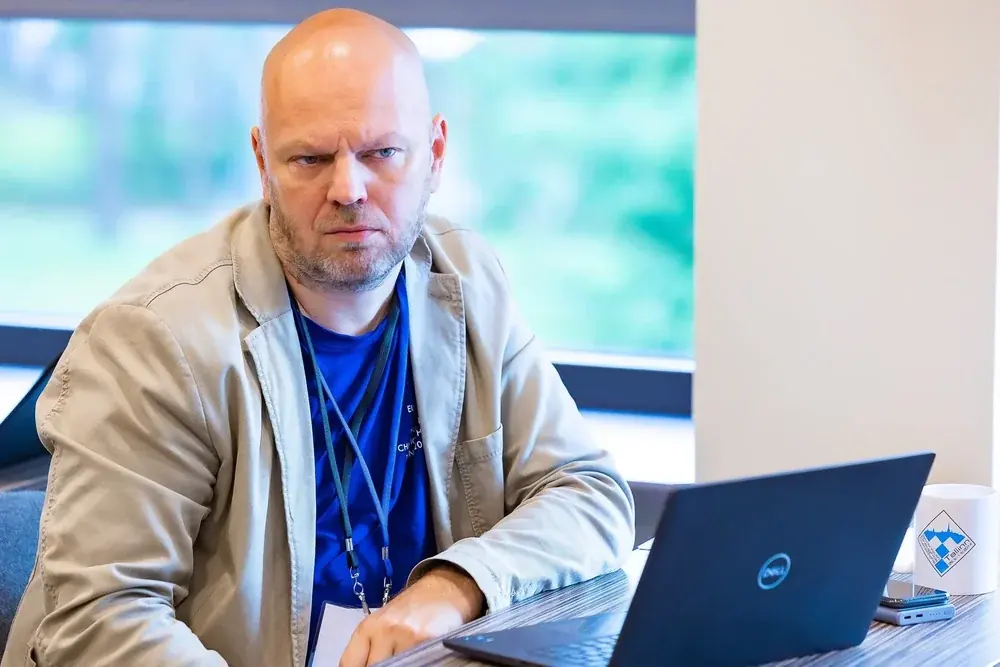
The company has over 600,000 customers. We asked Tarmo Tulva, Head of IT Infrastructure of Eesti Energia (Enefit), about laying the foundations of the IT systems for one of the largest companies in Estonia, whether it is better to manage IT infrastructure yourself or to outsource it as a service, and whether customers and employees would notice the relocation of an entire data center.
Many organisations are afraid of owning IT infrastructure. In which instances is it justified, when is it not reasonable, and which path have you chosen?
In my experience, it pays to have your own infrastructure if the company is large. It is definitely reasonable for a group the size of Eesti Energia (Enefit). However, in the past, I have worked in organisations where I as the IT manager had to manage outsourcing everything. If you have the capacity to hire one or two employees for IT and need ten virtual servers, there is no point in doing it yourself and relying on external partners would make sense. This way, you can focus solely on your business. However, the IT unit of Eesti Energia (Enefit) employs more than 300 people. At this scale, it makes sense to manage the infrastructure yourself. The systems, networks, and locations are all complex enough to require a partner to maintain an IT team of a similar size to keep it up and running. You could not just do two hours of work a week for Eesti Energia (Enefit) and use the rest of the time for providing services to others.
What can be gained from managing your IT infrastructure?
A peace of mind that you always have necessary technical expertise in-house. Moreover, partners will invariably claim that they have the capacity and the skills to provide all the required services, but there is no way for us to check what they know and who are providing the services. Know-how within your team means more control, faster decisions, and a quicker response. Naturally, this also entails a responsibility to deal with staff, which would not be the case with a partner. Ultimately, scale matters. For large companies, it makes sense to keep infrastructure in-house.
What kind of strategy has Eesti Energia (Enefit) used for building and managing IT infrastructure over the last decade?
I have been working in the IT sector for 25 years, but I have been employed by Eesti Energia (Enefit) only for the last two years, so I can speak mostly about this period. Our direction is clearly towards having multiple data centers with a similar capacity and enough hardware resources to cover all business needs and disaster recovery capabilities in the data centers. This is what we strive for in our daily work.
To what extent have these targets been achieved to date?
I should probably describe it more like a journey. We can never be fully ready because the world is constantly evolving. Nevertheless, we are in a much stronger position than we were two years ago. There are certainly things that continue to need attention and adaptation.
What is the overall footprint of the IT infrastructure of Eesti Energia (Enefit) today?
In the grand scheme of things, we keep the production-related information systems at the production site (information about power production is collected and processed at the plants for efficiency purposes – ed.) and the rest of the systems centrally in data centers.
What are your strategic objectives for the near future?
As the unit responsible for the IT infrastructure of Eesti Energia Group (Enefit), which also includes Enefit Power, Enefit Green, Elektrilevi, Enefit Connect, Enefit Solutions, and subsidiaries in Latvia, Lithuania, Poland, and Finland in addition to Eesti Energia (Enefit), we must provide a stable, high-quality, and reliable infrastructure for our business services. If we can do this and are prepared to deal with the unexpected, then our job is done. Naturally, technology changes over time with new devices, new solutions, and new platforms coming out, constantly changing the game. Still, our goals remain the same.
How will the consumer, the so-called man on the street, benefit from these developments?
Consumers have certainly benefited from improved reliability. If I look at it from my end, or from the point of view of infrastructure – the less we are noticed, the better our service.
So the golden rule of IT is – if no one talks about you, then you have done a good job?
This is not always the case for business services. If you develop a new service or software, your customers will notice. In the case of infrastructure and data centers, however, as long as everything is up and running, developers can get on with their work, and products and services are available, we tend to be invisible to the outsider. And perhaps it is a good thing that we are.
Speaking of standing out – Eesti Energia (Enefit) has recently garnered attention with its good financial results. Does this create opportunities for IT development and to what extent?
For as long as I have worked here, I have always been able to do what was needed. But that does not mean you can splurge. We must always keep efficiency in mind, whether we are developing infrastructure, business services, or applications.
Today, many organisations have chosen the hybrid cloud route. How have you found the balance between storing data on your own premises, in data centers, and in a public cloud?
Essentially, we are using all of these options. We do not dictate to a developer of an application or service within the group where to host their things. We will not force them onto our premises or into our cloud. It is the developer’s choice. There are pros and cons for both options, and cost certainly plays a big role.
I remember that a few years ago, there was a popular tendency in the wider tech world to move everything to the cloud. For a company the size of ours, it does not make sense, financially or otherwise. Data centers are an indispensable part of the infrastructure. In addition, there is a whole range of applications that must be on site, for example by power production units in power plants, that cannot be moved elsewhere. In other words, you have to have your own infrastructure.
Tarmo Tulva. Photo: Eesti Energia.
What might that split look like in three or five years? Is consolidation an important direction for you?
Yes, certainly. I have been in the field a long time, and over time you can see how network connections keep getting better and there is no longer a technical need to keep things scattered across Estonia. That makes managing the whole easier, availability better and costs more efficient, and lets us create various disaster recovery plans. Consolidation has many pluses.
What do you look at and value most in a data center?
A data center has to be built following the standards and intended as a data center from the start. It has to be made to a high quality, because otherwise we cannot be sure our things will function to a high quality.
That is also why we have decided not to build data centers ourselves. Although to an outsider it may seem a logical idea. Eesti Energia owns large power plants, after all, and it would seem very sensible to build a building next to them and fill it with servers. The electricity is practically free, after all. For us, though, a data center is not just a building and power. There are a great many nuances, from power supply, cooling and security to connectivity. It is not our business and it is not worth our while to build it ourselves.
The other part is the size of our infrastructure, which keeps getting smaller over time. Servers constantly become more capable and are packed into ever smaller enclosures. The number of rack units that need housing keeps falling. Where six or seven years ago Eesti Energia had quite a lot of rows of cabinets, today we can manage with significantly less, and looking ahead our footprint will shrink further.
Why did you recently look for a new data center?
Before moving to Greenergy Data Centers we likewise had several data centers. One of them was unfortunately in a location unfavourable for us. Although all the conditions for a data center were there, the distance from Tallinn and the speed and price of data connections placed limits on the technical possibilities. As mentioned above, the number and size of the equipment also changes over time, but at the previous location the space we used as a data center was fixed in terms of price and square metres. With the new data center we highly value the flexibility to take more space or give some up as needed.
What was ultimately the most important criterion in choosing the data center?
In the end it was the connection between our two data centers: its price, capacity and quality. That was resolved very well between GDC and our other locations, which technically gives us many additional possibilities. We also wanted to spread risks and use different service providers.
Eesti Energia provides critically important services across Estonia. Did the relocation of the equipment go without a hitch?
The planning was quite thorough. We made detailed preparations for the move for nearly half a year before we finally switched the boxes off and put them in the vehicles. The most complicated part of the move was reconfiguring the networks and services so that everything would work when one leg was moved away, and getting the system up in the new location. Some things also had to be temporarily shut down for the duration of the move. There were many such technical details.
The whole process went very well, though. Over one weekend we took all the equipment down in one place and set it up at GDC. On Monday, when people came to work, they essentially noticed nothing.
What recommendations would you share with others based on this experience?
I have been involved in moves repeatedly. The first recommendation is to plan as far ahead as at all possible, so that no surprises or downtime arise. Surprises cannot be ruled out completely, of course, but they can be minimised. If there is no previous experience of moving, it is worth asking for advice where possible. The whole process certainly also depends on the complexity of the systems, how the applications are built and what the business requirements are. There is a big difference between the business saying it is no great problem if applications are unavailable over the weekend and the business saying the maximum downtime is 10 seconds and nothing may be down longer than that, so work out for yourselves how you will move. Then it has to be planned quite differently.
We were able to move the data and applications off the servers being relocated digitally beforehand. When it came to transporting the physical items, we shut down the empty servers and took them with us. In that respect it went more easily.
What changed for you with the move to GDC?
Overall reliability improved significantly. Compared with before, disaster recovery capabilities were added. From our perspective that is the most important thing. Now we have equal hardware capacity in the data centers, and if something should happen in one, we can restore our operations significantly faster. The risks are smaller.
Our response speed also improved. Previously, driving to the previous data center location and transporting spare parts or specialists, for example, took several hours; today we manage with significantly less time. If a fault or larger problem should appear, the time needed to resolve it is of very critical importance.
What has the experience with GDC been so far?
The experience is very good. If there are questions, there are very good contacts you can call straight away and get things resolved. The cooperation is very good and no problems have arisen so far. It is a well-built building with top-level capacity, with few alternatives in Estonia.